Thrombocid
Ukraine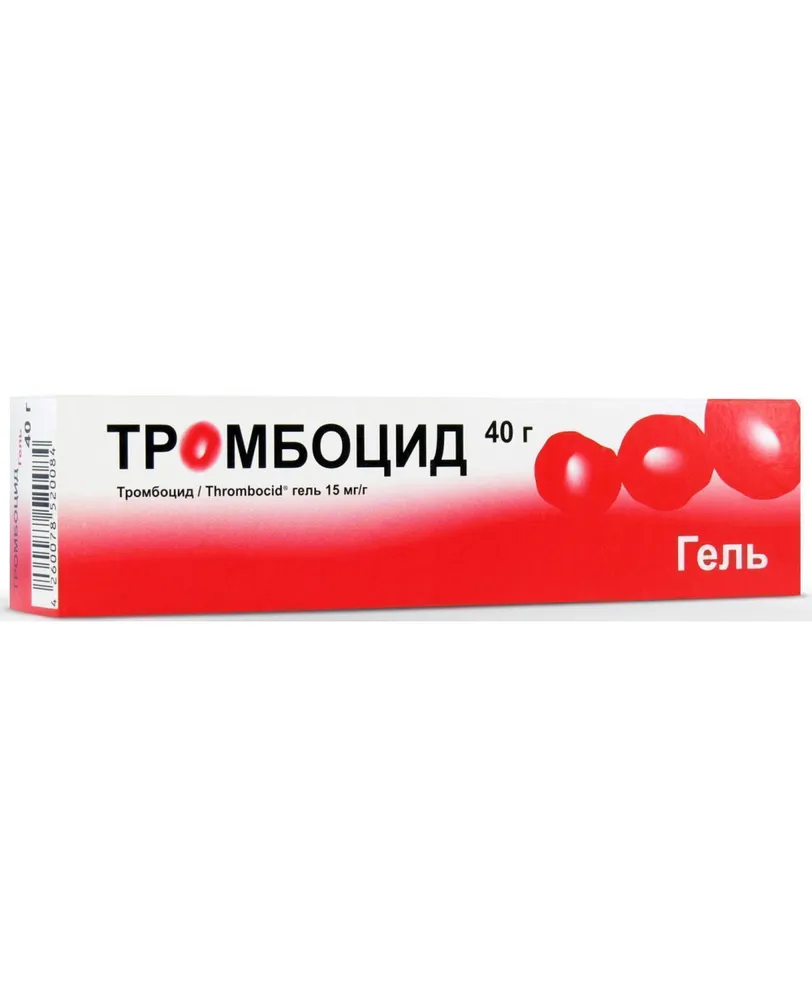
Table of Contents
INSTRUCTIONS FOR MEDICAL USE OF THE MEDICINAL PRODUCT TROMBOCID (THROMBOCIDÂ)
Composition:
Active ingredient: pentosan polysulfate sodium;
1 g of gel contains 15 mg of pentosan polysulfate sodium;
Excipients: purified water, isopropyl alcohol, triethanolamine, carbomer, rosemary oil, pine oil (from mountain pine), lemon balm oil.
Pharmaceutical form. Gel.
Main physico-chemical characteristics: transparent gel, colorless to light yellow, with an aromatic odor.
Pharmacotherapeutic group.
Angioprotectors. Agents used in varicose vein treatment. Heparin or heparinoids for topical use. Pentosan polysulfate sodium.
ATC code C05B A04.
Pharmacological properties.
Pharmacodynamics.
The systemic effect of pentosan polysulfate sodium on hemostasis occurs in three stages.
First, the drug inhibits platelet aggregation induced by collagen or adenosine diphosphate.
Second, pentosan polysulfate sodium affects blood coagulation primarily through an antithrombin III-independent inhibition of coagulation factor Xa, interacts with factor VIIIa, and inhibits activation of factor V. Unlike heparin, the drug exerts minimal effect on thrombin activity.
Third, pentosan polysulfate sodium influences fibrinolysis: it releases tissue plasminogen activator (t-PA) from the endothelium, activates factor XII, and modifies fibrin production. These effects stimulate thrombin release.
Additionally, pentosan polysulfate sodium exerts a systemic effect on lipid metabolism by releasing lipoprotein lipase from endothelial and liver cells, thereby reducing blood levels of total cholesterol, total lipids, and triglycerides.
The mechanism of action of pentosan polysulfate sodium, a heparinoid, is comparable to that of heparin and other heparin-like substances.
Due to its local action, pentosan polysulfate sodium enhances capillary blood flow in affected tissues through its fibrinolytic and anticoagulant activity. Pentosan polysulfate sodium exerts anti-inflammatory effects, inhibits hyaluronidase, reduces increased vascular permeability in affected tissues, and decreases edema. Essential oils provide an additional spasmolytic effect and alleviate pain in the affected area.
Pharmacokinetics.
Absorption
After subcutaneous administration, pentosan polysulfate sodium is rapidly and almost completely absorbed. However, at a dose of 75 mg, the drug undergoes a relatively intense first-pass effect.
Following oral administration, pentosan polysulfate sodium is rapidly absorbed but only to a limited extent and undergoes intensive first-pass metabolism. The absorption rate is 3.3–3.5% of the administered dose, increasing to approximately 11% after one week of repeated dosing. This was observed at doses of 2–10 mg/kg of 3H-pentosan polysulfate sodium.
Distribution
Animal studies involving intravenous administration of 3H-pentosan polysulfate sodium showed that the drug interacts with epithelial cells of the urogenital tract and accumulates in vascular endothelium. The highest concentrations of radioactivity were found in the liver and spleen, while levels in the kidneys, lungs, skin, and bone marrow were much lower. Histological studies confirmed that, similar to heparin, pentosan polysulfate sodium is primarily taken up by cells of the reticuloendothelial system. Gamma scintigraphy performed in volunteers after administration of 125I-labeled pentosan polysulfate sodium confirmed drug accumulation in the liver and spleen. The drug has low affinity for erythrocytes and cannot cross the placental barrier.
Metabolism
Pentosan polysulfate sodium is metabolized primarily in the liver and spleen, and partially in the kidneys. The drug is initially desulfated to pentosan and simultaneously depolymerized (in the kidneys), forming low-molecular-weight fractions of pentosan polysulfate sodium, which are also subject to desulfation. Both desulfation and depolymerization are saturable processes that can be influenced by increasing the dose.
Elimination
Due to its high tissue affinity and accumulation, pentosan polysulfate sodium is rapidly cleared from plasma. After intravenous administration at doses of 1–100 mg, the elimination half-life increases from 7 to 55 minutes as the binding sites become saturated. The terminal elimination half-life of pentosan polysulfate sodium is 24 hours and is independent of dose within the clinically relevant dose range.
Excretion
Pentosan polysulfate sodium and its metabolites are excreted primarily via the kidneys. Biliary excretion is of minor importance: after a 30-minute intravenous infusion of 75 mg of 3H-pentosan polysulfate sodium, cumulative renal excretion accounted for 27±3% of the administered dose, while cumulative fecal excretion was only 4±5%.
Characteristics typical for this class of substances
The pharmacokinetics of pentosan polysulfate sodium are equivalent to those of heparin and other medicinal products with similar chemical structure, both qualitatively and quantitatively. Thus, the accumulation of pentosan polysulfate sodium in vascular endothelial cells and the reticuloendothelial system is a characteristic feature of this class of substances, not unique to pentosan polysulfate sodium alone. This characteristic plays the same key role in the application of heparin and low-molecular-weight heparins.
Bioavailability
Due to extensive first-pass metabolism, the bioavailability of pentosan polysulfate sodium is considerably lower than its absorption rate and is approximately 35% after subcutaneous administration of 75 mg pentosan polysulfate sodium. After repeated oral administration of 700 mg pentosan polysulfate sodium tablets per day, bioavailability, due to low absorption and extensive first-pass metabolism, is initially only about 0.4% and increases to approximately 3% over two weeks. After topical application, the bioavailability of pentosan polysulfate sodium is similar to that observed with oral administration.
Clinical characteristics.
Indications.
Local symptomatic treatment of superficial thrombophlebitis.
Contraindications.
Hypersensitivity to pentosan polysulfate sodium salt or to any other component of the medicinal product.
Interaction with other medicinal products and other forms of interaction.
Concomitant use of this medicinal product with heparin or other anticoagulants may enhance their anticoagulant effect.
Special precautions for use.
The medicinal product should not be applied to open wounds.
Use with caution in elderly individuals, especially when used concomitantly with other medicinal products, particularly those affecting blood coagulation processes.
Use during pregnancy or breastfeeding.
Currently, there is no information or experience regarding the use of the medicinal product during pregnancy or breastfeeding.
Sodium pentosan polysulfate does not penetrate through the placental barrier.
Animal studies have not provided evidence of embryotoxic or fetotoxic effects. However, the medicinal product should not be used during pregnancy.
It is unknown whether sodium pentosan polysulfate is excreted in breast milk; therefore, the medicinal product should not be used during breastfeeding.
Ability to influence reaction rate when driving or operating machinery.
The medicinal product does not affect the reaction speed when driving or operating machinery.
Dosage and Administration.
Apply the gel as a thin layer to affected areas and surrounding skin, gently rubbing in, 3 times daily.
The duration of treatment is determined individually, depending on the patient's condition, course of the disease, and therapeutic response achieved.
Children.
The medicinal product is not recommended for use in children under 16 years of age.
Overdose.
Symptoms of intoxication due to overdose:
To date, no cases of overdose have been reported.
Therapeutic measures in case of overdose:
The antidote for sodium pentosan polysulfate is protamine sulfate.
Side effects
The frequency of adverse reactions is defined using the following categories:
Very common (≥ 1/10);
Common (≥ 1/100 to < 1/10);
Uncommon (≥ 1/1,000 to < 1/100);
Rare (≥ 1/10,000 to < 1/1,000);
Very rare (< 1/10,000);
Not known (cannot be estimated from the available data).
Skin and subcutaneous tissue disorders
Very rare: blisters at application sites, skin reactions such as sensation of warmth, itching, redness, swelling at application sites.
Other possible side effects
Hypersensitivity reactions and dryness of the skin at the site of application may occasionally occur.
Similar to high- and low-molecular-weight heparins, sodium pentosan polysulfate administered intravenously, subcutaneously or intramuscularly may lead to heparin-induced thrombocytopenia, independent of the administered dose. Although this adverse reaction is not associated with topical application of the medicinal product, medical advice should be sought if it occurs.
Shelf life
5 years.
Shelf life after first opening of the tube: 6 months.
Do not use after the expiry date stated on the packaging.
Storage conditions
Store at temperatures not exceeding 25 °C in a place inaccessible to children.
Packaging
40 g or 100 g of gel in a tube; 1 tube in a cardboard box.
Pharmaceutical classification
Over-the-counter (available without prescription).
Manufacturer
bene-Arzneimittel GmbH.
Manufacturer's address
Herterichstrasse 1-3, 81479 Munich, Germany.