Tranexam
Ukraine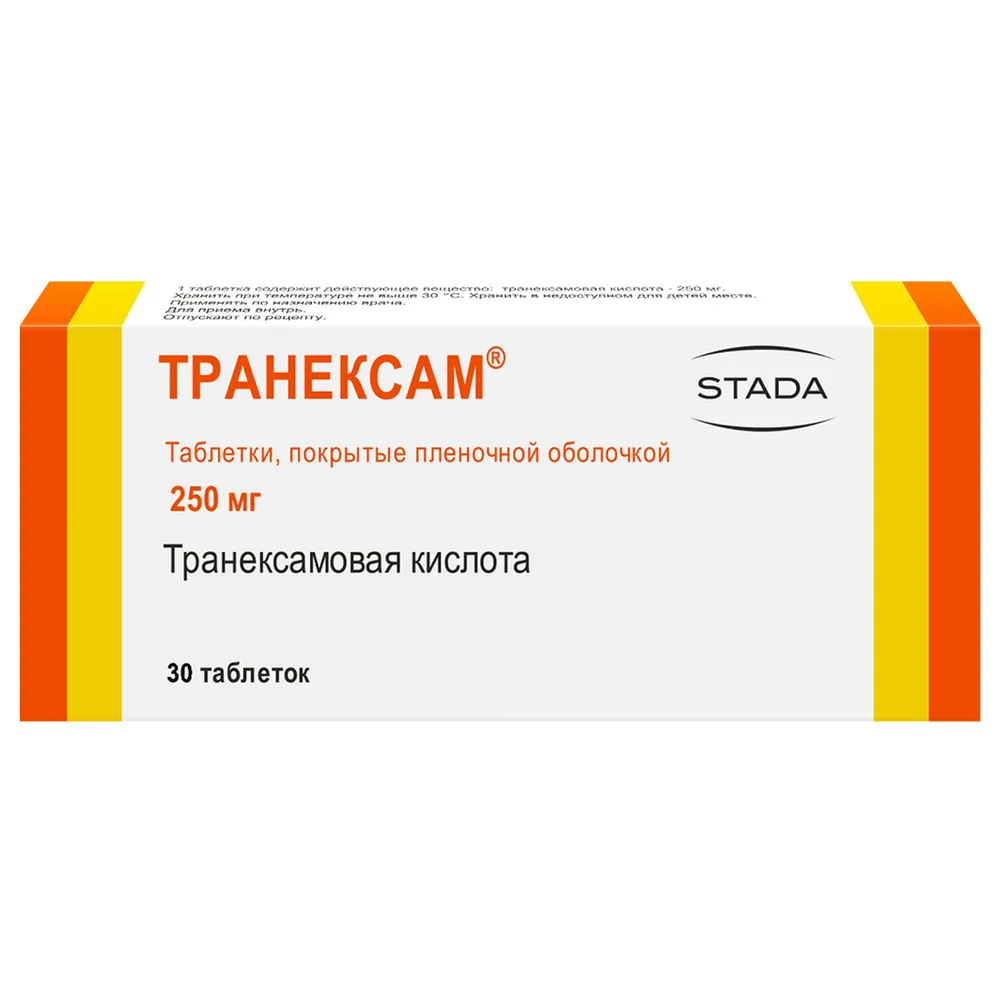
Table of Contents
INSTRUCTIONS FOR MEDICAL USE OF THE MEDICINAL PRODUCT TRANEXAM
Composition:
Active ingredient: tranexamic acid;
1 tablet contains 500 mg of tranexamic acid;
Excipients: microcrystalline cellulose, hydroxypropylcellulose, povidone, talc, colloidal anhydrous silicon dioxide, magnesium stearate, Opadry White 03F180011 (hypromellose, polyethylene glycol 8000, titanium dioxide (E 171)), vanillin.
Pharmaceutical form. Film-coated tablets.
Main physico-chemical characteristics: film-coated, elongated tablets of white or almost white color, with convex edge surfaces.
Pharmacotherapeutic group.
Antihemorrhagic agents. Fibrinolysis inhibitors. Amino acids. Tranexamic acid.
ATC code B02A A02.
Pharmacological properties.
Pharmacodynamics.
Tranexamic acid is an antifibrinolytic agent that acts as a potent competitive inhibitor of plasminogen activation to plasmin. At much higher concentrations, it acts as a non-competitive inhibitor of plasmin. The inhibitory effect of tranexamic acid on plasminogen activation by urokinase is 6–100 times greater, and by streptokinase is 6–40 times greater, than the inhibitory effect of aminocaproic acid. The antifibrinolytic activity of tranexamic acid is approximately 10 times higher than that of aminocaproic acid.
Pharmacokinetics.
Absorption
After intravenous administration of 500 mg tranexamic acid, maximum plasma concentration (Cmax) is achieved immediately, followed by a decline in concentration over 6 hours. The elimination half-life is approximately 3 hours.
Distribution
Parenterally administered tranexamic acid distributes in two directions: slowly into cerebrospinal fluid and into cells. The volume of distribution is approximately 33% of body weight.
Tranexamic acid can cross the placental barrier; in breast milk of lactating women, its concentration may reach approximately 1/100 of Cmax.
Elimination
Tranexamic acid is excreted unchanged in urine. About 90% of the administered dose is eliminated by the kidneys within the first 12 hours after administration (glomerular excretion without tubular reabsorption).
After oral administration, 1.13% and 39% of the administered dose were recovered after 3 and 24 hours, respectively.
In patients with renal impairment, plasma concentration of tranexamic acid is increased.
Clinical characteristics.
Indications.
For short-term treatment of hyperfibrinolysis or fibrinogenolysis with bleeding or risk of bleeding.
Local fibrinolysis observed in the following conditions:
- prostatectomy and interventions on the urinary bladder;
- menorrhagia;
- nosebleed (epistaxis);
- cervical conization;
- traumatic hyphema.
Hereditary angioedema.
Tooth extraction in patients with hemophilia.
Contraindications.
- Hypersensitivity to the active substance or to any of the excipients of the medicinal product;
- severe renal insufficiency — due to the risk of accumulation of the medicinal product;
- active thromboembolic disorders;
- history of venous or arterial thrombosis;
- fibrinolytic state following consumption coagulopathy;
- history of seizures.
Interaction with other medicinal products and other types of interactions.
Tranexamic acid reduces the thrombolytic effect of fibrinolytic agents.
Tranexamic acid should be used with caution in patients taking oral contraceptives, as the risk of thrombosis may increase.
Special precautions for use
In cases of renal origin haematuria (especially in haemophilia), the risk of mechanical anuria increases due to blood clot formation in the urinary tract.
For patients with hereditary angioedema receiving long-term treatment, periodic ophthalmological examinations are recommended, including assessment of visual acuity, color vision, intraocular pressure, visual fields, as well as liver function evaluation.
Tranexamic acid tablets should not be administered to patients with menstrual cycle disorders until the cause of irregular bleeding has been established. If menstrual bleeding cannot be reduced with Tranexamic acid, alternative treatment options should be considered.
Tranexamic acid should be used with caution in patients taking oral contraceptives due to an increased risk of thrombosis.
Patients with a history of thromboembolic complications or a family history of thromboembolic disorders (patients with thrombophilia) should use tranexamic acid only when clearly indicated and under strict medical supervision.
In patients with renal insufficiency, a reduced dose of the drug is recommended.
The use of tranexamic acid is not recommended in cases of increased fibrinolysis due to disseminated intravascular coagulation.
Patients experiencing visual disturbances must discontinue the use of this medicinal product.
There is no clinical experience with the use of tranexamic acid in children under 15 years of age with menorrhagia; therefore, the use of Tranexamic acid is not recommended in this patient group.
Seizures have been reported during the use of tranexamic acid. Most of these cases occurred after intravenous administration of high doses of tranexamic acid during cardiac surgery.
Use during pregnancy or breastfeeding
Although animal studies do not indicate teratogenic effects, standard precautions for drug use during pregnancy should be observed. Tranexamic acid crosses the placenta.
Tranexamic acid passes into breast milk at concentrations approximately 1% of maternal plasma levels. An antifibrinolytic effect in infants is unlikely.
Ability to affect reaction speed when driving or operating machinery
The drug does not affect the ability to drive vehicles or operate machinery.
Method of administration and dosage
The medicinal product Tranexam is intended for oral use. Tablets should be taken with sufficient fluid (e.g., one glass of water).
Local fibrinolysis
Recommended dose is 15–25 mg/kg body weight, i.e., 2–3 tablets of 500 mg 2–3 times daily.
The following dosing regimens may be used for the indications listed below:
- Prostatectomy
For prevention and treatment of hemorrhages in patients with increased risk before or after surgery, tranexamic acid is initially administered by injection, followed by tablets 1 g (2 tablets of 500 mg) 3–4 times daily until macroscopic hematuria disappears.
- Menorrhagia
Recommended dose is 2 tablets of 500 mg three times daily for no more than 4 days. In case of prolonged menstrual bleeding, the dose may be increased, but not exceeding the maximum daily dose (8 tablets of 500 mg per day). Treatment should not be initiated before the onset of menstrual bleeding.
- Epistaxis (nosebleeds)
For recurrent bleeding, administer 2 tablets of 500 mg three times daily for 7 days.
- Cervical conization
Administer 3 tablets of 500 mg three times daily.
- Post-traumatic hyphema
Administer 2–3 tablets of 500 mg three times daily. The dose is 25 mg/kg three times daily.
Hereditary angioedema
Some patients familiar with the course of disease exacerbations usually require 2–3 tablets of 500 mg 2–3 times daily for several days. Other patients should take the drug at the same dose for a prolonged period depending on the disease course.
Tooth extraction in patients with hemophilia
Recommended dose is 2–3 tablets (25 mg/kg) orally every 8 hours.
Renal impairment
In renal impairment, the dose should be adjusted according to serum creatinine levels as per the table:
| Serum creatinine |
Oral dose |
| 120–249 µmol/l |
15 mg/kg twice daily |
| 250–500 µmol/l |
15 mg/kg every 24 hours |
Elderly patients
In the absence of renal impairment, there is no need to reduce the dose.
Children
There is no clinical experience with the use of tranexamic acid in children under 15 years of age with menorrhagia; therefore, the drug should not be used in this patient population.
The recommended dose for children is 25 mg/kg. Data on efficacy, dosing, and safety of tranexamic acid in pediatric patients are limited.
Overdose
Symptoms: dizziness, headache, nausea, vomiting, abdominal pain, diarrhea. Orthostatic symptoms, arterial hypotension, and seizures may occur. Seizures are more common with higher doses.
There is a risk of thrombosis in predisposed individuals.
Treatment: induce vomiting, gastric lavage, administration of activated charcoal. Adequate fluid intake is necessary to promote renal excretion. Symptomatic treatment should be applied; if necessary, anticoagulant therapy may be administered.
Adverse Reactions
The frequency of adverse reactions is defined as follows: very common (≥ 1/10); common (≥ 1/100 to <1/10); uncommon (≥ 1/1000 to <1/100); rare (≥ 1/10000 to <1/1000); very rare (<1/10000); frequency not known (cannot be estimated due to insufficient data).
Immune system disorders: rare – hypersensitivity reactions, including anaphylaxis.
Eye disorders: rare – color vision disturbances, retinal/arterial occlusion.
Blood and lymphatic system disorders: rare – thromboembolism; very rare – arterial or venous thrombosis at any site.
Gastrointestinal disorders: very rare – dyspeptic symptoms (nausea, vomiting, and diarrhea), which resolve after dose reduction.
Skin and subcutaneous tissue disorders: rare – skin allergic reactions.
Nervous system disorders: frequency not known – seizures, especially in case of improper use.
Reporting of suspected adverse reactions
Reporting suspected adverse reactions after authorization of the medicinal product is important. It allows continued monitoring of the benefit-risk balance of the medicinal product. Healthcare professionals, as well as patients or their legal representatives, are encouraged to report any suspected adverse reactions and lack of efficacy of the medicinal product to the State Expert Centre of the Ministry of Health of Ukraine via the following link: https://aisf.dec.gov.ua.
Shelf life
2 years.
Storage conditions
Store at a temperature not exceeding 25 °C in the original packaging.
Keep out of reach and sight of children.
Packaging
10 tablets in a blister, 3 blisters in a cardboard box.
Prescription status
Prescription only.
Manufacturer
JSC "Technolog".
Manufacturer's address and place of business
8 Stara Prorina Street, Uman, Cherkasy region, 20300, Ukraine.