Tivomax-darnitsa
Ukraine
Table of Contents
INSTRUCTIONS for medical use of the medicinal product TIVOMAX-DARNITSA (TIVOMAX-DARNITSA)
Composition:
active substance: arginine hydrochloride;
1 ml of solution contains arginine hydrochloride 42 mg;
excipient: water for injections.
Pharmaceutical form. Infusion solution.
Main physicochemical properties: transparent, colorless or slightly yellowish-brown liquid.
Pharmacotherapeutic group. Plasma substitutes and perfusion solutions. Additional solutions for intravenous administration. Amino acids. Arginine hydrochloride.
ATC code B05XB01.
Pharmacological Properties
Pharmacodynamics
Arginine is an amino acid belonging to the class of conditionally essential amino acids. It acts as an active and versatile cellular regulator of numerous vital functions in the body and exerts significant protective effects under critical conditions.
The medicinal product exhibits anti-hypoxic, membrane-stabilizing, cytoprotective, antioxidant, free radical-scavenging, and detoxifying activities. It acts as an active regulator of intermediate metabolism and energy supply processes and plays a role in maintaining hormonal balance in the body. It is known that arginine increases blood levels of insulin, glucagon, growth hormone, and prolactin. It participates in the synthesis of proline, polyamines, and agmatine, is involved in fibrinolysis and spermatogenesis, and exerts membrane-depolarizing effects.
Arginine is one of the substrates in the urea cycle for urea synthesis in the liver. The drug's hypoammonemic effect is achieved by enhancing the conversion of ammonia into urea. It exerts hepatoprotective effects due to its antioxidant, anti-hypoxic, and membrane-stabilizing activities and positively influences energy metabolism in hepatocytes.
The drug is a substrate for nitric oxide synthase (NOS), the enzyme catalyzing nitric oxide (NO) synthesis in endothelial cells. The drug activates guanylate cyclase and increases the level of cyclic guanosine monophosphate (cGMP) in vascular endothelium. It reduces leukocyte and platelet activation and adhesion to the vascular endothelium, inhibits the synthesis of adhesion proteins VCAM-1 and MCP-1, thereby preventing the formation and progression of atherosclerotic plaques. It also inhibits the synthesis of endothelin-1, a potent vasoconstrictor and stimulator of vascular smooth muscle cell proliferation and migration. The drug further suppresses the synthesis of asymmetric dimethylarginine (ADMA), a powerful endogenous inducer of oxidative stress. It stimulates thymus function, which produces T-cells, and regulates blood glucose levels during physical exertion. The drug exerts an acidifying effect and aids in correcting acid-base balance.
Pharmacokinetics
During continuous intravenous infusion, maximum plasma concentration of arginine hydrochloride is reached within 20–30 minutes after the start of administration. The drug crosses the placental barrier, is filtered in the renal glomeruli, but is almost completely reabsorbed in the renal tubules.
Clinical characteristics.
Indications.
Metabolic alkalosis, hyperammonemia, atherosclerosis of the vessels of the heart and brain, peripheral vascular atherosclerosis, including manifestations of intermittent claudication, diabetic angiopathy, arterial hypertension, chronic heart failure, hypercholesterolemia, chronic obstructive pulmonary diseases, pulmonary hypertension, fetal growth retardation, and preeclampsia − as part of complex therapy.
Contraindications.
Hypersensitivity to the drug.
History of allergic reactions.
Severe impairment of kidney function, hypochloremic acidosis.
Use of potassium-sparing diuretics, spironolactone.
Myocardial infarction (including history of).
Interaction with other medicinal products and other types of interactions.
Potassium-sparing diuretics, spironolactone. When using the drug, it should be taken into account that it may cause pronounced and persistent hyperkalemia against the background of renal insufficiency in patients taking or having taken spironolactone. Prior use of potassium-sparing diuretics may also contribute to increased blood potassium concentration.
Aminophylline. Concurrent use with aminophylline may increase insulin levels in the blood.
Arginine is incompatible with thiopental.
Special precautions for use.
In patients with renal insufficiency, urine output and plasma potassium levels should be checked before starting the infusion, as the medicinal product may contribute to the development of hyperkalemia.
The medicinal product should be used with caution in patients with endocrine gland dysfunction. The product may stimulate insulin and growth hormone secretion. Dry mouth requires blood glucose monitoring.
The medicinal product should be used cautiously in patients with electrolyte imbalances and kidney diseases.
If symptoms of asthenia worsen during treatment with the medicinal product, therapy should be discontinued.
The medicinal product should be used with caution in patients with angina pectoris.
Use during pregnancy or breastfeeding.
The medicinal product crosses the placenta and therefore may be used during pregnancy only when the expected benefit to the mother outweighs the potential risk to the fetus.
Data regarding the use of the medicinal product during breastfeeding are lacking.
Breastfeeding should be discontinued for the duration of treatment.
Ability to influence reaction rate while driving or operating machinery.
The medicinal product may cause dizziness; therefore, caution should be exercised when driving or operating machinery.
Method of Administration and Dosage
The medicinal product should be administered intravenously by drip infusion at a rate of 10 drops per minute for the first 10–15 minutes; thereafter, the infusion rate may be increased to 30 drops per minute.
The daily dose of the medicinal product is 100 mL of solution.
In severe circulatory disturbances in central and peripheral vessels, pronounced symptoms of intoxication, hypoxia, and asthenic conditions, the dose may be increased up to 200 mL per day.
The maximum infusion rate must not exceed 20 mmol/hour.
For children under 12 years of age, the dose of the medicinal product is 5–10 mL per kg of body weight per day.
For the treatment of metabolic alkalosis, the dose can be calculated as follows:
arginine hydrochloride (mmol)
______________________________________ × 0.3 × body weight (kg)
excess base (Be) (mmol/L)
Infusion should be initiated with half of the calculated dose. Any additional correction should be performed after obtaining updated acid-base balance results.
Method of Administration
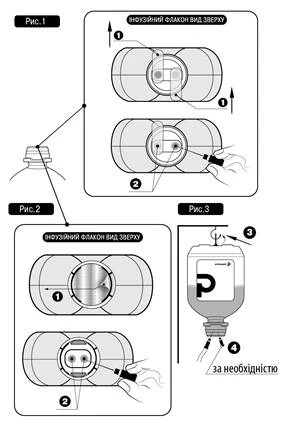
Do not insert needle(s) into areas of the polymer bottle not designated for this purpose, but only into sterile ports!
To perform infusion therapy, follow this procedure:
- Remove the protective plastic cap with tamper-evident seal (if present).
- Tear off protective valve(s) No. 1 as shown in Figures 1 and 2 (the manufacturer may use different types and materials for protective valves).
- Remove the needle cap and insert the needle into any of the designated ports No. 2 of the infusion medicinal product bottle (see Figures 1 and 2).
- The other sterile port may be used either for adding other medicinal products into the infusion bottle (No. 4, see Figure 3) or, if flow rate is insufficient, for a venting needle (No. 4, see Figure 3).
- Hang the bottle using the special ring No. 3 located at the bottom of the bottle (see Figure 3).
Children
The medicinal product may be administered to children aged 3 years and older.
Overdose.
Symptoms: renal failure, hypoglycemia, metabolic acidosis.
Treatment: In case of overdose, infusion of the medicinal product must be discontinued. Monitor physiological responses and provide supportive care to maintain vital functions. If necessary, administer alkalinizing agents and diuretics to restore diuresis, as well as electrolyte solutions (0.9% sodium chloride solution, 5% glucose solution).
Adverse reactions.
Respiratory, thoracic and mediastinal disorders: dyspnea.
Gastrointestinal disorders: dry mouth, nausea, vomiting.
Nervous system disorders: headache, dizziness, fear sensation, weakness, seizures, tremor – more frequent with excessive infusion rate.
Cardiac and vascular disorders: fluctuations in blood pressure, changes in heart rhythm, chest pain.
Immune system disorders: hypersensitivity reactions, including rash, urticaria, angioedema, anaphylactic shock.
Musculoskeletal and connective tissue disorders: joint pain.
General disorders: hyperthermia, hot flushes, malaise.
Administration site reactions: changes at the injection site, including hyperemia, itching, skin pallor, up to acrocyanosis.
Laboratory test abnormalities: hyperkalemia.
Shelf life. 3 years.
Storage conditions.
Store in the original packaging at a temperature not exceeding 25 °C. Do not freeze.
Keep out of reach of children.
Incompatibility.
The medicinal product is incompatible with thiopental.
Packaging.
100 ml in a vial; 1 vial per carton; 100 ml in vials.
Prescription status. Prescription only.
Manufacturer. JSC "Pharmaceutical company "Darnytsia".
Manufacturer's address and location of business activity.
13, Borispilska Street, Kyiv, 02093, Ukraine.