Thiocetam®
Ukraine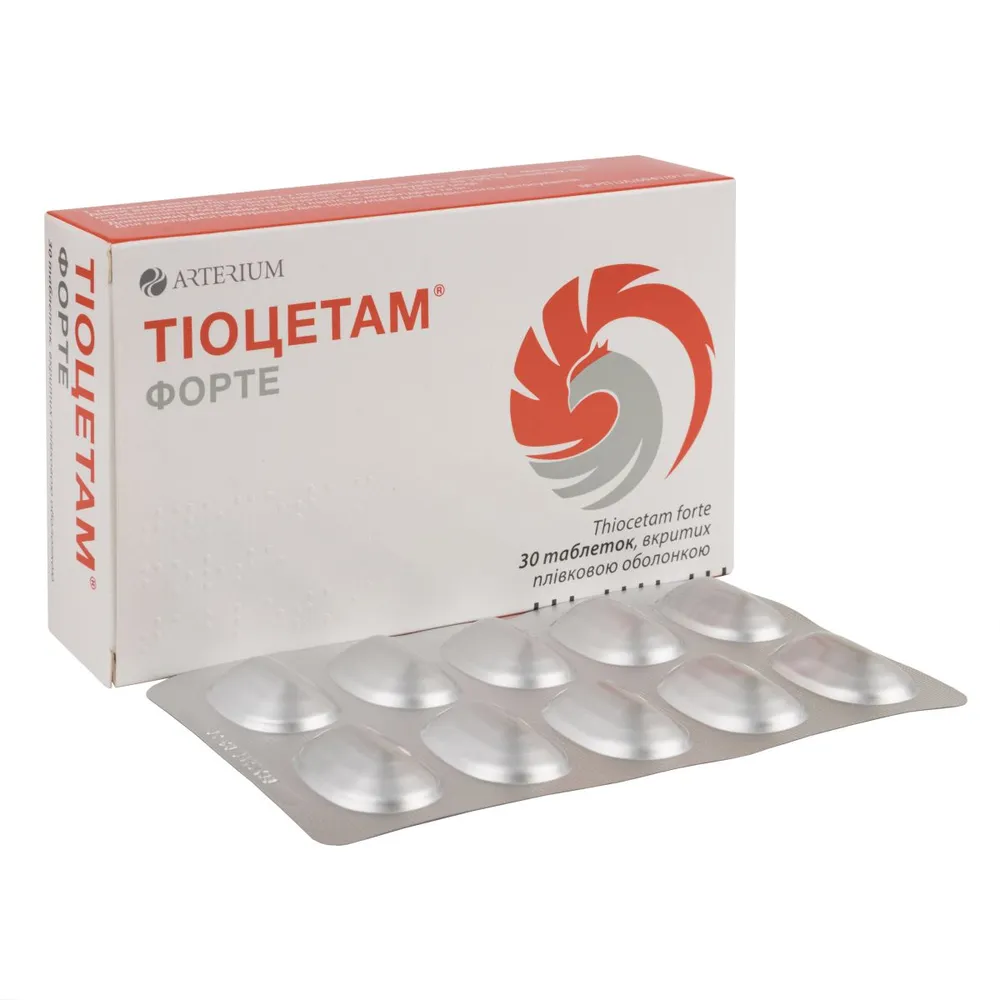
Table of Contents
INSTRUCTIONS FOR MEDICAL USE OF THE MEDICINAL PRODUCT TIOCETAMâ (THIOCETAM)
Composition:
Active substances:
One tablet contains piracetam, calculated as 100% substance, 200 mg; morpholine salt of thiatic acid, calculated as 100% substance, 50 mg, equivalent to 33.3 mg of thiatic acid;
Excipients: potato starch, povidone, powdered sugar, microcrystalline cellulose, calcium stearate, coating mixture "Opadry II Yellow" 33G22623 (containing lactose monohydrate, Yellow West FCF (E 110)).
Pharmaceutical form. Film-coated tablets.
Main physico-chemical characteristics: yellow, round, biconvex film-coated tablets; the white core is visible in cross-section.
Pharmacotherapeutic group. Medicinal products acting on the nervous system. Psychostimulants. Psychostimulants, drugs used in attention deficit hyperactivity disorder (ADHD) and nootropics. Other psychostimulant and nootropic agents.
ATC Code: N06BX.
Pharmacological Properties
Pharmacodynamics
The drug belongs to the group of cerebroactive agents and exhibits anti-ischemic, antioxidant, membrane-stabilizing, and nootropic properties.
The drug improves integrative and cognitive brain functions, enhances learning efficiency, helps eliminate symptoms of amnesia, and improves indices of short-term and long-term memory.
The pharmacological effect of the drug is due to the mutually potentiating action of tiothiazolin and piracetam.
The drug is capable of accelerating glucose oxidation in both aerobic and anaerobic oxidation reactions, normalizing bioenergetic processes, increasing ATP levels, and stabilizing metabolism in brain tissues.
The drug inhibits the formation of reactive oxygen species, reactivates the antioxidant enzyme system—particularly superoxide dismutase—suppresses free-radical processes in brain tissue during ischemia, improves blood rheological properties by activating the fibrinolytic system, and stabilizes as well as reduces areas of necrosis and ischemia.
Pharmacokinetics
The drug is well absorbed after oral administration and penetrates various organs and tissues, including brain tissue. It crosses the placental barrier. Each component of the drug is metabolized separately.
Piracetam is practically not metabolized in the body and is excreted in the urine. Elimination half-life is 4–8 hours.
The morpholine salt of thiazotic acid is rapidly absorbed after oral administration, with an absolute bioavailability of 53%. Maximum plasma concentration is reached approximately 1.6 hours after a single 200 mg dose. The elimination half-life is nearly 8 hours.
Clinical characteristics.
Indications.
Transient and chronic cerebral circulation disorders caused by cerebral atherosclerosis and previous cerebral circulation disturbances. The drug is also indicated in cerebral circulation disorders, cerebral metabolic disturbances caused by traumatic brain injuries, intoxications, diabetic encephalopathy, as well as in the rehabilitation period after ischemic stroke.
Contraindications.
Hypersensitivity to piracetam, pyrrolidone derivatives, thiatic acid, or to any other component of the drug.
Acute cerebral circulation disorder of hemorrhagic type.
Acute renal failure. Terminal stage of renal failure.
Huntington's chorea.
Interaction with other medicinal products and other forms of interaction.
Thiocetam® must not be administered with drugs having an acidic pH.
Due to the presence of piracetam in the drug formulation, interaction with the following medicinal products is possible:
Thyroid hormones.
When used concomitantly with thyroid hormones (T3+T4), increased irritability, disorientation, and sleep disturbances may occur.
Acenocoumarol.
In patients with severe recurrent thrombosis, administration of high-dose piracetam (9.6 g/day) did not require dose adjustment of acenocoumarol to achieve a prothrombin time (INR) of 2.5–3.5. However, when used concomitantly, a significant reduction in platelet aggregation, fibrinogen levels, von Willebrand factors (VIII:C; VIII:vW:Ag; VIII:vW:Rco), and blood and plasma viscosity was observed.
Pharmacokinetic interactions.
The likelihood of changes in piracetam's pharmacodynamics due to other medicinal products is low, as 90% of the drug is excreted unchanged in urine.
In vitro, piracetam does not inhibit cytochrome P450 isoforms CYP1A2, 2B6, 2C8, 2C9, 2C19, 2D6, 2E1, and 4A9/11 at concentrations of 142, 426, and 1422 μg/mL.
At a concentration of 1422 μg/mL, slight inhibition of CYP2A6 (21%) and 3A4/5 (11%) was observed. However, the Ki values for these two CYP isoenzymes are sufficiently high to exceed 1422 μg/mL. Therefore, metabolic interaction with drugs undergoing biotransformation by these enzymes is unlikely.
Antiepileptic drugs.
Administration of piracetam at a dose of 20 mg daily for 4 weeks or longer did not alter the concentration-time curve or maximum serum concentration (Cmax) of antiepileptic drugs (carbamazepine, phenytoin, phenobarbital, sodium valproate) in patients with epilepsy.
Concomitant use with enalapril or captopril increases the risk of adverse cardiovascular reactions.
Alcohol.
Concomitant use with alcohol did not affect the serum concentration of piracetam, and serum alcohol concentration was not altered when 1.6 g of piracetam was administered.
Special precautions for use.
The drug should be used with caution in elderly patients with cardiovascular diseases, as the above-mentioned adverse reactions occur more frequently in this patient group.
Allergic reactions are more common in individuals with a history of allergies.
Effect on platelet aggregation. Since piracetam reduces platelet aggregation, it should be administered with caution in patients with coagulation disorders, conditions that may be associated with bleeding (e.g., gastrointestinal ulcers), during major surgical procedures (including dental interventions), in patients showing signs of severe hemorrhage, and in patients with a history of hemorrhagic stroke; also in patients receiving anticoagulants, platelet antiaggregants, including low-dose acetylsalicylic acid. The drug is excreted by the kidneys; therefore, special attention should be paid to patients with renal impairment.
Elderly patients. During long-term therapy in elderly patients, regular monitoring of renal function is recommended; the dose should be adjusted as necessary according to creatinine clearance.
The drug contains lactose as an excipient, which should be taken into account when prescribing to patients with galactose intolerance, lactase deficiency, or glucose/galactose malabsorption syndrome.
One tablet of Tiocetamâ contains 3.5 mg of powdered sugar, which should be considered when prescribing to patients with diabetes mellitus.
Use during pregnancy or breastfeeding. Do not use.
Ability to affect reaction speed when driving or operating machinery. The use of the drug is not recommended when driving or operating machinery requiring high concentration, due to the risk of developing adverse reactions affecting the nervous system.
Dosage and Administration.
The dosage and duration of treatment are determined by a physician individually for each case, depending on the course of the disease.
In transient and chronic cerebral circulation disorders, and during the rehabilitation period after ischemic stroke – 2 tablets 3 times daily for 25–30 days.
Thiocetam® tablets should be taken 30 minutes before meals.
The treatment course ranges from 2–3 weeks to 3–4 months.
For treatment of diabetic encephalopathy, 2 tablets 3 times daily are administered for 45 days.
Children. Not recommended.
Overdose.
Symptoms. Overdose is unlikely when therapeutic doses are used.
If the prescribed doses are exceeded, adverse effects of the drug may occur or intensify (excitation, sleep disturbances, dyspeptic symptoms). In case of overdose, increased concentrations of sodium and potassium may occur in urine.
Treatment. The drug should be discontinued and symptomatic treatment initiated (induce vomiting, gastric lavage). There is no specific antidote; hemodialysis may be used (eliminates 50–60% of piracetam).
Adverse reactions.
During clinical use of the drug Thiocetam®, the following adverse reactions may occur:
Central and peripheral nervous system: headache, general weakness, insomnia, drowsiness, anxiety, inner tension;
Gastrointestinal tract: nausea, vomiting, dry mouth, diarrhea;
Immune system, skin and subcutaneous tissue: allergic reactions, including rash, itching, urticaria, sweating;
Vestibular system: dizziness.
Adverse reactions related to individual components of the drug may occur in patients:
- Piracetam:
Blood and lymphatic system: hemorrhagic disorders;
Immune system: hypersensitivity, anaphylactoid reactions;
Psychiatric disorders: irritability, depression, increased excitability, anxiety, confusion, hallucinations;
Nervous system: hyperkinesia, drowsiness, ataxia, loss of balance, increased frequency of epileptic seizures, headache, insomnia, tremor;
Ear and labyrinth disorders: dizziness;
Gastrointestinal system: abdominal pain, upper abdominal pain, diarrhea, nausea, vomiting;
Skin and subcutaneous tissues: angioedema, dermatitis, rash, urticaria, itching;
Reproductive system: increased sexual activity;
General disorders: asthenia, weight gain;
- Thiotropic acid:
Skin and subcutaneous tissue: itching, skin hyperemia, rash, urticaria, angioedema;
Immune system: anaphylactic shock;
Central and peripheral nervous system: dizziness, tinnitus;
Cardiovascular system: tachycardia, increased blood pressure;
Gastrointestinal tract: dyspepsia, including dry mouth, bloating, nausea, vomiting;
Respiratory system: dyspnea, suffocation;
General disorders: fever, general weakness.
The product contains the colorant Yellow FCF (E 110), which may cause allergic reactions.
Shelf life. 2 years.
Storage conditions. Store in the original packaging at a temperature not exceeding 25 °C. Keep out of reach of children.
Packaging. 10 tablets per blister pack, 3 or 6 blisters per carton.
Prescription status. Prescription only.
Manufacturer. JSC "Kievmedpreparat".
Manufacturer's address and place of business.
139 Saksaganskogo St., Kyiv, 01032, Ukraine.