Thiocolchicoside
Ukraine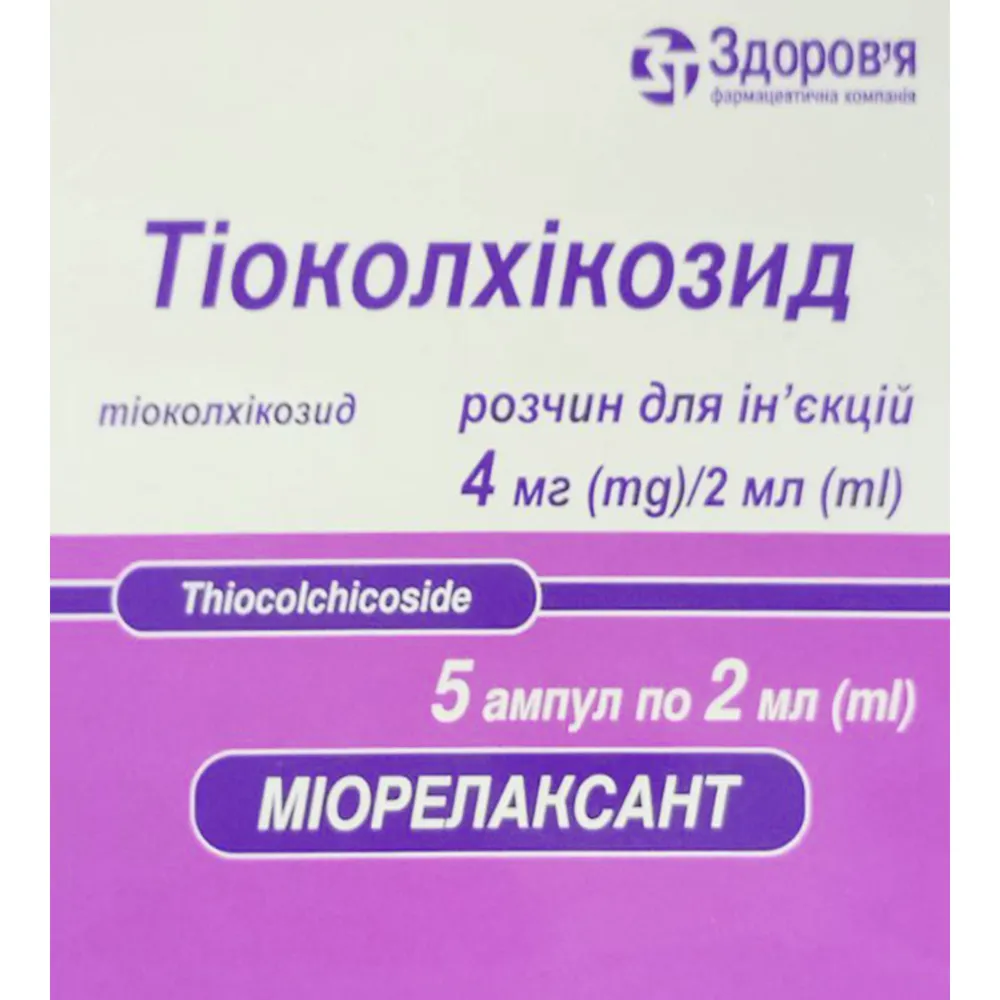
Table of Contents
INSTRUCTIONS FOR MEDICAL USE OF THE MEDICINAL PRODUCT THIOCOLCHICOSIDE
Composition:
Active substance: thiocolchicoside;
1 ampoule (2 ml) of the medicinal product contains 4 mg of thiocolchicoside;
Excipients: sodium chloride; sodium citrate; citric acid monohydrate; water for injections.
Pharmaceutical form. Solution for injection.
Main physicochemical properties: clear solution of light yellow color.
Pharmacotherapeutic group. Muscle relaxants. Muscle relaxants with central mechanism of action. Other centrally-acting agents. Thiocolchicoside. ATC Code M03B X05.
Pharmacological Properties.
Pharmacodynamics.
Thiocolchicoside is a semi-synthetic sulphur derivative of colchicoside with myorelaxant activity.
In vitro, thiocolchicoside binds only to strychnine-sensitive GABAergic and glycinergic receptors. Since thiocolchicoside acts as an antagonist at GABAergic receptors, its myorelaxant effect may be exerted at the supraspinal level through a complex regulatory mechanism, although a glycinergic mechanism of action cannot be ruled out. The characteristics of interaction with GABAergic receptors are qualitatively and quantitatively similar between thiocolchicoside and its main circulating metabolite, the glucuronidated derivative (see section "Pharmacokinetics").
In vivo, the myorelaxant properties of thiocolchicoside and its main metabolite have been demonstrated in various experimental models in rats and rabbits. The absence of a myorelaxant effect of thiocolchicoside in rats with transected spinal cord indicates predominant supraspinal activity. Furthermore, electroencephalographic studies have shown that thiocolchicoside and its main metabolite do not have sedative effects.
Pharmacokinetics.
Absorption
After intramuscular administration, Cmax of thiocolchicoside is reached within 30 minutes and reaches values of 113 ng/mL after a 4 mg dose and 175 ng/mL after an 8 mg dose. Corresponding AUC values are 283 and 417 ng×h/mL, respectively.
The pharmacologically active metabolite SL18.0740 is also detected—though at lower concentrations, with a Cmax of 11.7 ng/mL reached 5 hours after administration and an AUC of 83 ng×h/mL.
No data are available on the inactive metabolite SL59.0955.
Distribution
The apparent volume of distribution of thiocolchicoside is approximately 42.7 L after intramuscular administration of 8 mg. No data are available on metabolites.
Elimination
After intramuscular administration, the apparent half-life (T½) of thiocolchicoside is 1.5 hours, and plasma clearance is 19.2 L/h.
Clinical characteristics.
Indications.
Adjunctive therapy for painful muscular contractures associated with acute spinal disorders in adults and adolescents aged 16 years and older.
Contraindications.
Thiocolchicoside should not be used:
- in patients with hypersensitivity to the active substance or to any of the excipients;
- throughout pregnancy;
- during breastfeeding;
- in women of childbearing potential who are not using contraception;
- in patients with flaccid paralysis or muscle hypotonia.
Interaction with other medicinal products and other forms of interaction.
Interaction studies have not been conducted.
Special precautions for use
Episodes of vasovagal syncope have been observed after intramuscular administration; therefore, patients should be monitored following injection (see section "Adverse reactions").
Cases of liver injury have been reported during post-marketing use of thiocolchicoside. Serious cases (e.g., fulminant hepatitis) have been reported in patients who were concurrently taking non-steroidal anti-inflammatory drugs or paracetamol. Patients should be advised to discontinue treatment and consult a physician if they develop signs or symptoms of liver injury (see section "Adverse reactions").
Thiocolchicoside may provoke seizures, particularly in patients with epilepsy or those at risk of seizures (see section "Adverse reactions").
The maximum recommended daily dose of thiocolchicoside (8 mg) should not be exceeded. This dose should be divided into two administrations with a 12-hour interval. If a dose is missed, treatment should continue with the next scheduled dose; double dosing should be avoided.
In preclinical studies, one of the metabolites of thiocolchicoside (SL59.0955) induced aneuploidy (alteration in chromosome number in dividing cells) at concentrations close to human exposure levels observed with oral doses of 8 mg twice daily. Aneuploidy is considered a risk factor for teratogenicity, embryotoxicity/fetotoxicity, miscarriage, male fertility impairment, and as a potential risk factor for cancer. As a precautionary measure, the use of the medicinal product at doses higher than recommended or for prolonged periods should be avoided (see section "Dosage and administration").
Patients should be thoroughly informed about the potential risk in case of possible pregnancy and the necessity of effective contraceptive measures.
Important information on excipients
The medicinal product contains less than 1 mmol (23 mg)/dose of sodium, i.e., essentially "sodium-free".
Use during pregnancy or breastfeeding
Pregnancy
Data on the use of thiocolchicoside in pregnant women are limited. Therefore, potential risks to the embryo and fetus are unknown.
Animal studies have shown teratogenic effects.
The medicinal product is contraindicated in pregnant women and women of childbearing potential who are not using contraception (see section "Contraindications").
Breastfeeding
Thiocolchicoside is contraindicated during breastfeeding because it is excreted in breast milk (see section "Contraindications").
Fertility
In a rat fertility study, no impairment of fertility was observed at doses up to 12 mg/kg, i.e., at dose levels not causing clinical effects. Thiocolchicoside and its metabolites exhibit aneugenic effects at various concentration levels, which represents a potential risk factor for human fertility impairment.
Ability to influence the speed of reactions while driving or operating machinery
Studies on the ability to drive or operate machinery have not been conducted.
Since somnolence is a common occurrence, this should be taken into account when driving or operating machinery.
Dosage and Administration.
The medicinal product is intended for intramuscular administration. The recommended and maximum dose is 4 mg intramuscularly every 12 hours (8 mg per day). The treatment duration is limited to 5 consecutive days.
Doses higher than recommended or prolonged use should be avoided (see section "Special Warnings and Precautions for Use").
Children.
The medicinal product is contraindicated in children under 16 years of age.
Overdose.
Cases of overdose are unknown.
In the event of overdose, careful medical monitoring of the patient and symptomatic therapy are recommended.
Adverse Reactions
The adverse reactions listed below are classified according to MedDRA (Medical Dictionary for Regulatory Activities) system organ classes and frequency: very common (≥ 1/10), common (≥ 1/100 to < 1/10), uncommon (≥ 1/1000 to < 1/100), rare (≥ 1/10,000 to < 1/1000), very rare (< 1/10,000), frequency not known (cannot be estimated from available data).
Immune system disorders
Uncommon: pruritus.
Rare: urticaria.
Very rare: arterial hypotension.
Frequency not known: angioedema and anaphylactic reactions, including anaphylactic shock.
Nervous system disorders
Common: somnolence.
Rare: excitement or brief confusion.
Frequency not known: malaise, with or without vasovagal syncope occurring several minutes after intramuscular injection, seizures (see section "Special warnings and precautions for use").
Gastrointestinal disorders
Common: diarrhea, gastralgia.
Uncommon: nausea, vomiting.
Rare: heartburn.
Hepatobiliary disorders
Frequency not known: drug-induced liver injury (see section "Special warnings and precautions for use").
Skin and subcutaneous tissue disorders
Uncommon: allergic skin reactions.
Reporting suspected adverse reactions
Reporting suspected adverse reactions after medicine registration is important. It allows continuous monitoring of the benefit-risk balance of the medicine. Healthcare and pharmaceutical professionals, as well as patients or their legal representatives, should report all cases of suspected adverse reactions and lack of effectiveness via the Automated Information System for Pharmacovigilance at the following link: https://aisf.dec.gov.ua.
Shelf life. 2 years.
Storage conditions. Store in the original packaging at a temperature not exceeding 25 °C.
Keep out of reach and sight of children.
Incompatibility. Extemporaneous mixing in a syringe with parenteral preparations containing tenoxicam, piroxicam, ketoprofen, ketorolac tromethamine, sodium diclofenac, lysine acetylsalicylate, betamethasone disodium phosphate, cyanocobalamin (vitamin B12), and vitamin complex B1, B6, and B12 is possible.
Packaging. 2 ml in a vial, pack of 5 (5x1), pack of 10 (10x1) in a blister pack in a carton.
Prescription status. Prescription only.
Manufacturer. Limited liability company "Pharmaceutical Company "Zdorovya".
Manufacturer's address and place of business. 22 Shevchenko Street, Kharkiv, Kharkiv region, 61013, Ukraine.