Thiamine chloride-zdorovya
Ukraine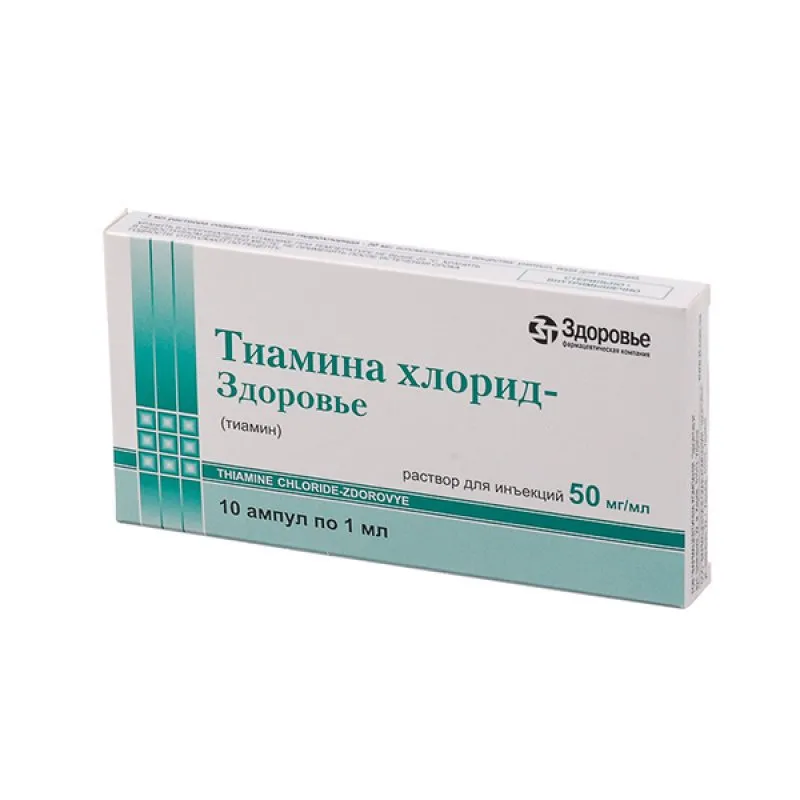
Table of Contents
INSTRUCTIONS FOR MEDICAL USE OF THE MEDICINAL PRODUCT THIAMINE CHLORIDE-ZDOROV'YA (THIAMINE CHLORIDE-ZDOROV'YA)
Composition:
Active substance: thiamine;
1 ml of solution contains thiamine hydrochloride 50 mg;
Excipients: unithiol, water for injections.
Pharmaceutical form. Injection solution.
Main physicochemical properties: clear solution ranging in color from yellowish to greenish-yellow with a faint characteristic odor.
Pharmacotherapeutic group. Vitamins. Simple vitamin B1 preparations. Thiamine (vitamin B1).
ATC code A11D A01.
Pharmacological properties.
Pharmacodynamics. Thiamine hydrochloride-Zdorovia is a synthetic water-soluble vitamin B1 preparation. In the human body, as a result of phosphorylation processes, it is converted into cocarboxylase, which is a coenzyme for many enzymatic reactions.
The drug restores vitamin B1 deficiency, which plays an important role in metabolism and neuro-reflex regulation, influences the conduction of nerve excitation in synapses, and exhibits ganglion-blocking and curare-like effects.
Pharmacokinetics. After intramuscular administration, the drug is rapidly absorbed. Phosphorylation occurs in the liver. It accumulates in the liver, heart, brain, kidneys, spleen. It is eliminated by the kidneys and intestine, with approximately 8–10% excreted unchanged.
Clinical characteristics.
Indications. Hypo- and avitaminosis of vitamin B1 (including in patients on tube feeding, hemodialysis, or suffering from malabsorption syndrome). As part of complex therapy: neuritis, polyneuritis, radiculitis, neuralgia, peripheral paresis and paralysis, neuropathies (diabetic, alcoholic), encephalopathies (including Wernicke-Korsakoff encephalopathy), neurasthenia, chronic liver diseases, myocardiodystrophy, peptic ulcer of the stomach and duodenum, intestinal atony, endarteritis, dermatoses (eczema, atopic dermatitis, pyoderma, psoriasis, discoid lupus erythematosus) with neurotrophic changes and metabolic disorders.
Contraindications. Increased sensitivity to the components of the drug, allergic diseases, idiosyncrasy, premenopausal and menopausal periods in women.
Interaction with other medicinal products and other forms of interaction. Concurrent use of the drug with other medicinal products may result in:
with depolarizing muscle relaxants (succinylcholine chloride), choline derivatives – weakening of their therapeutic effect;
with thiosemicarbazone, 5-fluorouracil – inhibition of thiamine activity;
with caffeine, drugs containing sulfur and estrogens – increased body demand for thiamine;
with anticonvulsants (phenobarbital, phenytoin, carbamazepine), digoxin, indomethacin, antacid drugs – development of thiamine deficiency;
with cyanocobalamin, pyridoxine – impaired conversion of thiamine into its phosphorylated biologically active form and enhanced allergizing effect of thiamine. Simultaneous parenteral administration of thiamine with pyridoxine (vitamin B6) or cyanocobalamin (vitamin B12) is not recommended;
with ethanol – slowing of thiamine absorption rate;
with adrenomimetics, sympathomimetics – weakening of their therapeutic effect.
Thiamine is unstable in alkaline and neutral solutions — co-administration with carbonates, citrates, barbiturates, Cu2+, iodide, iron-ammonium citrate, tannic acid is not recommended.
Special precautions for use. After injection, monitoring for 30 minutes is required due to the possibility of severe allergic reactions.
Thiamine injections should preferably be administered no sooner than 12 hours after pyridoxine injection.
When administered intramuscularly, the drug should be injected deeply into the muscle.
Intramuscular injections are painful due to the low pH of the solution.
Daily requirement for vitamin B1: in adult males – 1.2–2.1 mg, in elderly individuals – 1.2–1.4 mg, in females – 1.1–1.5 mg, with an additional 0.4 mg for pregnant women and 0.6 mg for women during lactation; in children, depending on age – 0.3–0.5 mg.
The drug must not be used as a substitute for a balanced diet — only in combination with dietary therapy.
The injectable form of the drug should be used in treating patients with impaired intestinal absorption or with gastric resection, when oral administration of thiamine in tablet form is impossible (nausea, vomiting, pre- and postoperative periods), as well as in severe forms of disease or at the beginning of treatment to achieve a faster therapeutic effect.
Parenteral administration should be initiated with small doses (not more than 0.5 ml for adults), and higher doses should be administered only if well tolerated.
Prescribe with caution in patients with increased nervous system excitability and hyperacid forms of duodenal ulcer.
In Wernicke's encephalopathy, thiamine must be administered before glucose infusion.
If allergy to vitamin B1 is detected, the patient should avoid rice, buckwheat, meat, and bread (types baked from coarse flour).
In patients with alcoholism, symptoms of adverse drug reactions may be intensified.
Thiamine may weaken the effect of depolarizing muscle relaxants, adrenolytic, and sympathomimetic agents.
The drug (when high doses are used) may distort test results when determining theophylline in blood serum by spectrophotometric method and urobilinogen using Ehrlich's reagent.
Use during pregnancy or lactation. Use during pregnancy or lactation is possible under medical supervision, when indicated, and at recommended doses.
Ability to affect reaction rate when driving or operating machinery. During treatment, caution should be exercised when driving vehicles or operating complex machinery due to the possibility of adverse reactions affecting the nervous system.
Method of administration and dosage. Administered intramuscularly (deeply into the muscle).
Adults: 25–50 mg (0.5–1 ml of the drug) once daily. Administration begins with small doses [not more than 25 mg (0.5 ml)]; higher doses [50 mg (1 ml)] are administered only if well tolerated. Treatment course: 10–30 injections.
In Wernicke-Korsakoff encephalopathy: 50–100 mg (1–2 ml) twice daily until clinical improvement. The possibility of developing an allergic reaction to vitamin B1 administration should be considered.
Children aged 8 years and older: 12.5 mg (0.25 ml) once daily. Treatment course: 10–30 injections.
Children. Children are usually administered a 2.5% solution of thiamine hydrochloride. Administration of the drug in this dosage form (5% solution) may be used in children aged 8 years and older.
Overdose.
Symptoms: possible intensification of adverse drug reactions. Development of hypercoagulation and purine metabolism disorders cannot be excluded.
Treatment: discontinue the drug, symptomatic therapy.
|doctor|, ,
Adverse reactions.
Cardiovascular system: tachycardia, palpitations, collapse.
Nervous system: headache, dizziness, anxiety, paresthesia.
Eye disorders: optic nerve damage.
Respiratory system: dyspnea, shortness of breath.
Gastrointestinal tract: dysphagia, nausea, intestinal hemorrhage.
Immune system: rash, pruritus (including at injection site), dermatitis, hyperemia, urticaria, angioneurotic edema, bronchospastic syndrome with convulsions, anaphylactic shock.
Hepatobiliary system: disturbances in liver enzyme activity.
General disorders: increased sweating, chills, tremor, general weakness, edema, fever.
Other: synaptoplegia phenomenon – thiamine's ability to form complexes with various mediators may be accompanied by decreased arterial pressure, cardiac arrhythmias, impaired contraction of skeletal muscles (including respiratory muscles), and central nervous system depression; thiamine promotes development of staphylococcal resistance to antibiotics.
Shelf life. 3 years.
Storage conditions. Store in original packaging at a temperature not exceeding 25 °C.
Keep out of reach of children.
Incompatibility. Should not be mixed with solutions containing sulfites, nicotinic acid – thiamine degradation occurs; with benzylpenicillin or streptomycin – degradation of antibiotics occurs; with carbonates, citrates, barbiturates, Cu2+, iodides, tannic acid – thiamine is unstable in alkaline and neutral solutions.
Packaging. 1 ml in ampoules, 10 ampoules per box; 5×2, 10 in blister packs per box.
Prescription status. Prescription only.
Manufacturer. LIMITED LIABILITY COMPANY "CORPORATION "ZDOROV'YA".
Manufacturer's address. 22, Shevchenka Street, Kharkiv, Kharkiv region, 61013, Ukraine.