Theraflex
Ukraine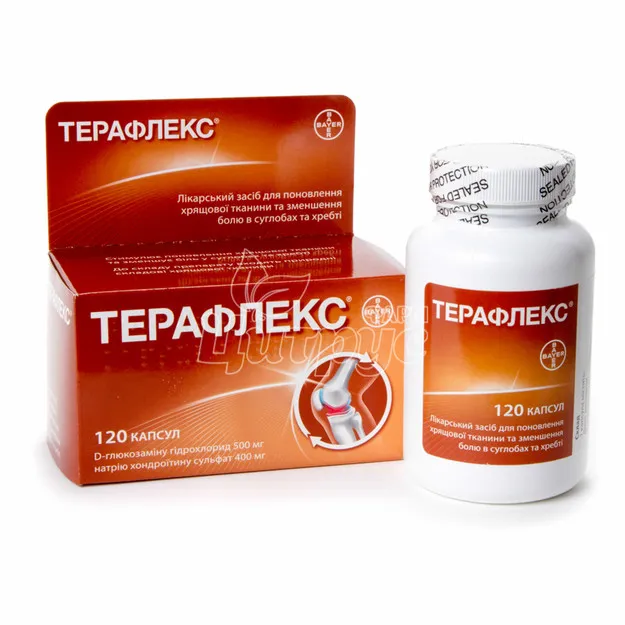
Table of Contents
INSTRUCTIONS FOR MEDICAL USE OF THE MEDICINAL PRODUCT THERAFLEX®
Composition:
Active substances: D-glucosamine hydrochloride and chondroitin sodium sulfate;
1 capsule contains 500 mg of D-glucosamine hydrochloride, 400 mg of chondroitin sodium sulfate;
Excipients: gelatin, stearic acid, magnesium stearate, manganese sulfate monohydrate.
Pharmaceutical form. Capsules.
Main physicochemical properties: hard, transparent gelatin capsules containing a powder from whitish to light beige in color with crystalline particles.
Pharmacotherapeutic group.
Agents used in pathologies of the musculoskeletal system. ATC code M09AX.
Pharmacological Properties
Pharmacodynamics
This medicinal product stimulates the regeneration of cartilage tissue. Chondroitin and glucosamine are effective in osteoarthritis. The drug exerts anti-inflammatory action at the cellular level, stimulates the synthesis of both endogenous proteoglycans and endogenous hyaluronic acid, reduces the catabolic activity of chondrocytes by inhibiting certain enzymes that degrade cartilage, such as collagenase, elastase, proteoglycanase, phospholipase A2, N-acetylglucosaminidase, etc., and also inhibits the formation of other substances that may damage cartilage tissue (in vitro), such as superoxide radicals and lysosomal enzyme activity.
Chondroitin is one of the main components of cartilage. It reduces the activity of the inflammatory process at early stages and thus slows down the degeneration of cartilage tissue. It helps reduce pain, improves joint function, and decreases the need for nonsteroidal anti-inflammatory drugs in knee and hip osteoarthritis.
Glucosamine is physiologically present in the human body and has chondroprotective properties. In vitro and in vivo studies have shown that glucosamine hydrochloride stimulates the synthesis of physiological glycosaminoglycans and proteoglycans by chondrocytes and the synthesis of hyaluronic acid by synoviocytes.
Pharmacokinetics
After a single oral administration of a therapeutic dose, the maximum plasma concentration of chondroitin sulfate is reached within 3–4 hours. The oral bioavailability is 12%.
In the blood, 85% of chondroitin and its depolymerized derivatives bind to several plasma proteins.
At least 90% of the administered chondroitin dose is initially metabolized by lysosomal phosphatases, followed by depolymerization by hyaluronidase, β-glucuronidase, and β-N-acetylhexosaminidase in the liver, kidneys, and other organs.
Chondroitin and its depolymerized derivatives are primarily excreted via renal excretion. The elimination half-life ranges from 5 to 15 hours.
After oral administration, glucosamine hydrochloride is rapidly and almost completely absorbed in the intestine. The pharmacokinetics of glucosamine are linear up to the standard dose of 1500 mg once daily, and higher doses do not result in a proportionally greater increase in maximum glucosamine concentration.
More than 25% of the administered glucosamine dose transfers from blood plasma to cartilage tissue and the synovial joint membrane.
Due to the first-pass effect in the liver, more than 70% of glucosamine is metabolized into urea, carbon dioxide, and water.
It is excreted unchanged primarily via the kidneys in urine and partially in feces. The elimination half-life is 68 hours.
Clinical characteristics.
Indications.
Primary and secondary osteoarthrosis; osteochondrosis; periarthritis of the shoulder and scapula; fractures (to accelerate callus formation).
Contraindications.
Hypersensitivity to any component of the drug (allergic reactions), tendency to bleeding, thrombophlebitis, hepatic or renal dysfunction in the decompensated stage. Do not use in patients with hypersensitivity (allergy) to seafood.
Interaction with other medicinal products and other forms of interaction.
No specific studies on drug interactions have been conducted; however, physicochemical and pharmacokinetic properties of glucosamine and chondroitin suggest a low probability of interaction.
The medicinal product is compatible with nonsteroidal anti-inflammatory drugs and corticosteroids.
Chondroitin sulfate may enhance the effect of anticoagulants, necessitating more frequent monitoring of blood coagulation parameters during concomitant use. Some sources indicate that concomitant use of glucosamine and warfarin may lead to increased international normalized ratio (INR) and risk of bleeding. Therefore, coagulation parameters should be monitored when used concomitantly.
Treatment efficacy is enhanced by enriching the diet with vitamins A and C, and salts of manganese, magnesium, copper, zinc, and selenium.
Special precautions for use.
- Do not exceed the recommended daily dose.
- In diabetic patients, blood glucose levels should be monitored more frequently, especially at the beginning of treatment.
- Exacerbation of asthma symptoms has been reported in patients with asthma after initiating glucosamine therapy; therefore, such patients should be aware of the potential worsening of symptoms.
- In rare cases, edema and/or fluid retention have been observed in patients with cardiac and/or renal insufficiency. This may be related to the osmotic effect of chondroitin sulfate.
Use during pregnancy or breastfeeding.
Due to the lack of clinical data on the efficacy and safety of the drug during pregnancy or breastfeeding, it should not be used during these periods.
Ability to affect driving or operating machinery.
No studies on the effect on the ability to drive or operate machinery have been conducted. However, patients should monitor any changes in their reaction speed before driving or operating machinery.
Dosage and Administration.
Take orally, swallowing with a small amount of water. The recommended dose for adults is 1 capsule three times daily. The minimum duration of treatment is 2 months. The recommended course of treatment is from 3 to 6 months. If necessary, the course may be repeated after an interval of 3 months.
This medicinal product is not intended for the treatment of acute pain. Symptomatic relief (particularly pain relief) may not occur even after several weeks of treatment, and in some cases may take longer. If no improvement is observed after 2–3 months of treatment, the patient should consult a physician.
Patients should consult a physician if symptoms worsen after starting this medicinal product.
Children. Due to insufficient experience with use in pediatric patients, administration to children is not recommended.
Overdose.
There have been no reported cases of overdose. Based on studies of acute and chronic toxicity, no toxic symptoms are expected, even with the use of high doses. However, if overdose occurs, treatment should be symptomatic. Standard supportive measures should be applied.
Adverse reactions.
Available data indicate that glucosamine and chondroitin sulfate, at the doses usually prescribed (1500 mg/day and 1200 mg/day, respectively), are non-toxic and do not cause known patterns of adverse reactions.
The adverse reactions described below have been reported during the post-marketing period of the medicinal product. Since the reports were voluntary and derived from a population of uncertain size, it is not always possible to reliably estimate their frequency.
Gastrointestinal disorders.
Epigastric pain, dyspepsia, constipation, flatulence, diarrhea, nausea, and vomiting.
Immune system disorders.
Allergic reactions, including skin rash, urticaria, pruritus, erythema, dermatitis, maculopapular rash, swelling, and angioedema. If allergic reactions occur, treatment should be discontinued and specialist consultation is required.
Nervous system disorders.
Dizziness, headache, drowsiness, insomnia, increased fatigue.
Other adverse reactions reported in the literature.
There have been reports of extrasystoles, visual disturbances, and alopecia during administration of 1200 mg of chondroitin sulfate; however, these are very rare.
Shelf life. 3 years.
Storage conditions.
Store in the original packaging at a temperature not exceeding 25°C. Keep out of reach of children.
Packaging.
Plastic bottles containing 30, 60, 120, or 200 capsules, packed in a cardboard box.
Prescription status.
Over-the-counter (without prescription).
Manufacturer.
Contract Pharmacal Corporation, USA
Manufacturer's address and place of business.
135 Adams Avenue, Hauppauge, New York 11788, USA