Tamsulid
Ukraine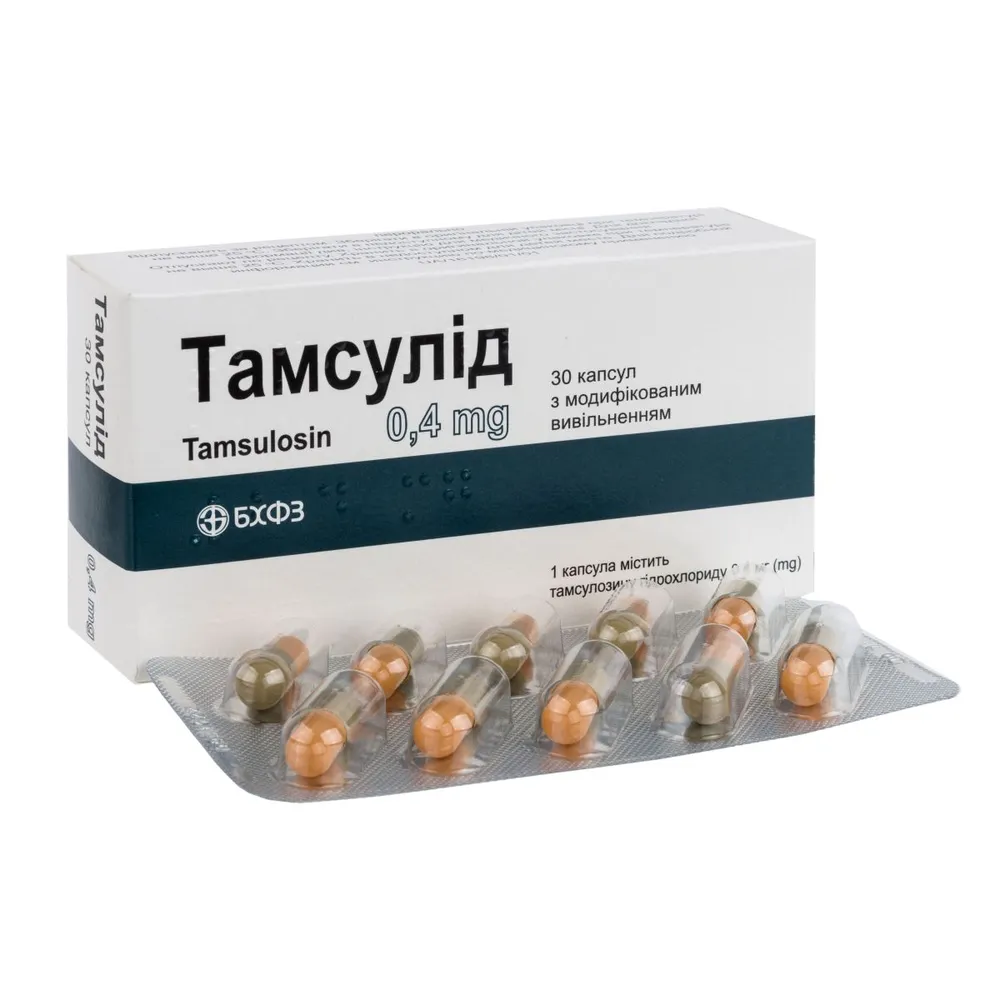
Table of Contents
INSTRUCTIONS FOR MEDICAL USE OF THE MEDICINAL PRODUCT TAMSULID (TAMSULID)
Composition:
Active substance: tamsulosin hydrochloride;
1 capsule contains tamsulosin hydrochloride 0.4 mg;
Excipients: microcrystalline cellulose, 30% dispersion of methacrylic acid – ethyl acrylate copolymer (1:1) containing polysorbate 80 (approximately 2.8%) and sodium lauryl sulfate (approximately 0.7%), triethyl citrate, talc;
coating of pellets: 30% dispersion of methacrylic acid – ethyl acrylate copolymer (1:1) containing polysorbate 80 (approximately 2.8%) and sodium lauryl sulfate (approximately 0.7%), talc, triethyl citrate;
capsule shell composition: iron oxide red (E 172), titanium dioxide (E 171), iron oxide yellow (E 172), gelatin, indigocarmine (E 132), iron oxide black (E 172).
Pharmaceutical form. Modified-release capsules.
Main physicochemical properties: hard gelatin capsules with an orange-colored body and an olive-colored cap. The capsule contains white or almost white pellets.
Pharmacotherapeutic group. Agents used in benign prostatic hyperplasia. Alpha1-adrenoreceptor antagonists. ATC code G04C A02.
Pharmacological properties.
Pharmacodynamics.
The mechanism of action of tamsulosin is due to selective competitive binding to postsynaptic α1-adrenoceptors, particularly subtypes α1A and α1D, resulting in reduced smooth muscle tone of the prostate gland, bladder neck, prostatic urethra, and improved urinary flow.
Concurrently, obstructive and irritative symptoms associated with benign prostatic hyperplasia are reduced. α1-Adrenoceptor antagonists have the ability to lower blood pressure by reducing peripheral vascular resistance. During clinical studies with tamsulosin hydrochloride, no clinically significant reduction in blood pressure was observed. The drug does not cause clinically relevant reduction in systemic arterial pressure in patients with normal baseline blood pressure.
Therapeutic effect usually develops within 2 weeks after initiation of treatment, although symptom improvement may occur after the first doses.
Pharmacokinetics.
Absorption. Tamsulosin is rapidly and almost completely absorbed from the gastrointestinal tract. Absorption is slowed when the drug is administered after food intake. Consistent release of the active substance can be achieved by taking tamsulosin at the same time each day after meals. Tamsulosin exhibits linear kinetics. Peak plasma concentrations are reached approximately 6 hours after a single dose taken after food. Steady-state concentration is achieved by day 5 of daily administration, with maximum plasma concentration being about two-thirds higher than after a single dose. Although these data were obtained specifically in elderly patients, a similar outcome can be expected in younger patients.
Plasma levels of tamsulosin may vary considerably among individual patients, both after single and repeated dosing.
Distribution. Plasma protein binding is 99%. Volume of distribution is low (approximately 0.2 L/kg).
Metabolism. Tamsulosin does not undergo first-pass effect and is slowly metabolized in the liver, forming pharmacologically active metabolites that retain high selectivity for α1-adrenoceptors. The majority of the active substance in blood is present in unchanged form.
Elimination. Tamsulosin and its metabolites are primarily excreted via urine, with approximately 9% of the dose excreted unchanged.
After a single dose of tamsulosin taken after food and at steady-state plasma concentrations, elimination half-lives are approximately 10 and 13 hours, respectively.
Clinical characteristics.
Indications.
Treatment of functional disorders of the lower urinary tract due to benign prostatic hyperplasia.
Contraindications.
- Hypersensitivity to tamsulosin hydrochloride, including drug-induced angioneurotic edema, or to any of the excipients;
- Orthostatic hypotension in medical history;
- Severe hepatic impairment.
Interaction with other medicinal products and other forms of interaction.
Interaction studies have been conducted only in adults.
No drug interactions were observed when tamsulosin hydrochloride was administered concomitantly with atenolol, enalapril, nifedipine, digoxin, or theophylline. Concomitant administration with cimetidine increases, and with furosemide decreases, plasma concentration of tamsulosin; however, since these levels remain within the normal range, no special dosage adjustment of tamsulosin is required.
In in vitro studies, diazepam, propranolol, trichlormethiazide, chlormadinone, amitriptyline, diclofenac, glibenclamide, simvastatin, and warfarin did not affect the free fraction of tamsulosin in human plasma. Similarly, tamsulosin did not alter the levels of free fractions of diazepam, propranolol, trichlormethiazide, and chlormadinone in human plasma. However, diclofenac and warfarin may accelerate the elimination of tamsulosin from plasma.
Concomitant administration with strong CYP3A4 inhibitors may lead to an increased effect of tamsulosin hydrochloride. Administration with ketoconazole (a known strong CYP3A4 inhibitor) results in a 2.8-fold and 2.2-fold increase in AUC and Cmax of tamsulosin hydrochloride, respectively.
Tamsulosin hydrochloride should be used with caution in combination with strong (e.g., ketoconazole, itraconazole, voriconazole, clarithromycin, indinavir, nelfinavir, ritonavir, saquinavir) and moderate (e.g., erythromycin) CYP3A4 inhibitors. In patients with low CYP2D6 metabolism, tamsulosin hydrochloride should not be prescribed in combination with strong CYP3A4 inhibitors.
Concomitant administration with paroxetine (a strong CYP2D6 inhibitor) leads to a 1.3-fold and 1.6-fold increase in Cmax and AUC of tamsulosin, respectively, but this increase is not considered clinically significant.
There is a risk of enhanced hypotensive effect when tamsulosin is used concomitantly with medicinal products that may reduce blood pressure, including anesthetics, phosphodiesterase-5 inhibitors, and other α1-adrenoblockers.
In vitro studies using hepatic microsomal fractions showed no interaction with amitriptyline, salbutamol, glibenclamide, and finasteride.
Special precautions for use.
As with other α1-adrenoblockers, in individual cases, administration of Tamsuloside may lead to a decrease in blood pressure, which may occasionally result in loss of consciousness. If the first signs of orthostatic hypotension (dizziness, weakness) occur, the patient should assume a horizontal position until the aforementioned symptoms disappear.
Before initiating treatment with Tamsuloside, a medical examination should be performed to rule out other concomitant diseases that may cause similar symptoms to benign prostatic hyperplasia.
Prior to starting treatment, a digital rectal examination of the prostate should be performed, and, if necessary, the level of prostate-specific antigen (PSA) should be monitored before and regularly during treatment.
Tamsuloside should be prescribed with particular caution to patients with severe renal impairment (creatinine clearance < 10 mL/min) due to insufficient clinical experience.
Angioedema has been rarely reported following administration of tamsulosin. In such cases, treatment should be discontinued immediately and the patient monitored until the swelling resolves; tamsulosin should not be administered again.
In some patients receiving or who have received tamsulosin, intraoperative iris flaccidity (intraoperative floppy iris syndrome, IFIS), a variant of miosis syndrome, has been observed during cataract or glaucoma surgery, associated with α1-receptor blockade. IFIS increases the risk of ocular complications during or after such surgery.
Generally, it is recommended to discontinue tamsulosin treatment 1–2 weeks prior to cataract or glaucoma surgery; however, the benefit, appropriateness, and exact timing of discontinuation have not been definitively established. Cases of IFIS have also been reported in patients who discontinued tamsulosin administration several months prior to surgery.
Initiating therapy with tamsulosin hydrochloride is not recommended in patients scheduled for cataract or glaucoma surgery. Ophthalmic surgeons should be informed whether the patient is currently taking or has previously taken tamsulosin to prevent potential complications related to IFIS.
Tamsulosin is extensively metabolized, primarily by CYP3A4 and CYP2D6. Tamsulosin hydrochloride should not be administered in combination with strong CYP3A4 inhibitors (e.g., ketoconazole) in patients who are poor metabolizers of CYP2D6.
Tamsulosin hydrochloride should be used cautiously in combination with strong (e.g., ketoconazole) and moderate CYP3A4 inhibitors (e.g., erythromycin) (see section "Interaction with other medicinal products and other forms of interaction").
Cases of allergic reactions to tamsulosin have been reported in patients with a history of allergy to sulfonamides. Caution should be exercised when administering tamsulosin hydrochloride to patients with a previous history of sulfonamide allergy.
The drug should be taken only as prescribed by a physician.
Use during pregnancy or breastfeeding.
Tamsuloside is not indicated for use in women.
Fertility. During both short- and long-term clinical studies of tamsulosin, ejaculation disorders were observed. Cases of ejaculation disorder, retrograde ejaculation, and inadequate ejaculation have been reported in the post-marketing period.
Ability to affect reaction speed when driving or operating machinery.
Studies on the effect of the drug on the ability to drive or operate machinery have not been conducted. However, patients should be warned about the possible occurrence of drowsiness, blurred vision, dizziness, and syncope.
Method of Administration and Dosage
The recommended dose for adults is 1 capsule daily, taken after breakfast or after the first meal of the day. The capsule should be swallowed whole, while sitting or standing. The capsule must not be chewed or crushed, as this would interfere with the modified release of the active ingredient.
Elderly patients do not require dose adjustment. However, it should be noted that orthostatic hypotension risk is increased in geriatric patients.
Patients with renal impairment do not require dose adjustment.
Patients with mild to moderate hepatic impairment do not require dose adjustment (see also "Contraindications").
Children
The drug is not intended for use in children. Safety and efficacy of tamsulosin in pediatric patients (under 18 years of age) have not been established.
Overdose
Symptoms. Overdose of tamsulosin hydrochloride may cause acute and severe hypotensive effects, as well as nausea and diarrhea. Severe hypotensive effects have been observed at various overdose levels.
Treatment. In case of acute arterial hypotension due to overdose, supportive therapy should be administered to restore normal cardiovascular function (e.g., the patient should be placed in a supine position). If this is ineffective, intravenous infusion therapy and vasopressor agents should be administered. Renal function should be monitored, and general supportive measures should be implemented. Due to the high degree of plasma protein binding of tamsulosin, hemodialysis is unlikely to be effective.
To prevent further absorption of the drug, induced vomiting may be considered. In cases of significant overdose, gastric lavage should be performed, and activated charcoal or low-osmotic laxatives such as sodium sulfate may be administered.
Side effects
Side effects are classified by system organ class and frequency of occurrence: common (> 1/100, < 1/10); uncommon (> 1/1000, < 1/100); rare (> 1/10000, < 1/1000); very rare (< 1/10000); not known (cannot be estimated from available data).
Nervous system: common – dizziness; uncommon – headache; rare – syncope (fainting).
Eye: not known – blurred vision*, visual disturbances*.
Cardiovascular system: uncommon – orthostatic hypotension, palpitations.
Respiratory system: uncommon – rhinitis; not known – epistaxis*.
Reproductive system: common – ejaculation disorders, including retrograde ejaculation and ejaculatory insufficiency; very rare – priapism.
Gastrointestinal system: uncommon – constipation, diarrhea, nausea, vomiting; not known – dry mouth.
Skin and subcutaneous tissue: uncommon – pruritus, rash, urticaria; rare – angioneurotic edema; very rare – Stevens-Johnson syndrome; not known – erythema multiforme*, exfoliative dermatitis*, photosensitivity reactions*.
General disorders: uncommon – asthenia.
*Observed during the post-marketing period of tamsulosin use.
In addition to the above-mentioned adverse reactions, spontaneous reports have been received during the post-marketing period regarding cases of atrial fibrillation, tachycardia, arrhythmia, and dyspnea. Since these reports were spontaneous, the frequency of these reactions and their causal relationship to tamsulosin cannot be reliably determined.
As with other alpha-blockers, somnolence, dry mouth, and edema may occur.
Cases of intraoperative iris floppiness (a variant of intraoperative floppy iris syndrome, known as IFIS) have been reported during cataract and glaucoma surgery in patients on long-term tamsulosin therapy.
Shelf life. 3 years.
Do not use after the expiry date stated on the packaging.
Storage conditions.
Store in the original packaging at a temperature not exceeding 25 °C.
Keep out of reach and sight of children.
Packaging.
10 capsules per blister, 3 blisters per carton.
Prescription status. Prescription only.
Manufacturer.
Public Joint-Stock Company "Scientific and Production Center "Borysyivsky Chemical and Pharmaceutical Plant".
Manufacturer's address and place of business.
17 Mira Street, Kyiv, 03134, Ukraine.