Tachiben®
Ukraine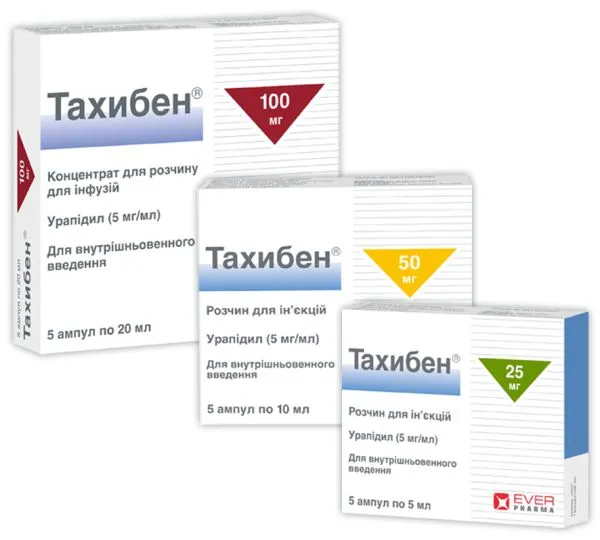
Table of Contents
INSTRUCTION FOR MEDICAL USE OF THE MEDICINAL PRODUCT TACHYBEN® (TACHYBEN®)
Composition:
Active substance: urapidil;
1 ml of solution contains 5 mg of urapidil;
Excipients: hydrochloric acid concentrated; sodium dihydrogen phosphate dihydrate; disodium hydrogen phosphate dihydrate; propylene glycol; sodium hydroxide; hydrochloric acid diluted; water for injections.
Pharmaceutical form. Concentrate for solution for infusion.
Main physicochemical properties: clear, colorless solution.
Pharmacotherapeutic group.
Antihypertensive agents. Antiadrenergic agents with peripheral mechanism of action. Alpha-adrenoreceptor blockers. ATC code C02CA06.
Pharmacological Properties.
Pharmacodynamics.
Urapidil causes a reduction in systolic and diastolic arterial pressure by decreasing peripheral vascular resistance.
Heart rate remains practically unchanged.
Cardiac output is not altered; however, if cardiac output was previously reduced due to elevated afterload, it may increase.
Urapidil has both central and peripheral mechanisms of action.
- Peripheral action: Urapidil primarily blocks postsynaptic α1-adrenoceptors, thereby inhibiting the vasoconstrictive effects of catecholamines.
- Central nervous system (CNS) action: Urapidil modulates the activity of brain centers controlling circulation. As a result, reflexive increases in sympathetic nervous system tone are inhibited, or sympathetic tone is reduced.
Pharmacokinetics.
After intravenous administration of a 25 mg dose, a biphasic decline in urapidil serum concentration is observed (an initial distribution phase followed by a terminal elimination phase). The distribution half-life is approximately 35 minutes, and the volume of distribution is 0.8 L/kg (range 0.6–1.2 L/kg).
Urapidil is predominantly metabolized in the liver. The main metabolite is a hydroxylated derivative of urapidil at the fourth position of the phenyl ring, which has virtually no antihypertensive activity. The O-demethylated metabolite is formed in very small amounts and has approximately the same biological activity as urapidil.
In humans, 50–70% of urapidil and its metabolites are excreted in urine (approximately 15% as pharmacologically active urapidil). The remainder is excreted in feces as metabolites (predominantly as inactive para-hydroxylated urapidil).
The elimination half-life of urapidil in plasma after intravenous bolus administration averages 2.7 hours (range 1.8–3.9 hours). In vitro, the plasma protein binding of urapidil in human blood is 80%. This relatively low degree of plasma protein binding explains why, to date, there has been no reported drug interaction between urapidil and other agents that are highly protein-bound.
In patients with severe hepatic and/or renal insufficiency, as well as in elderly patients, the volume of distribution and clearance of urapidil are reduced, and the elimination half-life is prolonged.
Urapidil crosses the blood-brain and placental barriers.
Clinical characteristics.
Indications.
- Hypertensive crisis.
- Severe forms of arterial hypertension.
- Refractory arterial hypertension.
- Controlled reduction of arterial pressure when it increases during and/or after surgery.
Contraindications.
- Hypersensitivity to urapidil or to any of the excipients.
- Aortic stenosis.
- Arteriovenous shunt (except for a hemodynamically inactive shunt used for dialysis).
Interaction with other medicinal products and other forms of interaction.
The hypotensive effect of urapidil may be enhanced when administered concomitantly with alpha-adrenoreceptor blockers (including those used for urological indications), vasodilators, and other antihypertensive agents, as well as in conditions of hypovolemia (diarrhea, vomiting), and during alcohol consumption.
Urapidil should be used with caution in combination with baclofen, as baclofen may enhance the hypotensive effect.
Cimetidine, when administered concomitantly, inhibits the metabolism of urapidil. The plasma concentration of urapidil may increase by 15%; therefore, dose reduction should be considered in such cases.
Caution is required when urapidil is used concomitantly with the following drugs:
- imipramine (hypotensive effect and risk of orthostatic hypotension);
- neuroleptics (hypotensive effect and risk of orthostatic hypotension);
- corticosteroids (reduction of hypotensive effect due to sodium and water retention).
Since sufficient experience with combination therapy using ACE inhibitors is lacking, this combination is not recommended at present.
Special precautions for use
The drug should be used with caution:
- in heart failure caused by mechanical dysfunction of the heart, for example, aortic or mitral valve stenosis, pulmonary artery embolism, or worsening cardiac function due to pericardial disease;
- in patients with hepatic impairment;
- in patients with moderate to severe renal impairment;
- in elderly patients;
- in patients concurrently receiving cimetidine (see section "Interaction with other medicinal products and other forms of interaction").
If urapidil is not used as first-line antihypertensive therapy, sufficient time should elapse before initiating treatment to account for the effects of previously prescribed antihypertensive drugs. In such cases, treatment should be initiated with a lower dose of urapidil.
Excessively rapid reduction of arterial blood pressure may lead to bradycardia or cardiac arrest.
Since propylene glycol is an ingredient of Tachyben® (Tahyben®), symptoms resembling those of alcohol consumption may occur during treatment.
One dose of the medicinal product contains a very small amount of sodium – less than 1 mmol (23 mg).
Use during pregnancy or breastfeeding
Urapidil is not recommended during pregnancy. Adequate data on the use of urapidil in pregnant women are lacking.
Animal studies have demonstrated reproductive toxicity of urapidil without signs of teratogenicity. Given the limitations of these studies, the potential risk to humans is unknown.
It is currently unknown whether urapidil is excreted in breast milk; therefore, breastfeeding should be discontinued during treatment with this medicinal product.
Ability to influence reaction speed when driving or operating machinery
In individual cases, certain adverse reactions from the central nervous system (CNS) (e.g., dizziness) may affect the ability to drive or operate complex machinery. This is mainly observed at the beginning of treatment, when the dose is increased/replaced, or when alcohol is consumed concomitantly.
Administration and Dosage
Hypertensive crisis, severe forms of arterial hypertension, refractory arterial hypertension
Intravenous injections: 10–50 mg of urapidil administered slowly intravenously with continuous monitoring of arterial pressure (AP). Reduction in arterial pressure can be expected within 5 minutes after injection. Depending on the clinical effect, repeated intravenous administration of the drug is possible (at a dose of 10–50 mg of urapidil).
Intravenous infusion or infusion using an infusion pump: to maintain arterial pressure at the level achieved by injections, the drug should be administered by infusion.
Preparation of infusion solution:
- Intravenous drip infusion: Add 250 mg of urapidil (50 mL of the drug) to 500 mL of 0.9% sodium chloride infusion solution or 5% or 10% glucose infusion solution.
- Intravenous infusion using an infusion pump: Draw 100 mg of urapidil (20 mL of the drug) into the infusion pump and dilute to a volume of 50 mL with 0.9% sodium chloride infusion solution or 5% or 10% glucose infusion solution.
The drug must be diluted under aseptic conditions.
Before administration, the solution should be visually inspected for discoloration and presence of particulate matter. Only clear, colorless solutions free from particulate matter should be used.
The concentration of the infusion solution must not exceed 4 mg of urapidil/mL.
The infusion rate should be adjusted according to the individual blood pressure response. The recommended initial infusion rate is no more than 2 mg/min.
Maintenance dose – average 9 mg/hour. When diluting 50 mL of the drug (250 mg of urapidil) in 500 mL of diluent, 1 mg = 44 drops = 2.2 mL.
Controlled reduction of arterial pressure during and/or after surgical intervention
Dosage regimen:
| Intravenous injection |
Blood pressure decreases |
Stabilization of blood pressure by infusion Initial infusion rate – up to 6 mg within |
|
| after 2 minutes |
Blood pressure unchanged |
||
| Intravenous injection |
Blood pressure decreases |
||
| after 2 minutes |
Blood pressure unchanged |
||
| Slow intravenous injection of 50 mg urapidil (10 ml of solution) |
Blood pressure decreases |
||
Note
The drug should be administered intravenously to patients lying in a supine position. The dose may be given as a single or multiple injections or by slow intravenous infusion. Injections may be combined with subsequent slow infusion.
Treatment of elderly patients
Antihypertensive agents should be used with caution in elderly patients and initiated at low doses, as sensitivity to drugs of this pharmacotherapeutic class is often altered in elderly patients.
Treatment of patients with renal and/or hepatic impairment
Dosage reduction of urapidil may be necessary in patients with impaired renal and/or hepatic function.
Duration of therapy
Parenteral therapy lasting up to 7 days has been shown to be safe from a toxicological standpoint. This period should generally not be exceeded when administering parenteral antihypertensive agents.
If arterial pressure rises again, parenteral therapy may be repeated.
Oral antihypertensive therapy can be initiated during the course of emergency parenteral treatment with urapidil.
Children.
The safety and efficacy of intravenous administration of urapidil in children (under 18 years of age) have not been established.
Overdose.
Symptoms: dizziness, orthostatic hypotension and collapse, as well as fatigue and drowsiness.
Treatment in case of overdose: in case of excessive reduction in arterial pressure, the patient should be placed in a horizontal position with low head elevation, and infusion therapy should be initiated to increase circulating blood volume. If these measures are insufficient, vasoconstrictors should be administered slowly intravenously under arterial pressure monitoring. In individual cases, catecholamines may be required (e.g., adrenaline 0.5–1.0 mg, diluted in 10 ml of isotonic sodium chloride solution).
Side effects.
Most adverse effects are related to too rapid a reduction in blood pressure. However, clinical experience shows that these effects resolve within a few minutes, even during ongoing infusion of the drug; therefore, the decision to discontinue therapy should be based on the severity of the adverse effect.
Adverse reactions are categorized according to frequency as follows: very common (≥ 1/10), common (≥ 1/100, < 1/10), uncommon (≥ 1/1000, < 1/100), rare (≥ 1/10000, < 1/1000), very rare (< 1/10000), frequency not known (available data do not allow estimation of frequency).
Cardiovascular system
Uncommon: palpitations, tachycardia, bradycardia, sensation of pressure or chest pain (symptoms similar to angina), dyspnea, orthostatic dysregulation (decrease in blood pressure upon change in body position, e.g., standing up from lying down).
Gastrointestinal tract
Common: nausea.
Uncommon: vomiting.
General and local reactions
Uncommon: increased fatigue, changes at the site of administration.
Investigations
Uncommon: arrhythmias.
Very rare: thrombocytopenia*.
Nervous system
Common: dizziness, headache.
Psychiatric disorders
Very rare: anxiety.
Reproductive system and breast
Rare: priapism.
Respiratory system, thoracic and mediastinal organs
Rare: nasal congestion.
Skin and subcutaneous tissues
Uncommon: increased sweating.
Rare: symptoms of skin allergic reactions (itching, rash, skin redness).
Frequency not known: angioneurotic edema, urticaria.
* In isolated cases, a decrease in platelet count has been observed during treatment with the drug, although a causal relationship with urapidil administration has not been established, for example, by immunohematological investigations.
Shelf life.
The medicinal product in the original packaging – 3 years.
The product after opening the ampoule and infusion solution remain chemically and physically stable for 50 hours when stored at 15–25 °C.
From a microbiological point of view, the medicinal product or infusion solution should be used immediately. If not used immediately, storage duration and conditions should be under the responsibility of the person in charge. Generally, storage time for solutions should not exceed 24 hours at 2–8 °C, unless all manipulations were performed under controlled and validated aseptic conditions.
Storage conditions.
Store in the original packaging at a temperature not exceeding 30 °C.
Keep out of the reach of children.
Incompatibilities.
The product should not be mixed with other medicinal products except 0.9% sodium chloride infusion solution or 5% or 10% glucose infusion solution.
Alkaline injection and infusion solutions should not be used simultaneously, as this may cause clouding of the solution, formation of flakes or precipitate.
Packaging.
20 ml in a vial made of colorless glass; 5 vials in a cardboard box.
Prescription status.
Prescription only.
Manufacturer/Marketing Authorization Holder.
EVER Neuro Pharma GmbH, Austria.
Manufacturer's address and location of marketing authorization holder.
Oberburgau, 3, 4866 Unterach am Attersee, Austria.