Sinupret
Ukraine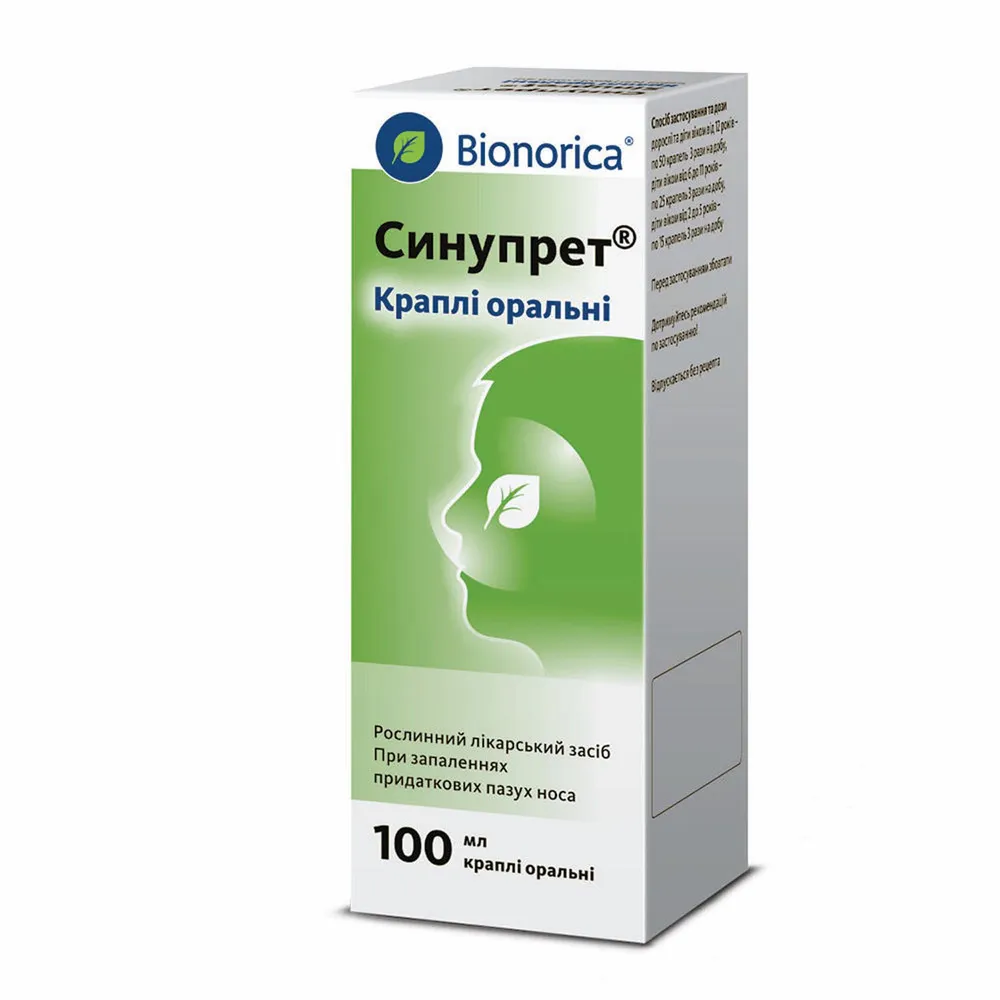
Table of Contents
INSTRUCTIONS FOR MEDICAL USE OF THE MEDICINAL PRODUCT SİNUPRET® (SİNUPRET®)
Composition:
Active substances: 100 g of drops contains 29 g of extract (1:11) from the root of gentian (Radix Gentianae); primrose flowers with calyx (Flores Primulae cum Calycibus); sorrel herb (Herba Rumicis); elder flowers (Flores Sambuci); verbena herb (Herba Verbenae) (1:3:3:3:3), extraction solvent: ethanol 59% (v/v);
Excipient: purified water.
Ethanol content – 19% (v/v).
Pharmaceutical form. Oral drops.
Main physicochemical properties: clear or slightly cloudy yellowish-brown liquid with an aromatic odor. During storage, slight clouding or precipitation may occur.
Pharmacotherapeutic group.
Preparations used for cough and colds. ATC code R05X.
Pharmacological properties.
The components contained in the herbal medicinal product have a complex activity, manifested in secretolytic, anti-edematous, anti-inflammatory, immunostimulatory, and antiviral effects.
The active components of the medicinal product Sinupret**®** inhibit the replication of various respiratory viruses, such as influenza virus A, parainfluenza, and RSV (respiratory syncytial viruses).
Under the influence of the drug, secretion is regulated and tissue edema is reduced. Drainage and ventilation of the nasal sinuses are restored, nasal congestion is relieved, and the protective function of the respiratory epithelium is normalized. The efficacy of antibiotic therapy is increased.
Clinical characteristics.
Indications. Acute and chronic inflammation of the paranasal sinuses.
Contraindications. Hypersensitivity to any of the active or excipient ingredients of the medicine, to other species of primrose, as well as peptic ulcer.
Interaction with other medicinal products and other forms of interaction. No interaction with other medicinal products has been observed. Combination with antibiotics is possible and advisable.
Special precautions for use.
Medical advice is recommended if the patient experiences pronounced symptoms of severe rhinosinusitis, such as epistaxis (nosebleed), fever, severe pain, purulent nasal discharge, visual disturbances, facial or ocular asymmetry, or facial numbness, as emergency medical treatment may be required.
If symptoms persist for more than 7–14 days, worsen, or recur periodically during treatment, the patient should consult a physician.
Particular caution is required when administering the medicinal product to patients with gastritis or functional dyspepsia (so-called "sensitive stomach"). The drug should be taken after food.
The medicinal product contains 19% ethanol (v/v); therefore, it should not be used in patients suffering from alcoholism or who have successfully completed treatment for alcoholism.
Also, when doses exceeding the recommended amounts are taken, there is a health risk for children and patients with liver disease, epilepsy, or organic brain disorders.
During storage, the preparation may become cloudy or a precipitate may form; however, this does not affect the drug's efficacy. Shake well before use.
Use during pregnancy or breastfeeding. The drug may be used during pregnancy or breastfeeding only with caution and solely after a physician has clearly established the diagnosis and evaluated the benefit-risk ratio for the mother and fetus (child).
Ability to affect reaction speed when driving or operating machinery. At recommended doses, the drug does not affect the ability to drive or operate machinery; however, it should be noted that the drug contains ethanol.
Method of administration and dosage.
If the physician has not prescribed otherwise, the drug should be used in the following doses:
| Age |
Single dose |
Daily dose |
| Children aged 2 to 5 years |
15 drops, equivalent to 0.9 mL |
45 drops (3 times 15 drops), equivalent to 2.7 mL |
| Children aged 6 to 11 years |
25 drops, equivalent to 1.5 mL |
75 drops (3 times 25 drops), equivalent to 4.5 mL |
| Children aged 12 years and adults |
50 drops, equivalent to 3 mL |
150 drops (3 times 50 drops), equivalent to 9 mL |
Adults usually take the drops undiluted or, if desired, mixed with an appropriate amount of liquid. The drops should be administered diluted to children, and to mask the bitter taste, they can be added to juice or tea.
The usual recommended treatment course is 7–14 days, unless otherwise prescribed. Follow the recommendations provided in the section "Special precautions".
Children. Due to insufficient experience, the drug should not be used in children under 2 years of age.
Overdose. Cases of overdose are currently unknown. Exceeding the dose may lead to an increase in adverse reactions (see "Adverse reactions").
Treatment: symptomatic therapy is required in case of signs of poisoning or overdose.
Side effects
Gastrointestinal disorders are uncommon, including stomach pain, nausea, diarrhea, vomiting, and abdominal discomfort. Hypersensitivity reactions are possible, including rash, skin redness, itching, urticaria, angioedema (Quincke's edema), dyspnea, and facial swelling.
If any adverse reactions occur, discontinue use of the medicine and consult a physician.
Shelf life. 2 years.
Do not use the medicine after the expiry date stated on the packaging.
The shelf life refers to use of the medicine up to the last day of the indicated month.
After first opening of the bottle, the medicine remains suitable for use for 3 months.
Storage conditions. Store in the original packaging at a temperature not exceeding 25°C, in a place inaccessible to children.
Packaging. 50 ml or 100 ml of solution in a bottle with a dropper dispenser, screw cap and tamper-evident ring, placed in a cardboard box.
Supply classification. Over-the-counter (without prescription).
Manufacturer/Applicant. Bionorica SE / Bionorica SE.
Address of manufacturer and place of business / Address of applicant and/or applicant's representative.
Kerschensteinerstrasse, 11-15, 92318 Neumarkt, Germany.
Contact details of the manufacturer's representative in Ukraine, LLC "Bionorica":
Phone: 044 521 86 00; Fax: 044 521 86 01; Email: [email protected]