Synthomycin
Ukraine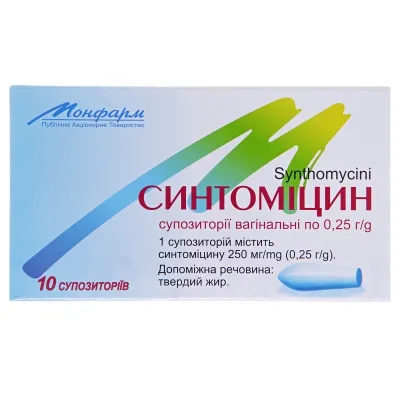
Table of Contents
INSTRUCTIONS for medical use of the medicinal product SYNTOMYCIN (SYNTOMYCIN)
Composition:
Active ingredient: chloramphenicol;
1 suppository contains syntomycin 250 mg (0.25 g);
Excipient: hard fat.
Pharmaceutical form. Vaginal suppositories.
Main physicochemical characteristics: white or white with yellowish or creamy tint colored suppositories.
Pharmacotherapeutic group. Antimicrobial and antiseptic agents used in gynecology. Antibiotics. ATC code G01A A05.
Pharmacological properties.
Pharmacodynamics.
The active ingredient of the drug is chloramphenicol – a broad-spectrum antibiotic with high antibacterial activity against causative agents of various purulent-inflammatory conditions. Chloramphenicol is a bacteriostatic antibiotic; it disrupts protein synthesis in bacterial cells (due to good lipophilicity, it penetrates the bacterial cell membrane and reversibly binds to the 50S subunit of bacterial ribosomes, resulting in inhibition of amino acid transfer to growing peptide chains, thus disrupting protein synthesis). It is active against most strains of Gram-positive and Gram-negative microorganisms, causative agents of purulent and intestinal infections, meningococcal infection: Escherichia coli, Shigella dysenteriae, Shigella flexneri, Shigella boydii spp., Shigella sonnei, Salmonella spp. (including Salmonella typhi, Salmonella paratyphi), Staphylococcus spp., Streptococcus spp. (including Streptococcus pneumoniae), Neisseria meningitidis, Neisseria gonorrhoeae, some strains of Proteus spp., Burkholderia pseudomallei, Rickettsia spp., Treponema spp., Leptospira spp., Chlamydia spp. (including Chlamydia trachomatis), Coxiella burnetii, Ehrlichia canis, Bacteroides fragilis, Klebsiella pneumoniae, Haemophilus influenzae. It has no effect on acid-resistant bacteria (including Mycobacterium tuberculosis), anaerobes, methicillin-resistant Staphylococcus strains, Acinetobacter, Enterobacter, Serratia marcescens, indole-positive Proteus strains, Pseudomonas aeruginosa spp., protozoa, or fungi.
Microbial resistance to chloramphenicol develops slowly.
Pharmacokinetics.
Acts locally and penetrates well into uterine tissues. The half-life is 3–5 hours. It is excreted in urine unchanged and as metabolites, partially excreted in feces.
Clinical characteristics.
Indications. Bacterial gynecological infections (vaginitis, cervicitis) caused by microorganisms sensitive to synthomycin.
For the prevention of purulent-inflammatory diseases in gynecology; prior to invasive procedures: abortions, gynecological surgeries (diathermocoagulation of the cervix, hysterosalpingography), and before and after intrauterine contraceptive device insertion.
Contraindications.
- Hypersensitivity to components of the drug.
- Allergy and toxic reactions (dyspeptic symptoms, dysbacteriosis, mental disorders) to chloramphenicol in medical history.
- Psoriasis.
- Eczema.
- Fungal infections of the vagina.
- Bone marrow suppression.
Interaction with other medicinal products and other types of interactions. Concurrent use of the drug with erythromycin, oleandomycin, nystatin, and levorin increases antibacterial activity, whereas use with benzylpenicillin salts decreases it. The drug is incompatible with diphenyl, barbiturates, and ethanol. It should not be prescribed concurrently with drugs that suppress hematopoiesis (sulfonamides, pyrazolone derivatives, cytostatics).
Special precautions for use.
With prolonged use, genital candidiasis may develop. Regular monitoring of peripheral blood parameters is required during treatment; if leukopenia occurs, the drug should be discontinued.
Use during pregnancy or breastfeeding. Do not use during pregnancy or breastfeeding.
Ability to influence reaction rate while driving or operating machinery. Studies on the influence of suppositories on the ability to drive vehicles or operate machinery have not been conducted.
Administration and Dosage
For use in adult women.
After removing the suppository from its foil wrapper, insert it as deeply as possible into the vagina. The patient should lie on her back during insertion.
Use 1 suppository 2–3 times daily.
Maximum daily dose – 4 suppositories. Treatment duration – 5–7 days.
Children. The drug is not intended for use in children.
Overdose.
Symptoms: increased incidence or severity of the drug's adverse effects may occur.
Treatment: symptomatic.
Side effects.
Hematological system: leukopenia, thrombocytopenia, reticulocytopenia, decreased hemoglobin levels in blood.
Immune system: possible allergic reactions, including: Quincke's edema, other signs of irritation not observed prior to treatment, skin rashes, itching, burning sensation, hyperemia, swelling.
Gastrointestinal tract: dyspeptic symptoms (nausea, vomiting, diarrhea).
In such cases, the use of the drug should be discontinued.
Shelf life. 2 years.
Storage conditions. Store in original packaging at a temperature not exceeding 25 °C.
Keep out of reach of children.
Packaging. 5 suppositories per strip. 2 strips per cardboard box.
Prescription status. Prescription only.
Manufacturer: JSC "Monfarm".
Manufacturer's address and place of business.
8, Zavodska St., Avramivka village, Uman district, Cherkasy region, 19161, Ukraine.