Synthomycin
Ukraine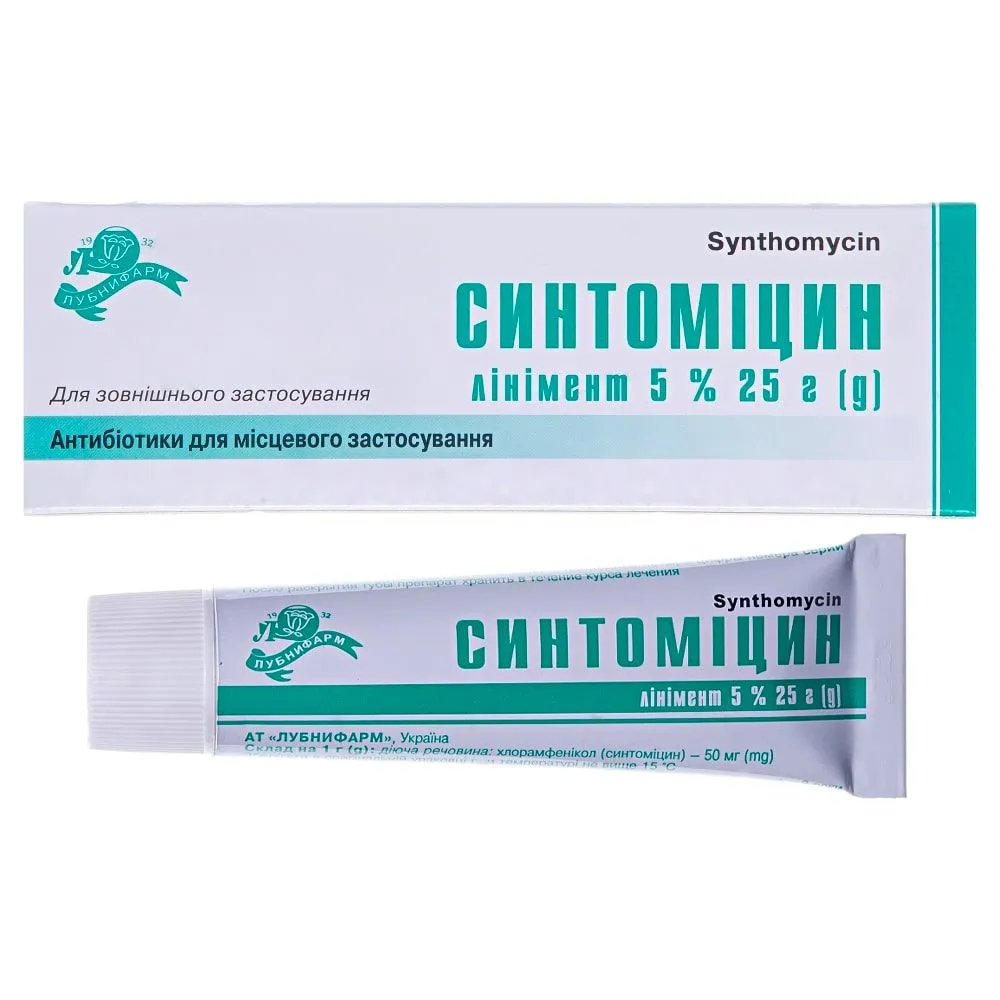
Table of Contents
INSTRUCTION FOR MEDICAL USE OF THE MEDICINAL PRODUCT SYNTOMICIN
Composition:
Active substance: 1 g of liniment contains chloramphenicol (syntomycin) – 50 mg;
Excipients: castor oil, emulsifier No. 1, sorbic acid, sodium carboxymethylcellulose, purified water;
Excipients included in emulsifier No. 1: cetyl alcohol, stearyl alcohol.
Pharmaceutical form. Liniment.
Main physico-chemical properties: liniment of white or white with a slightly yellowish tint, with a weak specific odor.
Pharmacotherapeutic group.
Antibiotics for topical use. Chloramphenicol. ATC code D06AX02.
Pharmacological properties.
The drug is active against strains of bacteria resistant to penicillin, streptomycin, and sulfonamides; against gram-positive (Staphylococcus spp., Streptococcus spp.) and gram-negative (Neisseria gonorrhoeae, Neisseria meningitidis) cocci, many bacteria (Escherichia coli, Haemophilus influenzae, Salmonella spp., Shigella spp., Klebsiella spp., Serratia spp., Proteus stuartii, Yersinia), rickettsiae, spirochetes, and causative agents of trachoma, psittacosis, and lymphogranuloma venereum. It exerts antimicrobial and antibacterial (bacteriostatic) action. The mechanism of action is associated with inhibition of microbial protein synthesis. Microbial resistance to chloramphenicol develops relatively slowly.
Clinical characteristics.
Indications.
Local treatment of purulent-inflammatory skin lesions (carbuncles, furuncles), purulent wounds, slowly healing trophic ulcers, II-III degree burns, and nipple fissures in lactating women.
Contraindications.
Individual hypersensitivity to any component of the drug.
Psoriasis, eczema, fungal skin diseases.
Interaction with other medicinal products and other forms of interactions.
Simultaneous use of the drug with erythromycin, oleandomycin, nystatin, and levorin enhances the antibacterial activity of the liniment, whereas concomitant use with benzylpenicillin salts reduces it. The drug is incompatible with sulfonamides.
The drug is incompatible with cytostatics, diphenyl, barbiturates and pyrazolone derivatives, and ethanol.
Special precautions for use.
It is not allowed for the liniment to get into the eyes. Unsupervised use of the drug in pediatric practice is prohibited; it should be used only as prescribed by a physician.
Topical antibacterial agents may lead to skin sensitization, resulting in the development of hypersensitivity reactions in the future (when these drugs are administered topically or in dosage forms intended for systemic action).
Use during pregnancy or breastfeeding.
Since the pharmacokinetics of Chloramphenicol has not been studied, the drug should be used with caution during pregnancy and only when, in the opinion of the physician, the expected benefit to the mother outweighs the potential risk to the fetus.
During treatment of nipple fissures in nursing mothers, breastfeeding need not be discontinued.
Before breastfeeding, any residual medication on the nipple and surrounding skin should be wiped off with a clean cloth, and the breast should be thoroughly and carefully washed.
Ability to influence reaction rate while driving or operating machinery.
Does not affect.
Administration and dosage.
Gauze swabs are soaked with the preparation or the preparation is applied directly in a thin layer to the affected area. A regular dressing is then applied, optionally with parchment or compress paper. Dressings are changed depending on indications every 1–3 days, sometimes every 4–5 days. The duration of treatment is determined individually by a physician.
For nipple fissures in postpartum women, after each feeding, nipples are washed with a 0.25% ammonia solution, then a sterile gauze pad coated with a layer of liniment is applied to the fissure. This rapidly relieves sharp pain, and fissures heal within 2–5 days after starting treatment.
Children.
Not prescribed for children during the first 4 weeks of life.
Overdose.
Symptoms: possible intensification of the drug's adverse effects.
Treatment: symptomatic.
Side effects.
Allergic reactions are possible (including skin rash, itching, burning sensation, hyperemia, swelling).
Shelf life. 2 years.
Storage conditions.
Store in the original packaging at a temperature not exceeding 25 °C. Do not freeze.
Keep out of reach of children.
After opening the tube, the preparation can be stored throughout the course of treatment.
Packaging.
25 g in tubes № 1.
Availability category. Over-the-counter.
Manufacturer.
JSC «Lubnipharm».
Manufacturer's address and location of its business activity.
16, Barvinkova St., Lubny, Poltava region, 37500, Ukraine