Synthomycin
Ukraine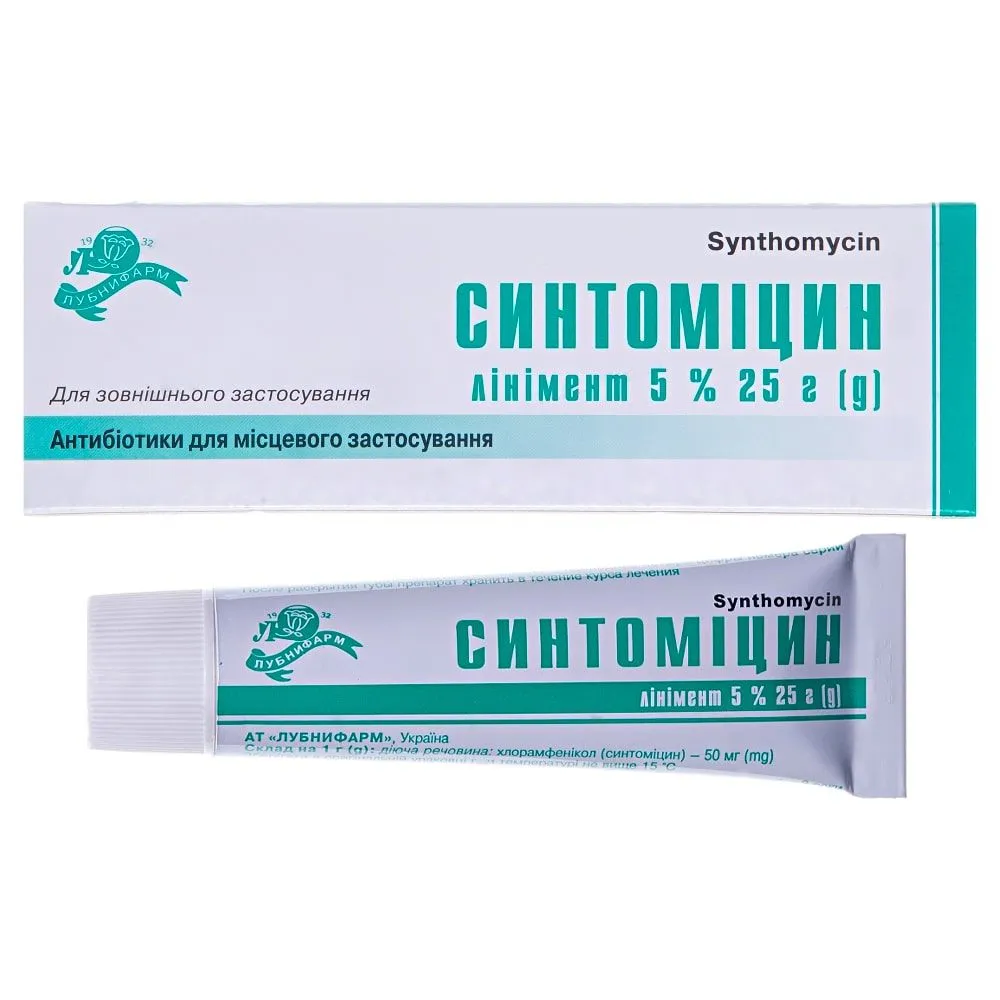
Table of Contents
INSTRUCTIONS for medical use of the medicinal product SYNTHOMYCIN (SYNTHOMYCIN)
Composition:
Active substance: chloramphenicol (synthomycin);
1 g of liniment contains chloramphenicol (synthomycin) — 100 mg;
Excipients: ricinus oil, emulsifier No. 1 (cetyl alcohol, stearyl alcohol), sorbic acid, sodium carboxymethylcellulose, purified water.
Pharmaceutical form. Liniment for topical use.
Main physicochemical properties: liniment of white or whitish-yellowish color.
Pharmacotherapeutic group. Antibiotics and chemotherapeutic agents for dermatological use. Antibiotics for local application. Other antibiotics for local application. Chloramphenicol.
ATC code D06AX02.
Pharmacological Properties
Pharmacodynamics
A broad-spectrum antibiotic. The drug is active against bacterial strains resistant to penicillin, streptomycin, and sulfonamides; against Gram-positive (Staphylococcus spp., Streptococcus spp.) and Gram-negative cocci (Neisseria gonorrhoeae, Neisseria meningitidis), many bacteria (Escherichia coli, Haemophilus influenzae, Salmonella spp., Shigella spp., Klebsiella spp., Serratia spp., Proteus stuartii), Yersinia, rickettsiae, spirochetes, and pathogens of trachoma, psittacosis, and lymphogranuloma venereum, among others. It exerts antimicrobial and antibacterial (bacteriostatic) effects. The mechanism of action is associated with inhibition of microbial protein synthesis. Microbial resistance to chloramphenicol develops relatively slowly.
Pharmacokinetics
When applied topically, it penetrates well into tissues and body fluids. It is excreted mainly in the urine as inactive metabolites, partially also with bile and feces.
Clinical characteristics
Indications. For local treatment of purulent-inflammatory skin lesions (carbuncles, furuncles), purulent wounds, slowly healing trophic ulcers, burns of II–III degree, and nipple fissures in postpartum women.
Contraindications. Individual hypersensitivity to the components of the medicinal product, history of allergy or toxic reactions (dyspeptic symptoms, dysbacteriosis, psychiatric disorders) to chloramphenicol, psoriasis, eczema, fungal skin diseases. Not prescribed to children during the first 4 weeks of life.
Interaction with other medicinal products and other types of interactions
Concurrent use of this medicinal product with erythromycin, oleandomycin, nystatin, and levorin enhances the antibacterial activity of the liniment, whereas concurrent use with benzylpenicillin salts reduces it. Chloramphenicol is incompatible with sulfonamides.
The drug is incompatible with cytostatics, diphenyl, barbiturates and pyrazolone derivatives, and ethanol.
Special precautions for use
Before applying the medicinal product, wash the affected area with soap and water and dry thoroughly. The medication should not be used more frequently or for a longer duration than prescribed. If there is no improvement within 1 week, consult a physician.
Avoid contact of the liniment with the eyes. Unsupervised use of this medication in pediatric practice is not allowed — it should be used in children only under medical supervision.
Topical antibacterial agents may lead to skin sensitization and development of hypersensitivity reactions in the future (when these agents are administered topically or systemically).
The medicinal product contains castor oil, which may cause skin reactions, and sorbic acid, which may cause local skin reactions (e.g., contact dermatitis).
Use during pregnancy or breastfeeding
Since the pharmacokinetics of sulfathiazole have not been studied, the medicinal product should be used during pregnancy only with caution and when, in the physician’s opinion, the expected benefit to the mother outweighs the potential risk to the fetus.
Treatment of nipple fissures in postpartum women does not require discontinuation of breastfeeding.
Before breastfeeding, remove any residual medication from the nipple and surrounding skin with a clean cloth, and carefully and thoroughly wash the area.
Ability to influence reaction rate when driving or operating machinery. No effect.
Method of Administration and Dosage
Gauze pads are soaked with the liniment or it is applied in a thin layer directly to the affected area. A regular dressing is then applied over the top, optionally with parchment or compress paper. Dressings are changed depending on indications every 1–3 days, sometimes every 4–5 days. The duration of treatment is determined individually by a physician.
For nipple fissures in nursing mothers, after each feeding the nipples are washed with a 0.25% ammonium spirit solution, then a sterile pad covered with a layer of liniment is applied to the fissure. This rapidly relieves sharp pain sensations, and within 2–5 days after the start of treatment the fissures heal.
Children. Not prescribed for children during the first 4 weeks of life.
Overdose
Symptoms: possible intensification of the drug's adverse effects.
Treatment: symptomatic.
Side effects
Prolonged topical use may often lead to contact sensitization.
Allergic reactions: burning sensation, itching, hyperemia (redness), rashes (papular, urticarial, etc.), swelling, Quincke's edema, and other signs of irritation not observed prior to treatment.
Reporting suspected side effects
Reporting of suspected adverse reactions after marketing authorization of the medicinal product is of great importance. It allows continuous monitoring of the benefit-risk balance of the medicinal product. Medical and pharmaceutical professionals, as well as patients or their legal representatives, are encouraged to report all suspected adverse reactions and lack of efficacy via the Automated Information System of Pharmacovigilance at the following link: https://aisf.dec.gov.ua.
Shelf life. 2 years.
Do not use after the expiry date stated on the packaging.
Storage conditions
Store in the original packaging at a temperature not exceeding 25 °C.
Keep out of reach of children.
Packaging. 25 g in tubes; 1 tube per cardboard box.
Availability. Over-the-counter (without prescription).
Manufacturer. JSC "Lubnipharm".
Manufacturer's address and location of business activity. 16, Barvinkova Street, Lubny, Poltava region, 37500, Ukraine.