Strepsils® plus
Ukraine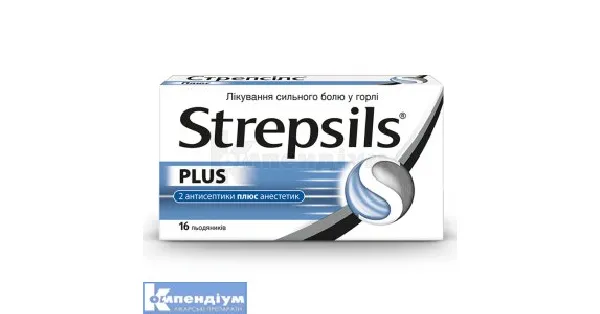
Table of Contents
INSTRUCTIONS FOR MEDICAL USE OF THE MEDICINAL PRODUCT STREPSILS® PLUS (STREPSILS® PLUS)
Composition:
Active substances: lidocaine hydrochloride, amylobarbitone, 2,4-dichlorobenzyl alcohol.
One lozenge contains: lidocaine hydrochloride 10 mg; amylobarbitone 0.6 mg; 2,4-dichlorobenzyl alcohol 1.2 mg;
Excipients: levomenthol, peppermint oil, star anise oil, tartaric acid, sodium saccharin, sucrose solution, glucose solution, quinoline yellow (E 104), indigotine (E 132).
Pharmaceutical form. Lozenges.
Main physicochemical characteristics: round lozenge of pale blue-green color with embossing in the form of the letter S on both sides.
Pharmacotherapeutic group.
Preparations used in throat disorders. Antiseptics. Dichlorobenzyl alcohol. ATC Code R02A A03.
Pharmacological properties.
Pharmacodynamics.
2,4-dichlorobenzyl alcohol and amylmetacresol have antiseptic properties. Lidocaine is an amide-type local anaesthetic whose action results in reversible loss of sensation by preventing the generation and transmission of sensory nerve impulses at the site of application or by reducing them. Neuronal membrane depolarization and ion exchange are reversibly inhibited. Analgesic effect is achieved by blocking neuronal conduction.
Pharmacokinetics.
Lidocaine is readily and rapidly absorbed from the mucous membranes. The plasma half-life of the drug is approximately 2 hours. Lidocaine is metabolized in the liver, forming active metabolites, including glycinexylidide. Less than 10% of lidocaine is excreted unchanged by the kidneys. Metabolites are also excreted in the urine.
2,4-dichlorobenzyl alcohol is metabolized in the liver to form hippuric acid, which is excreted in the urine. There is no available data on the metabolism and elimination of amylmetacresol.
Clinical characteristics.
Indications.
Symptomatic treatment of infections of the oral cavity and throat, including severe sore throat.
Contraindications.
Hypersensitivity to any component of the medicinal product or to other amide local anesthetics.
Fructose intolerance, glucose-galactose malabsorption syndrome, sucrase-isomaltase deficiency.
History of methemoglobinemia or suspicion of methemoglobinemia.
Bronchial asthma or bronchospasm.
Interaction with other medicinal products and other forms of interaction.
Theoretically possible interactions with lidocaine, although clinically significant effects on patient safety are unlikely with local application of the medicinal product.
The toxicity of oral lidocaine may be increased when the medicinal product is taken concomitantly with the following agents:
- erythromycin;
- itraconazole;
- cimetidine;
- fluvoxamine;
- beta-blockers;
- other antiarrhythmic agents (e.g., mexiletine).
Special precautions for use
If symptoms persist for more than 3 days, are accompanied by high fever, headache or other symptoms, consult a physician.
The product may cause numbness of the tongue; therefore, food and drinks should be consumed cautiously after taking the product.
Diabetic patients should be aware that one Strepsils® Plus lozenge contains approximately 2.6 g of sugar.
The product should not be used immediately before or during eating to prevent food from entering the airways due to the local anesthetic effect of lidocaine.
The product may cause mild transient disturbances of taste sensation; therefore, caution should be exercised when consuming hot food and drinks.
The local analgesic effect of lidocaine may cause temporary numbness of the oral cavity and pharynx and may also affect the swallowing process.
Use with caution in patients with erosive or desquamative mucosal lesions, or large fresh wounds in the oral cavity and pharynx.
Do not exceed the recommended doses.
Use during pregnancy or breastfeeding
Pregnancy
The safety of this medicinal product during pregnancy has not been established. However, available data in pregnant women (300–1000 pregnancy cases) indicate no evidence of malformations or fetal/neonatal toxicity associated with lidocaine. There are no or only limited data on the use of amylocresol and 2,4-dichlorobenzyl alcohol in pregnant women.
Therefore, this medicinal product is not recommended during pregnancy except under medical supervision.
Breastfeeding period
Lidocaine/metabolites are excreted in breast milk, but when the product is used at therapeutic doses, no effect on neonates/infants during breastfeeding is expected. It is unknown whether amylocresol and 2,4-dichlorobenzyl alcohol or their metabolites are excreted in breast milk. The risk to neonates/infants cannot be excluded. Therefore, this medicinal product is not recommended during breastfeeding except under medical supervision.
Fertility
There are no data on the effects of the active substances on fertility.
Ability to affect reaction speed while driving or operating machinery
There have been no reports on the effect on the ability to drive or operate machinery.
Dosage and Administration.
Use the lowest effective dose for the shortest duration necessary to relieve symptoms.
Recommended for adults and children aged 12 years and older.
Use one lozenge every 2 hours as needed.
The lozenge must be slowly dissolved in the mouth until completely dissolved. Do not use more than 8 lozenges within 24 hours. Dose adjustment is not required for elderly patients.
Children.
Not recommended for children under 12 years of age.
Overdose.
Due to the lozenge formulation, accidental or intentional overdose is highly unlikely. Overdose primarily causes excessive numbness of the upper gastrointestinal tract and may manifest as gastrointestinal discomfort symptoms. In such cases, discontinue use of the medicinal product. Treatment of potentially toxic overdose should be symptomatic and supportive, and carried out under medical supervision.
Significant lidocaine overdose affects the nervous and cardiovascular systems and may lead to severe hypotension, asystole, bradycardia, apnea, seizures, coma, cardiac arrest, respiratory arrest, and death. It may also cause methemoglobinemia. Methemoglobinemia is treated by immediate intravenous administration of 1–4 mg/kg methylene blue.
Adverse Reactions
The adverse reactions listed below were observed during short-term use of 2,4-dichlorobenzyl alcohol and amylmetacresol at over-the-counter doses. Additional adverse effects may occur with long-term treatment of chronic conditions.
Adverse reactions associated with the use of 2,4-dichlorobenzyl alcohol and amylmetacresol are listed by system organ class and frequency of occurrence. Frequency is defined as follows: very common (≥1/10), common (≥1/100 to <1/10), uncommon (≥1/1,000 to <1/100), rare (≥1/10,000 to <1/1,000), very rare (<1/10,000), and frequency not known (cannot be estimated from available data). Within each frequency grouping, adverse reactions are listed in order of decreasing severity.
| System organ class |
Frequency |
Adverse reactions |
| Immune system disorders |
Unknown |
Hypersensitivity1, anaphylactic reactions, allergic reactions including rash, burning sensation in the mouth or throat and swelling of the mouth and throat, urticaria, angioneurotic edema. |
| Blood and lymphatic system disorders |
Unknown |
Methemoglobinemia. |
| Skin and subcutaneous tissue disorders |
Unknown |
Rash, pruritus. |
| Gastrointestinal disorders |
Unknown |
Nausea, oral discomfort, abdominal pain, stomatitis, dyspepsia, pyrosis. |
| Nervous system disorders |
Unknown |
Dysgeusia. |
1 Hypersensitivity reactions to lidocaine may manifest as rash, angioedema, urticaria, bronchospasm, and hypotension with loss of consciousness, including swelling of the face, neck, throat, or tongue, which may affect breathing.
Shelf life.
3 years.
Storage conditions.
Store at a temperature not exceeding 25 °C.
Keep out of reach of children.
Packaging.
8 lozenges in a blister; 2 blisters in a cardboard box.
Dispensing category.
Over-the-counter (without prescription).
Manufacturer.
Reckitt Benckiser Healthcare International Limited.
Manufacturer's location and address of place of business.
Nottingham site, Tay Road, Nottingham, NG90 2DB, United Kingdom.