Spironolactone
Ukraine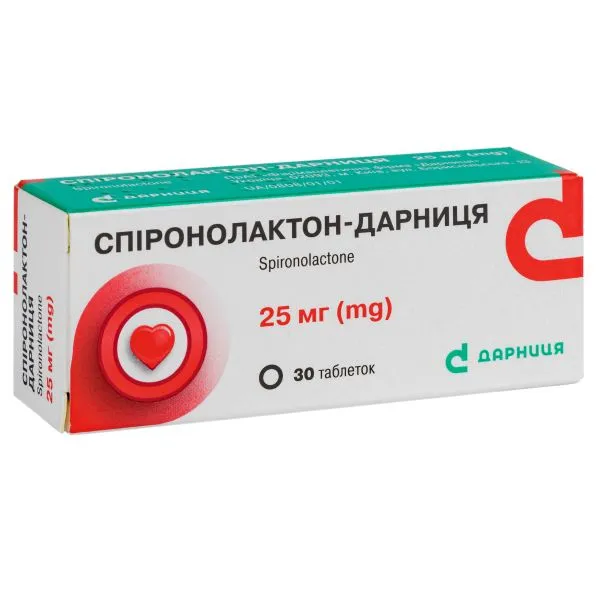
Table of Contents
INSTRUCTIONS FOR MEDICAL USE OF THE MEDICINAL PRODUCT C SPIRONOLACTONE (SPIRONOLACTONE)
Composition:
Active substance: spironolactone;
One tablet contains 25 mg, 50 mg, or 100 mg of spironolactone;
Excipients:
tablets of 25 mg and 100 mg: calcium sulfate dihydrate, corn starch, povidone 30, magnesium stearate, mint flavor, Opadry White 03F180011 [hypromellose, polyethylene glycol 8000, titanium dioxide (E 171)], iron oxide yellow (E 172);
tablets of 50 mg: calcium sulfate dihydrate, corn starch, povidone 30, magnesium stearate, mint flavor, Opadry White 03F180011 [hypromellose, polyethylene glycol 8000, titanium dioxide (E 171)].
Pharmaceutical form. Coated tablets.
Main physicochemical properties:
tablets of 25 mg and 100 mg: coated tablets, from pale yellow to yellow in color, straight solid cylinders with convex end surfaces;
tablets of 50 mg: coated tablets, white or almost white, straight solid cylinders with convex end surfaces.
Pharmacotherapeutic group. Cardiovascular system agents. Diuretics. Aldosterone antagonists and other potassium-sparing agents. Aldosterone antagonists. Spironolactone.
ATC code C03DA01.
Pharmacological Properties
Pharmacodynamics
Spironolactone is a specific antagonist of aldosterone, acting primarily through competitive binding to receptors at the aldosterone-dependent site of sodium-potassium exchange in the distal renal tubules. Spironolactone acts as a potassium-sparing diuretic, promoting enhanced excretion of sodium and water while retaining potassium and magnesium.
By acting on the distal segments of the renal tubules, spironolactone enhances the effect of conventional diuretics, which primarily act in the proximal segment, thereby increasing sodium delivery to the distal segment. Under the influence of aldosterone, sodium is reabsorbed in the distal tubular segment in exchange for potassium, thus reducing diuresis. Diuretics themselves may affect glucose and uric acid metabolism. The diuretic effect of spironolactone develops gradually and reaches its maximum on day 3. After discontinuation of therapy, the diuretic effect persists for another 2–3 days.
Pharmacokinetics
Absorption
Food increases the bioavailability of spironolactone by enhancing absorption and possibly reducing its metabolism during first-pass through the body.
Bioavailability is > 90%.
After administration of 100 mg spironolactone daily for 15 days to healthy volunteers after food intake, the tmax was 2.6 hours, Cmax was 80 ng/mL, and t1/2 was 1.4 hours. For the metabolite 7-alpha-(thiomethyl)spironolactone, tmax was 3.2 hours, Cmax was 391 ng/mL, and t1/2 was 13.8 hours; for canrenone, tmax was 4.3 hours, Cmax was 181 ng/mL, and t1/2 was 16.5 hours.
Distribution
Plasma protein binding of spironolactone and canrenone exceeds 90%.
Metabolism
After oral administration, spironolactone is rapidly and completely metabolized.
The two main active metabolites of spironolactone are canrenone and 7-alpha-(thiomethyl)spironolactone.
Elimination
Spironolactone and its metabolites are excreted primarily in the urine and to a lesser extent in bile and feces.
Spironolactone and its metabolites cross the placental barrier. Canrenone passes into breast milk.
Clinical characteristics.
Indications.
Essential hypertension
Spironolactone should be prescribed in combination with other antihypertensive agents when conventional treatments are ineffective or cause undesirable effects.
Hypertension
In cases of increased aldosterone secretion, hypokalemia, and metabolic alkalosis.
Edema in heart failure
Especially in patients receiving digitalis therapy and in patients at risk of diuretic-induced hypokalemia.
Cirrhosis of the liver with ascites
This condition is often associated with very high levels of aldosterone.
Nephrotic syndrome
When conventional measures such as restriction of water and salt intake, and therapy with conventional diuretics, do not yield the desired result.
Idiopathic edema
In the presence of secondary hyperaldosteronism.
Primary hyperaldosteronism
Diagnosis and treatment.
Contraindications.
Spironolactone is contraindicated:
- in acute renal failure;
- in severe renal impairment (creatinine clearance < 30 mL/min);
- in anuria;
- in Addison's disease;
- in hyperkalemia;
- in hyponatremia;
- when used concomitantly with eplerenone;
- in hypersensitivity to spironolactone or to any of the excipients in the medicinal product;
- during pregnancy or breastfeeding.
Interaction with other medicinal products and other forms of interaction.
Combining spironolactone with potassium supplements, potassium-sparing diuretics such as amiloride, triamterene, potassium-containing salt substitutes, angiotensin-converting enzyme (ACE) inhibitors, angiotensin II receptor antagonists, aldosterone receptor antagonists, eplerenone, heparin, low molecular weight heparins, indomethacin, trimethoprim, and other hyperkalemic agents may lead to the development of life-threatening hyperkalemia (see section "Special precautions for use").
Spironolactone may enhance the effect of other diuretics and antihypertensive agents. Therefore, it may be necessary to reduce their dosage when spironolactone is administered.
Noradrenaline and adrenaline: spironolactone reduces vascular sensitivity to noradrenaline and adrenaline. This should be taken into account during local or general anesthesia using these agents.
Digoxin: spironolactone may prolong the half-life of digoxin; therefore, when these drugs are used concomitantly, digoxin doses should be reduced. In addition, the patient's condition should be closely monitored to prevent digitalis intoxication.
Effect of the drug on laboratory test results: may interfere with the determination of digoxin plasma concentration by radioimmunoassay methods and cause falsely elevated values, and may also interfere with cortisol measurement.
Nonsteroidal anti-inflammatory drugs (NSAIDs): in some patients, the use of NSAIDs (e.g., aspirin, indomethacin, and mefenamic acid) may reduce the diuretic, natriuretic, and antihypertensive effects of diuretics due to inhibition of intrarenal prostaglandin synthesis. It has also been shown that NSAIDs reduce the diuretic effect of spironolactone. Concomitant use of NSAIDs and spironolactone increases the risk of hyperkalemia.
Antipyrine: spironolactone stimulates the metabolism of antipyrine.
ACE inhibitors and furosemide: concomitant use of spironolactone, ACE inhibitors, and furosemide may lead to acute renal failure.
Ammonium chloride, cholestyramine: hyperkalemic metabolic acidosis has been reported with concomitant administration of spironolactone with ammonium chloride or cholestyramine.
Carbenoxolone: concomitant use of spironolactone and carbenoxolone may reduce the efficacy of both drugs.
Neomycin may delay absorption of spironolactone.
Abiraterone: when used concomitantly, spironolactone binds to the androgen receptor and may increase prostate-specific antigen (PSA) levels in patients with prostate cancer receiving abiraterone. Concomitant use with abiraterone is not recommended.
Mitotane: spironolactone may reduce plasma levels of mitotane in patients with adrenocortical carcinoma receiving mitotane therapy.
Special precautions for use.
During treatment with spironolactone, concomitant use of potassium supplements, diets high in potassium, other potassium-sparing diuretics, potassium-containing salt substitutes, angiotensin-converting enzyme (ACE) inhibitors, nonsteroidal anti-inflammatory drugs (NSAIDs), angiotensin II receptor antagonists, aldosterone receptor antagonists, heparin or low molecular weight heparins, trimethoprim, or other drugs or conditions that may cause hyperkalemia, can lead to severe hyperkalemia, especially in patients with renal impairment.
In some patients with decompensated liver cirrhosis, even with normal renal function, reversible hyperchloremic metabolic acidosis, usually associated with hyperkalemia, has been observed.
Caution is advised in patients predisposed to acidosis and/or hyperkalemia due to underlying disease (e.g., diabetes mellitus).
Periodic monitoring of serum electrolytes and renal function is recommended, especially in elderly patients and/or patients with pre-existing renal or hepatic impairment, due to the risk of developing hyperkalemia, hyponatremia, and transient increases in blood urea nitrogen (BUN).
Additionally, caution is required in cases of mild renal impairment (serum creatinine from 1.2 mg/100 mL to 1.8 mg/100 mL or creatinine clearance from 30 mL/min to 60 mL/min), arterial hypotension, and hypovolemia.
Excessively rapid weight loss should be avoided.
Hyperkalemia in patients with severe heart failure
Hyperkalemia can be life-threatening. In patients with severe heart failure, serum potassium levels must be monitored.
The use of potassium-sparing diuretics should be avoided. Oral potassium supplements should also be avoided in patients with serum potassium levels above 3.5 mmol/L. Monitoring of serum potassium and creatinine is recommended one week after initiation of treatment or dose increase, then monthly for the first three months, followed by four times a year for one year, and thereafter every six months. Treatment should be discontinued or interrupted if serum potassium exceeds 5 mmol/L or if serum creatinine exceeds 4 mg/dL.
Use during pregnancy or breastfeeding
Pregnancy
In animal studies, feminization of male offspring genital organs was observed with spironolactone. Therefore, the drug should not be used during pregnancy unless absolutely necessary.
Breastfeeding
Canrenone, a metabolite of spironolactone, may pass into breast milk. Therefore, spironolactone is not recommended for nursing mothers. If treatment is necessary, breastfeeding should be discontinued.
Ability to affect reaction speed when driving or operating machinery
Somnolence and dizziness have been observed in some patients, especially at the beginning of treatment. Therefore, caution should be exercised when driving or operating machinery, particularly at the start of therapy, until the patient's response to the drug is known.
Method of Administration and Dosage
Spironolactone is generally prescribed in combination with conventional diuretics, as the full effect of spironolactone may not be evident until at least the third day of treatment. Adults may take the daily dose as a single dose or divided into several doses. The maintenance dose should always be individually adjusted.
Essential Hypertension
The usual initial dose for adults is 50–100 mg daily as a single dose or divided into two doses and it is advisable to administer spironolactone in combination with other antihypertensive agents. In severe cases, the dose may be increased at 2-week intervals up to 200 mg daily. The therapeutic response should be evaluated no earlier than 2 weeks after initiation of treatment, as the effect of spironolactone often appears with a delay. Subsequently, individual dose adjustment is required. During prolonged spironolactone therapy, dose reduction is always indicated.
Adjunctive Therapy in Arterial Hypertension Associated with Increased Aldosterone Secretion, Hypokalemia, and Metabolic Alkalosis
In combination with other antihypertensive agents, the initial dose is 100 mg daily. If necessary, the dose may be increased to 200 mg daily over a period of 2 weeks.
Edema in Heart Failure
The usual dose for adults is 100 mg daily. In complicated cases, the dose may be increased to 200 mg daily. After diuresis has commenced, a dose reduction may be attempted. For maintenance therapy, 25–100 mg daily is usually prescribed (see section "Special Warnings and Precautions for Use" regarding hyperkalemia in patients with severe heart failure).
Cirrhosis of the Liver with Ascites
If the urinary Na/K ratio is greater than 1, the daily dose is 100 mg. If the ratio is less than 1, the dose should be 200–400 mg/day. After body weight has stabilized, the lowest possible dose for maintenance therapy should be selected to prevent any adverse effects of diuretic therapy.
Nephrotic Syndrome
The usual dose is 100–200 mg daily. Spironolactone has no anti-inflammatory effect and does not influence the underlying disease process. Therefore, spironolactone should be used only when fluid and salt restriction and conventional diuretics have proven ineffective.
Idiopathic Edema
100 mg daily.
Diagnosis and Treatment of Primary Hyperaldosteronism
Spironolactone may be used as an initial diagnostic agent in patients on a normal diet when early signs of primary hyperaldosteronism are detected.
Short-term test
400 mg spironolactone daily for 4 days in adults. If serum potassium levels increase during spironolactone administration and decrease after discontinuation, primary hyperaldosteronism should be considered.
Long-term test
400 mg spironolactone daily for 3–4 weeks in adults. Correction of hypokalemia and arterial hypertension suggests possible primary hyperaldosteronism. After further evaluation confirms the diagnosis of hyperaldosteronism, spironolactone may be prescribed at doses of 100–400 mg daily in preparation for surgery.
In inoperable patients, the spironolactone dose should be individually titrated to the lowest effective dose.
Hypokalemia
To correct potassium deficiency caused by diuretic therapy, or when oral potassium supplementation is contraindicated: 25–100 mg daily.
Children.
Edema in Children
The initial dose is 1.5–3.0 mg/kg body weight daily, divided into several doses. Dosage should be adjusted according to treatment response and tolerability.
A suspension can be prepared by crushing 25 mg spironolactone tablets, dissolving them in a small amount of glycerin, and then diluting in syrup. The stability of the suspension is guaranteed for 1 month when stored in a refrigerator.
Overdose.
Symptoms
Acute spironolactone overdose may cause nausea, vomiting, drowsiness, confusion, maculopapular or erythematous rash, and diarrhea. Electrolyte imbalance (e.g., hyperkalemia, hyponatremia) or dehydration may occur.
Cardiac conduction disturbances may also develop (e.g., atrioventricular block, atrial fibrillation, ventricular fibrillation, cardiac arrest) along with ECG changes (tall T waves and progressive widening of the QRS complex).
Treatment
Symptomatic and supportive measures are required. Induce vomiting or perform gastric lavage. There is no specific antidote. Treat dehydration, electrolyte imbalance, and hypotension with standard therapies. Hyperkalemia may be managed by rapid administration of glucose (20–50%) and regular insulin (0.25–0.5 IU per gram of glucose). Potassium-wasting diuretics and ion-exchange resins may also be used. Spironolactone administration should be discontinued and potassium intake restricted (including potassium-containing foods).
Adverse reactions.
The most commonly reported adverse reactions in patients receiving spironolactone were hyperkalemia and gynecomastia. All medically significant adverse reactions observed in clinical trials and during post-marketing use of spironolactone are listed below by organ system according to the Medical Dictionary for Regulatory Activities (MedDRA), using MedDRA frequency definitions: very common (≥ 1/10), common (≥ 1/100 to < 1/10), uncommon (≥ 1/1,000 to < 1/100), rare (≥ 1/10,000 to < 1/1,000), very rare (< 1/10,000), frequency not known (cannot be estimated from the available data).
Benign, malignant and unspecified neoplasms (including cysts and polyps): uncommon — in males: benign breast neoplasms.
Blood and lymphatic system disorders: rare — leukopenia (including agranulocytosis), thrombocytopenia, eosinophilia in patients with hepatic cirrhosis.
Metabolism and nutrition disorders: uncommon — life-threatening hyperkalemia (see adverse reactions in the cardiac system below), hyponatremia, acidosis (spironolactone may induce or exacerbate hyperchloremic metabolic acidosis), increased blood urea or blood nitrogen levels and creatinine, elevated uric acid levels.
Hyponatremia may occur, particularly after excessive fluid intake. Electrolyte imbalances may manifest as cardiac arrhythmias, fatigue, generalized muscle weakness, muscle cramps (e.g., leg cramps), or dizziness.
Nervous system disorders: common — confusion, dizziness; uncommon — headache, somnolence, lethargy, ataxia.
Cardiac disorders: common — dangerous hyperkalemia (especially in patients with impaired renal function), which may lead to cardiac arrhythmias and hyperkalemic paralysis.
Vascular disorders: rare — vasculitis.
Gastrointestinal disorders: common — nausea; uncommon — gastrointestinal disturbances such as diarrhea and cramps, vomiting; rare — gastritis, gastric mucosal hemorrhage, ulcers.
Hepatobiliary disorders: rare — jaundice, hepatitis, hepatotoxicity with elevated liver enzymes.
Skin and subcutaneous tissue disorders: common — pruritus, erythematous or maculopapular rash; uncommon — erythema annulare, urticaria, alopecia, hypertrichosis, hirsutism, lupus-like or lichenoid skin changes; frequency not known — Stevens-Johnson syndrome, toxic epidermal necrolysis, drug reaction with eosinophilia and systemic symptoms (DRESS syndrome).
Musculoskeletal and connective tissue disorders: common — leg muscle cramps; rare — osteomalacia.
Renal and urinary disorders: common — acute renal failure.
Reproductive system and breast disorders: common — predominantly reversible gynecomastia (incidence depends on dose and duration of treatment), mastodynia in males; uncommon — erectile dysfunction, impotence, decreased sperm motility and count, libido changes; in females: irregular menstruation or amenorrhea, postmenopausal bleeding, mastodynia.
General disorders and administration site conditions: common — malaise; frequency not known — fever. In some cases, irreversible voice changes may occur, such as hoarseness, and in females — also deepening of voice.
Reporting of adverse reactions. Reporting of adverse reactions after marketing authorization is highly important. It allows continuous monitoring of the benefit-risk balance of the medicinal product. Medical and pharmaceutical professionals, as well as patients or their legal representatives, are encouraged to report all suspected adverse reactions and lack of efficacy through the Automated Pharmacovigilance Information System at the following link: https://aisf.dec.gov.ua.
Shelf life. 3 years.
Storage conditions. Store in the original packaging at a temperature not exceeding 30 °C. Keep out of reach of children.
Packaging. 10 tablets per blister; 2, 3, or 5 blisters per cardboard box.
Prescription status. Prescription only.
Manufacturer. JSC "Tekhnolohiya".
Manufacturer's address and location of business activity. 8 Stara Prorizna Street, Uman, Cherkasy Oblast, 20300, Ukraine.