Solehum® forte
Ukraine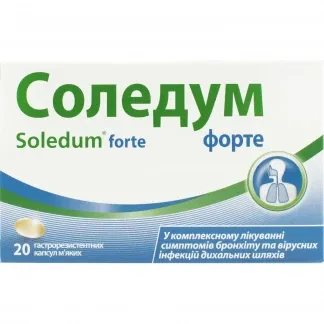
Table of Contents
INSTRUCTIONS FOR MEDICAL USE OF THE MEDICINAL PRODUCT SOLEDUM® FORTE (SOLEDUM® FORTE)
Composition:
Active substance: cineole;
1 gastro-resistant soft capsule contains 200 mg of cineole;
Excipients:
capsule contents: medium-chain triglycerides;
capsule shell: gelatin; glycerin (85%); non-crystallizing sorbitol solution (E 420);
film coating: ethylcellulose; ammonium hydroxide; medium-chain triglycerides; oleic acid; sodium alginate; stearic acid; candelilla wax.
Pharmaceutical form. Gastro-resistant soft capsules.
Main physicochemical characteristics: soft transparent yellowish gelatin capsules, size 6.
Pharmacotherapeutic group. Expectorants.
ATC Code R05C A13.
Pharmacological properties.
Pharmacodynamics.
Soledum**®** forte is an anti-inflammatory and mucolytic medicinal product used as an adjunctive therapy for respiratory tract diseases.
Cineole is the main component of eucalyptus oil. It stimulates expectoration and secretion, as well as exerts a mild hyperemic and local analgesic effect. Clinical studies have demonstrated enhanced mucociliary clearance with cineole administration within the therapeutic dose range. The expectorant effect is considered to be associated with positive influence on subjective parameters such as sputum production and dyspnea. In addition, a weak spasmolytic effect of cineole has been observed. In vitro studies have shown inhibition of leukotriene B4 production in monocytes and suppression of other inflammatory mediators. Bronchial hyperreactivity was reduced.
Pharmacokinetics.
Data regarding cineole metabolism have been obtained solely from animal experiments. In rabbits, cineole is metabolized to 2- and 3-hydroxy-cineole glucuronides. There is no data available on the biological activity of these metabolites. Cineole is extensively absorbed from the gastrointestinal tract. It is partially eliminated via exhaled air from the lungs and partially via the kidneys after hepatic metabolism. In rodents, high doses induce microsomal enzymes.
Clinical characteristics.
Indications.
As part of complex treatment of symptoms of bronchitis and viral respiratory tract infections.
Adjunctive therapy of chronic and inflammatory respiratory tract diseases (e.g. paranasal sinuses).
Contraindications.
Solevedum**®** forte is contraindicated in patients with known hypersensitivity to the active substance cineole or to any of the excipients of the medicinal product, in cases of whooping cough, croup, and in children under 12 years of age.
Interaction with other medicinal products and other forms of interaction.
In animal experiments, cineole stimulated liver enzyme metabolism. For this reason, high doses of cineole may reduce the efficacy and/or duration of action of other medicinal products. However, such an effect has not been observed in humans when cineole is used appropriately.
Special precautions for use.
Soleum**®** Forte should be used with particular caution in any condition associated with marked increased sensitivity of the respiratory tract. In patients with bronchial asthma, treatment with Soleum**®** Forte should be administered only under medical supervision.
Soleum**®** Forte should not be used in patients with rare inherited fructose intolerance.
If you have been diagnosed with intolerance to certain sugars, consult your doctor before taking this medicinal product.
If symptoms of illness persist for more than one week, or if dyspnea, malaise, or purulent or bloody sputum occur, seek immediate medical advice.
Use during pregnancy or breastfeeding.
Pregnancy
Scientific studies on the use of Soleum**®** Forte in pregnant women have not been conducted. Soleum**®** Forte may be prescribed during pregnancy only after careful assessment of the risk-benefit ratio.
Breastfeeding
Due to the lipophilic properties of the active ingredient, penetration of cineole into breast milk cannot be excluded. However, no systematic studies have been conducted in this regard, particularly regarding the potential development of adverse drug reactions. Essential oils may alter the taste of milk and cause feeding difficulties. Women who are breastfeeding should consult their doctor before starting treatment with Soleum**®** Forte.
Ability to influence reaction rate when driving or operating machinery.
Soleum**®** Forte does not affect the ability to drive or operate machinery.
Method of administration and dosage.
Dosage
| Age |
Single dose |
Total daily dose |
| Adolescents from 12 years and adults |
1 capsule (equivalent to 200 mg cineole) |
2–4 capsules (equivalent to 400–800 mg cineole) |
Adolescents from 12 years of age and adults: 1 capsule three times a day.
In particularly severe cases: 1 capsule four times a day.
For prolonged and continuous treatment, a dose of 1 capsule twice daily is usually sufficient.
Soleum® Forte can be safely used in diabetes mellitus. For patients with diabetes mellitus, it should be noted that one capsule of Soleum**®** Forte is equivalent to 0.0015 bread units.
Method of administration
Soleum**®** Forte capsules should be swallowed whole with a sufficient amount of non-hot liquid of moderate temperature (preferably one glass [200 ml] of drinking water), approximately 30 minutes before meals. For patients with increased gastric sensitivity, it is recommended to take Soleum**®** Forte during meals.
The patient should consult a physician if symptoms persist after more than one week of treatment, or if dyspnea, fever, or purulent or bloody sputum occur. The duration of therapy depends on the nature, severity, and course of the disease.
Children.
Children from 12 years of age: 1 capsule three times daily.
Overdose.
There are no specific data regarding cineole. In cases of intoxication with high doses of eucalyptus oil of unknown purity (average lethal dose upon oral administration – 20 g), neurological disturbances may occur, such as: confusion, fatigue, limb weakness, miosis, and in more severe cases – coma and respiratory system disorders.
Rapid regression of symptoms and return to the initial condition is expected, due to the rapid elimination of the substance from the body. Further treatment options for Soleum**®** Forte poisoning depend on the severity, course, and clinical signs of the condition in each individual case.
Adverse reactions.
The adverse reactions are listed below according to the frequency of occurrence: very common (≥ 1/10), common (≥ 1/100 to < 1/10), uncommon (≥ 1/1,000 to < 1/100), rare (≥ 1/10,000 to < 1/1,000), very rare (< 1/10,000), frequency not known (cannot be estimated from the available data).
Immune system disorders: rare – hypersensitivity reactions (e.g. facial swelling, itching, hives, cough) and dysphagia.
If any signs of hypersensitivity occur, treatment with Solenum**®** forte should be discontinued immediately.
Gastrointestinal disorders: uncommon – gastrointestinal discomfort, such as nausea, diarrhea; rare – dysphagia.
Shelf life. 60 months.
Storage conditions. Store at a temperature not exceeding 30 °C in the original packaging. Keep out of the reach of children.
Packaging.
20 gastro-resistant soft capsules in a blister, 1 blister per cardboard box.
25 gastro-resistant soft capsules in a blister, 2 or 4 blisters per cardboard box.
Supply classification. Over-the-counter.
Manufacturer.
Klosterfrau Berlin GmbH
Artesan Pharma GmbH & Co. KG
Address of manufacturing site:
Motzener Strasse 41, 12277 Berlin, Germany
Wendlandstrasse 1, Luechow (Wendland), Lower Saxony, 29439, Germany
Marketing Authorization Holder.
Cassella-med GmbH & Co. KG
Address:
Gereonsmühlengasse 1, 50670 Cologne, Germany