Solantra
Ukraine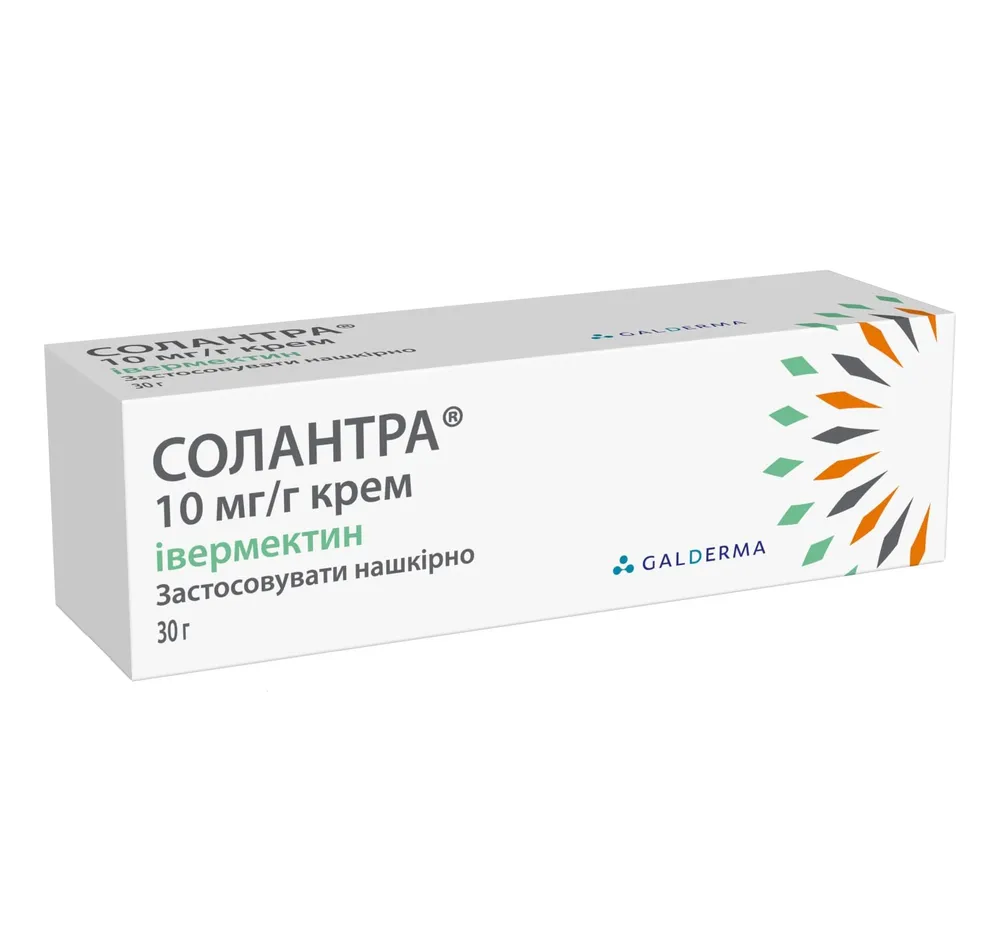
Table of Contents
INSTRUCTIONS for medical use of the medicinal product SОЛАНТРА® (SOOLANTRA®)
Composition:
Active substance: ivermectin;
1 g of cream contains 10 mg of ivermectin;
Excipients: glycerin; isopropyl palmitate; carbomer copolymer type B; dimethicone 20 Cst; disodium edetate; citric acid monohydrate; cetyl alcohol; stearyl alcohol; macrogol cetostearyl ether; sorbitan stearate; methylparahydroxybenzoate (E 218); propylparahydroxybenzoate (E 216); phenoxyethanol; propylene glycol; oleyl alcohol; sodium hydroxide; purified water.
Pharmaceutical form. Cream.
Main physicochemical characteristics: cream ranging from white to pale yellow.
Pharmacotherapeutic group. Dermatologicals. Other dermatologicals.
ATC code: D11AX22.
Pharmacological properties.
Pharmacodynamics.
Mechanism of action
Ivermectin belongs to the class of avermectins. Avermectins exert anti-inflammatory effects by inhibiting lipopolysaccharide-induced production of inflammatory cytokines. Anti-inflammatory properties of ivermectin applied to the skin have been observed in animal models of skin inflammation. Ivermectin also causes death of parasites, primarily by selectively binding with high affinity to glutamate-gated chloride channels located in nerve and muscle cells of invertebrates. The exact mechanism of action of Solantra® cream in the treatment of inflammatory lesions of rosacea is unknown, but it may be related to the anti-inflammatory effect of ivermectin as well as to the death of Demodex mites, which have been reported to be one of the factors contributing to skin inflammation.
Clinical efficacy and safety
In two randomized, double-blind, placebo-controlled clinical studies with identical design, treatment of inflammatory lesions of rosacea with Solantra® cream applied once daily at bedtime was evaluated. A total of 1,371 patients aged 18 years and older participated in the studies, receiving either Solantra® cream or placebo once daily every day for 12 weeks.
Overall, 96% of participants were of Caucasian race, 67% were women. Based on the 5-point Investigator Global Assessment (IGA) scale at baseline, lesions in 79% of participants were rated as moderate (IGA = 3), and 21% as severe (IGA = 4).
Co-primary efficacy endpoints in both clinical studies were the proportion of treatment success based on IGA scale rating (percentage of patients rated as "clear" or "almost clear" at week 12 of the study) and the absolute change in inflammatory lesion count compared to baseline. The IGA scale is based on the definitions provided in Table 1.
Table 1
Investigator Global Assessment (IGA) Scale
| Grade |
Score |
Clinical description |
| Clean |
0 |
No inflammatory lesions, no erythema. |
| Almost clean |
1 |
Very few small papules/pustules, very mild erythema. |
| Mild |
2 |
Occasional small papules/pustules, mild erythema. |
| Moderate |
3 |
Several small or large papules/pustules, moderate erythema. |
| Severe |
4 |
Numerous small and/or large papules/pustules, severe erythema. |
The results of both clinical studies demonstrated that Solantra® cream applied once daily for 12 weeks was significantly superior to placebo in terms of treatment success rate according to the IGA scale and absolute changes in the number of inflammatory lesions (p < 0.001, see Table 2).
The table below presents efficacy outcomes obtained in both studies.
Table 2
Efficacy outcomes
| Assessment parameters |
Study 1 |
Study 2 |
||
| Solantre® |
Placebo (N = 232) |
Solantre® (N = 459) |
Placebo (N = 229) |
|
| Investigator's global assessment |
||||
| Number (%) of participants rated as "clear" or "almost clear" at week 12 |
173 (38.4) |
27 (11.6) |
184 (40.1) |
43 (18.8) |
| Inflammatory lesions |
||||
| Mean number of inflammatory lesions at baseline |
31.0 |
30.5 |
33.3 |
32.2 |
| Mean number of inflammatory lesions at week 12 |
10.6 |
18.5 |
11.0 |
18.8 |
| Mean absolute changes (percentage change) in inflammatory lesion count at week 12 compared to baseline |
-20.5 (-64.9) |
-12.0 (-41.6) |
-22.2 (-65.7) |
-13.4 (-43.4) |
|
|
Solatra® cream demonstrated statistically significant superiority over vehicle cream for the co-primary efficacy endpoints, with treatment efficacy becoming evident at 4 weeks (p < 0.05).
The IGA scale was used to assess patients during the 40-week extension of both clinical trials, and the percentage of patients treated with Solatra® cream who achieved an IGA score of 0 or 1 continued to increase up to week 52. The success rate (IGA = 0 or 1) at week 52 was 71% and 76% in studies 1 and 2, respectively.
The efficacy and safety of this medicinal product for the treatment of inflammatory lesions of rosacea were also evaluated in a randomized, investigator-blinded, active-controlled clinical trial. The study involved 962 patients aged 18 years and older who received treatment with Solatra® cream once daily or metronidazole cream 7.5 mg/g twice daily for 16 weeks. In this study, 99.7% of participants were Caucasian, 65.2% were female; at baseline, 83.3% of participants had moderate (IGA = 3) and 16.7% had severe (IGA = 4) lesions according to the IGA scale.
The results of this study demonstrated that Solatra® cream was statistically superior to metronidazole cream 7.5 mg/g for the primary efficacy endpoint (mean percentage reduction in inflammatory lesion count): after 16 weeks of treatment, reduction compared to baseline was observed in 83.0% and 73.7% of patients in the ivermectin and metronidazole groups, respectively (p < 0.001). The superiority of Solatra® cream at week 16 was also confirmed by the rates of successful treatment according to the IGA scale and absolute changes in inflammatory lesion counts (secondary endpoints; p < 0.001).
Overall, approximately 300 participants aged 65 years and older were included in all clinical trials of this medicinal product. No significant differences in efficacy and safety profiles were observed between elderly patients and those aged 18 to 65 years.
The safety profile described in the "Adverse Reactions" section remained stable during long-term use, as observed during prolonged treatment courses of up to one year.
Treatment with ivermectin in combination with modified-release doxycycline capsules 40 mg.
The relative efficacy of Solatra (IVM) in combination with modified-release doxycycline capsules 40 mg (DMR) versus IVM plus placebo (PBO) in the treatment of severe rosacea was evaluated in the ANSWER clinical trial. This was a 12-week, randomized, double-blind, parallel-group study involving 273 male and female subjects aged ≥18 years with 20–70 inflammatory facial lesions (papules and pustules) and an IGA score of 4.
The primary efficacy endpoint was the percentage change in inflammatory lesion count at week 12 from baseline. A significantly greater mean percentage reduction in inflammatory lesion count was observed in the IVM + DMR group compared to the IVM + PBO group (mean ± standard deviation: -80.29 ± 21.65% vs. -73.56 ± 30.52%; p = 0.032).
Children
The European Medicines Agency has waived the obligation to submit results of studies with Solatra® cream in all pediatric subpopulations with papulopustular rosacea.
Pharmacokinetics.
Absorption
The absorption of ivermectin from Solatra® cream was evaluated in a clinical study in adult participants with severe papulopustular rosacea under conditions of maximal use. At steady state (after 2 weeks of treatment), the highest mean plasma concentration of ivermectin (± standard deviation) was reached within 10 ± 8 hours after dose application (Cmax 2.1 ± 1.0 ng/mL, range 0.7–4.0 ng/mL), and the highest mean (± standard deviation) AUC0-24h was 36 ± 16 ng·h/mL (range: 14–75 ng·h/mL). After two weeks of treatment, systemic exposure to ivermectin reached a plateau (at steady state). During the longest treatment courses in Phase 3 studies, systemic exposure to ivermectin was similar to that observed after two weeks of treatment. At steady state, systemic exposure to ivermectin (AUC0-24h 36 ± 16 ng·h/mL) was lower than exposure after a single oral dose of 6 mg ivermectin in healthy volunteers (AUC0-24h 134 ± 66 ng·h/mL).
Distribution
An in vitro study demonstrated that ivermectin is more than 99% bound to plasma proteins, primarily to human serum albumin. No significant binding of ivermectin to erythrocytes was observed.
Metabolism
In vitro studies using human liver microsomes and recombinant CYP450 enzymes demonstrated that ivermectin is primarily metabolized by CYP3A4 enzymes.
In vitro studies showed that ivermectin does not inhibit the cytochrome P450 isoenzymes 1A2, 2A6, 2B6, 2C8, 2C9, 2C19, 2D6, 3A4, 4A11, and 2E1. In human hepatocyte cultures, ivermectin did not induce expression of CYP450 enzymes (1A2, 2B6, 2C9, and 3A4).
In a clinical pharmacokinetic study with maximal use of ivermectin, two major metabolites were identified and further studied in Phase 2 clinical trials (3’’-O-demethylivermectin and 4α-hydroxyivermectin). Like the parent compound, the metabolites reached steady state after 2 weeks of treatment, with no evidence of accumulation over 12 weeks. Furthermore, systemic exposure to metabolites (measured by Cmax and AUC) at steady state was substantially lower than after oral administration of ivermectin.
Elimination
In a clinical pharmacokinetic study with maximal use of ivermectin in patients who applied the product once daily for 28 days, the terminal elimination half-life averaged 6 days (mean 145 hours, range 92–238 hours). Elimination after topical application of Solatra® cream depends on absorption. The pharmacokinetics of ivermectin in patients with renal or hepatic impairment has not been studied.
Preclinical Safety Data
In repeat-dose animal studies of up to 9 months' duration with topical application of ivermectin cream 10 mg/g, no toxic effects or signs of local toxicity at systemic exposure levels observed during clinical use were detected.
In in vitro and in vivo experiments, ivermectin did not show genotoxic effects. In a two-year carcinogenicity study with topical application of ivermectin cream 10 mg/g in animals, no increased tumor incidence was observed.
In reproductive toxicity studies following oral administration of ivermectin, teratogenic effects were observed in rats (cleft palate) and rabbits (wrist deformities) at high doses (the margin of exposure to NOAEL was at least 70 times higher than with clinical use).
Neonatal toxicity in animal studies following oral administration was related not to in utero exposure, but to postnatal exposure via breast milk, leading to high concentrations of ivermectin in brain tissue and plasma of offspring. Ivermectin cream 10 mg/g caused skin irritation, sensitization, and photo-sensitization in animals, but did not cause photo-toxic effects.
Environmental Risk Assessment (ERA)
Ivermectin is highly toxic to invertebrate animals, and a risk to aquatic environments, sediment, and terrestrial environments has been identified. Appropriate safety measures should be followed to prevent environmental contamination, particularly of aquatic environments.
Clinical characteristics.
Indications.
For topical treatment of inflammatory lesions caused by rosacea (papulopustular form) in adult patients.
Contraindications.
Hypersensitivity to the active substance or to any of the excipients of the medicinal product.
Interaction with other medicinal products and other forms of interaction.
Drug interaction studies have not been conducted.
Concomitant use of Solantra® cream with other medicinal products for topical or systemic treatment of rosacea has not been studied.
In vitro studies have shown that ivermectin is metabolized predominantly by the CYP3A4 enzyme. Therefore, ivermectin should be used with caution in combination with strong CYP3A4 inhibitors, as plasma exposure to the substance may significantly increase.
Special precautions for use
In patients, there may be a temporary exacerbation of rosacea due to the death of Demodex mites, which usually resolves within 1 week with continued treatment.
If the patient's condition worsens to a severe degree with development of pronounced skin reaction, treatment must be discontinued.
The use of Solantra® cream in patients with impaired renal or hepatic function has not been studied.
This medicinal product contains:
- cetyl alcohol and stearyl alcohol, which may cause local skin reactions (e.g. contact dermatitis);
- methylparahydroxybenzoate (E 218) and propylparahydroxybenzoate (E 216), which may cause allergic reactions (possibly delayed);
- propylene glycol, which may cause skin irritation.
Use during pregnancy or breast-feeding
Pregnancy
Data on topical use of ivermectin in pregnant women are lacking or limited. Oral administration of ivermectin in reproductive toxicity studies demonstrated teratogenic effects in animals; however, due to the low systemic exposure following topical application at the recommended dose, the likelihood of harm to the human embryo is considered low. Nevertheless, Solantra® cream is not recommended during pregnancy.
Breast-feeding
After oral administration, ivermectin is excreted in low concentrations into human breast milk. Excretion into human breast milk following topical application has not been studied. Available pharmacokinetic/toxicological data in animals also indicate excretion of ivermectin into breast milk. A risk to the nursing infant cannot be excluded. A decision must be made whether to discontinue breast-feeding or to discontinue/abandon treatment with Solantra® cream, taking into account the benefit of breast-feeding for the child and the benefit of therapy for the woman.
Fertility
There is no information available on the effect of ivermectin on human fertility. In animals, no effect on mating performance or fertility has been observed during treatment with ivermectin.
Ability to affect reaction speed when driving or operating machinery
Solanta® cream has no effect or has a negligible effect on the ability to drive vehicles or operate machinery.
Dosage and Administration
Dosage
Apply the medicinal product once daily every day throughout the entire treatment course, but not for longer than 4 months. The treatment course may be repeated.
Solantara® cream can be used as monotherapy or as part of combination therapy.
If no improvement is observed after 3 months of treatment, discontinue use.
Special Patient Groups
Renal Impairment
Dosage adjustment is not required.
Hepatic Impairment
Use with caution in patients with severe hepatic impairment.
Elderly Patients
No dosage adjustment is required for elderly patients.
Administration
Solantara® cream is for topical use on the facial skin only.
Apply a small amount of the medicinal product (about the size of a pea) to each of the five facial areas: forehead, chin, nose, and both cheeks. Spread the product evenly as a thin layer over the entire face, avoiding the eye area, lips, and mucous membranes.
Hands should be washed immediately after application.
Cosmetics may be applied only after the cream has dried completely.
Children
The safety and efficacy of Solantara® cream in children (under 18 years of age) have not been studied. Data are lacking.
Overdose
No cases of overdose with Solantara® cream have been reported.
In accidental or significant human exposure to unknown amounts of veterinary ivermectin products, via ingestion, inhalation, injection, or dermal contact, the most frequently reported adverse effects include: rash, swelling, headache, dizziness, asthenia, nausea, vomiting, and diarrhea. Other reported adverse reactions include: seizures, ataxia, dyspnea, abdominal pain, paresthesia, urticaria, and contact dermatitis.
In case of accidental ingestion of the medicinal product, supportive therapy should be initiated. As clinically indicated, this may include parenteral administration of fluids and electrolytes, respiratory support (including oxygen and mechanical ventilation, if necessary), and vasopressor agents in the presence of clinically significant hypotension. If necessary, to prevent absorption of the ingested substance, vomiting should be induced artificially and/or gastric lavage performed as soon as possible, along with administration of laxatives and other measures typical for poisoning management.
Adverse reactions.
The most frequently reported adverse reactions were skin burning sensation, skin irritation, pruritus, and dry skin. The incidence of these reactions was ≤ 1% of patients treated with this medicinal product during clinical studies.
These adverse reactions are usually mild or moderate in severity and generally decrease with continued treatment.
No clinically significant difference in the safety profile was observed between patients aged 18–65 years and patients over 65 years of age.
Adverse reactions reported in clinical studies are classified by system organ classes and frequency of occurrence using the following categories: very common (≥ 1/10), common (≥ 1/100 to < 1/10), uncommon (≥ 1/1000 to < 1/100), rare (≥ 1/10000 to < 1/1000), very rare (< 1/10000), frequency not known (cannot be estimated from the available data) (see Table 3).
Table 3
Adverse reactions
| Organ system class |
Frequency |
Adverse reactions |
| Skin and subcutaneous tissue disorders |
Common |
Burning sensation of the skin |
| Uncommon |
Skin irritation, pruritus, dry skin, exacerbation of rosacea* |
|
| Frequency unknown |
Erythema, contact dermatitis (allergic or irritant), facial swelling |
|
| Laboratory investigations |
Frequency unknown |
Elevated transaminase levels* |
* Data obtained during the post-marketing period.
Reporting suspected adverse reactions
Reporting adverse reactions after marketing authorization of a medicinal product is of great importance. It enables continuous monitoring of the benefit-risk balance of the medicinal product. Healthcare and pharmaceutical professionals, as well as patients or their legal representatives, should report all suspected adverse reactions and lack of efficacy of the medicinal product via the Automated Pharmacovigilance Information System at the following link: https://aisf.dec.gov.ua.
Shelf life.
2 years.
After first opening of the tube, the medicinal product is suitable for use for 6 months.
Storage conditions.
No special storage conditions required. Keep out of reach of children.
Packaging.
30 g in a tube; one tube per cardboard box.
Prescription status.
Prescription only.
Manufacturer.
LABORATOIRES GALDERMA.
Manufacturer's address and location of operations.
Z.I. Mondésir, 74540 Albigny-sur-Saône, France.