Soderm
Ukraine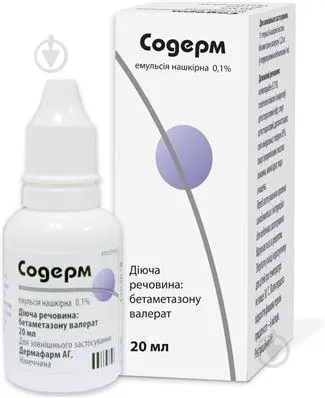
Table of Contents
INSTRUCTIONS FOR MEDICAL USE OF THE MEDICINAL PRODUCT SODERM®
Composition:
Active substance: betamethasone valerate;
1 g of topical emulsion contains betamethasone valerate 1.22 mg (equivalent to betamethasone 1 mg);
Excipients: methylparaben (E 218); polyethylene glycol cetylstearyl ether; cetylstearyl alcohol; diethylene glycol stearate; mineral oil; glycerol 85%; isopropyl alcohol; citric acid monohydrate; purified water.
Pharmaceutical form. Topical emulsion.
Main physicochemical characteristics: emulsion of uniform consistency, white in color.
Pharmacotherapeutic group. Corticosteroids for dermatological use. High-potency corticosteroids (group III). Betamethasone.
ATC code: D07AC01.
Pharmacological Properties
Pharmacodynamics
Betamethasone is a synthetic glucocorticosteroid whose efficacy exceeds that of cortisol by 30 times. This substance has virtually no mineralocorticoid-like activity. Among all corticosteroids, calculated by weight, betamethasone exhibits the highest potency.
At the intracellular level, betamethasone binds to cytoplasmic receptor proteins; this corticosteroid-receptor complex penetrates into the cell nucleus, where it induces the synthesis of mRNA, thereby indirectly promoting the synthesis of specific proteins (e.g., catabolic enzymes, suppressor proteins). This process results in anti-inflammatory effects, manifested as normalization of vascular tone, dissolution of inflammatory infiltrates, breakdown of pathological accumulations in the body, and degradation of autogenous metabolic products. In addition, the processes of neovascularization and cellular proliferation are suppressed, as well as fibroblast formation; acantholysis is also slowed. Concurrently, stabilization of lysosomal membranes contributes to the anti-inflammatory action of betamethasone.
Due to topical application of betamethasone, subjective symptoms such as itching and pain sensation are also suppressed.
Pharmacokinetics
When applied topically, absorption of betamethasone is possible, but this process depends more on the condition of the skin and the method of dressing application than on the applied substance or the drug base.
According to available research data, this may extend to cases where, typically with local or time-limited use of topical corticosteroid-containing medicinal products, no significant systemic absorption of the substance occurs.
The systemic plasma half-life is 5½ hours; plasma protein binding is 64%. The volume of distribution is 1.4 L/kg. Betamethasone crosses the blood-brain barrier, penetrates into plasma, and likely into breast milk. Metabolism of betamethasone occurs primarily in the liver.
With time-limited and localized application of betamethasone-containing preparations, no clinically significant systemic absorption of the substance occurs. In clinical studies with this drug, no systemic adverse effects were observed.
Assessment of cortisol levels did not indicate clinically significant suppression of endogenous cortisol production.
In studies conducted in patients and in placebo-controlled studies in volunteers regarding local tolerance, no specific intolerance reactions were observed.
Clinical characteristics.
Indications.
Treatment of dermatoses sensitive to potent glucocorticosteroid therapy, such as psoriasis; initial treatment of severe atopic eczema.
Contraindications.
- Hypersensitivity to any component of the drug;
- perioral dermatitis;
- anogenital pruritus;
- rosacea;
- varicella (chickenpox);
- vaccination reactions;
- acne;
- specific skin disorders, including cutaneous tuberculosis and syphilis;
- cutaneous infections caused by viruses, bacteria, or fungi.
Do not use in children under 1 year of age. The topical emulsion should also not be used under occlusive conditions, such as under diapers.
Particular caution should be exercised when applying to the facial skin. Therefore, to prevent the development of facial skin changes, prolonged therapy with topical corticosteroids should be avoided whenever possible. Avoid applying the product to the eyelids, as this may cause glaucoma. Glucocorticosteroid-containing products are not intended for use in the eye area.
Interaction with other medicinal products and other types of interactions.
Not known to date.
Special precautions for use.
Enhanced systemic absorption of topical corticosteroids in some individuals may lead to manifestations of hypercortisolism (Cushing's syndrome) and reversible suppression of the hypothalamic-pituitary-adrenal (HPA) axis, followed by adrenal insufficiency.
If suppression occurs, the drug should be discontinued, the frequency of application reduced, or the patient should be switched to a corticosteroid with weaker activity.
Sudden discontinuation of treatment may lead to adrenal insufficiency (see section "Adverse reactions").
Factors increasing the risk of enhanced systemic effects include:
- Potency and formulation of the topical corticosteroid;
- Duration of use;
- Application over large areas of skin;
- Use of occlusive dressings, for example, in intertriginous skin areas, or application under occlusive dressings (in children, diapers may act as occlusive dressings);
- Enhanced hydration of the stratum corneum;
- Application to thin skin, such as facial skin;
- Application to damaged skin or impaired skin barrier;
- In infants and young children, compared to adults, due to the incompletely developed skin barrier and larger body surface area relative to body weight, a higher amount of topical corticosteroids may be absorbed systemically. Therefore, systemic adverse effects are more likely in infants and young children.
Soderm® topical emulsion should be used in children only for short-term treatment (less than 1 week) and over small areas (less than 10% of body surface area). When treating children with corticosteroid preparations, increased caution is required, as corticosteroids may be absorbed through the skin in higher amounts compared to adults.
Long-term treatment in infants and children under 12 years of age should be avoided, as enhanced transdermal absorption—and consequently adrenal suppression—may occur even without the use of occlusive dressings.
Warm, moist conditions in skin folds may promote bacterial infections, or bacterial infections may be caused by the use of occlusive dressings. If occlusive dressings are used, the skin should be cleaned during dressing changes. Topical corticosteroids should be used with caution in psoriasis, as cases of rebound flare-ups (withdrawal syndrome), development of tachyphylaxis, risk of generalized pustular psoriasis, and local or systemic toxicity due to impaired skin barrier have been reported. When using the cream in psoriasis, the patient's condition should be closely monitored.
Treatment of skin disorders with corticosteroids that result in infection requires appropriate antibacterial therapy. If such infection spreads, treatment with topical corticosteroids should be discontinued and the patient should consult a physician who will decide on further specific treatment. This medicinal product must not come into contact with the eyes or mucous membranes when applied to facial areas.
Facial skin is particularly sensitive. To avoid atrophic skin changes, long-term therapy with topical corticosteroids should not be used on the face.
Topical corticosteroids are sometimes used to treat dermatitis around chronic leg ulcers. However, such use may be associated with a higher incidence of local hypersensitivity reactions and an increased risk of local infections.
Visual disturbances
Visual disturbances may occur with both systemic and topical use of corticosteroids. If a patient presents with symptoms such as blurred vision or other visual disturbances, they should be referred to an ophthalmologist for evaluation of possible causes, including cataract, glaucoma, or rare conditions such as central serous chorioretinopathy, which has been reported following systemic or topical corticosteroid use.
Cetostearyl alcohol may cause limited local skin irritation (e.g., contact dermatitis).
Use during pregnancy or breastfeeding.
To date, experience with the use of glucocorticosteroids in humans has not revealed any suspicion of increased risk of abnormal development. During pregnancy, topical corticosteroids should not be used in high doses over large areas or for prolonged periods due to possible systemic effects, which may lead to disturbances in the hypothalamic-pituitary-adrenal axis regulation. Impairment of fetal development and growth should not be excluded. Use of the drug near the end of pregnancy may result in adrenal cortical atrophy in newborns.
During pregnancy, especially during the first 3 months, prolonged topical treatment should be carried out only after careful assessment of benefit versus risk. To date, there are no human data indicating teratogenic effects; however, with prolonged oral administration of glucocorticosteroids, intrauterine growth disturbances should not be ruled out.
When used late in pregnancy, there is a risk of adrenal cortical atrophy in the fetus, which may require gradual initiation of replacement therapy in newborns.
Betamethasone passes into breast milk. No adverse effects in newborns have been reported to date. However, indications for use during breastfeeding should be clearly defined. If during breastfeeding the drug needs to be used in high doses or over a large skin area (covering more than 20% of body surface), breastfeeding should be discontinued. The drug should not be applied to the area of the mammary glands during breastfeeding.
Ability to affect reaction speed when driving or operating machinery.
There is no experience regarding negative effects of the drug on the ability to drive or operate machinery.
Method of Administration and Dosage
At the beginning of treatment, Soderm**®** should be applied 2–3 times daily as a thin layer to affected skin areas and gently rubbed into the skin. When the condition improves, the frequency of application may be reduced to once daily.
In children aged 1 year and older, once-daily application is usually sufficient in most cases.
The preparation should be applied as a thin layer to affected skin areas and, if possible, gently rubbed in. The duration of treatment in adults should not exceed 3–4 weeks; in children, it should not exceed 2 weeks. Longer-term treatment should be prescribed only in exceptional cases when clinically indicated.
Children
Do not use the drug in children under 1 year of age.
Soderm**®** emulsion for topical use should be used in children only for a short duration (less than 2 weeks) and on small areas (less than 10% of body surface area). Particular caution should be exercised when using corticosteroid preparations in children, as, unlike in adults, corticosteroids may be absorbed through the skin in higher amounts.
Long-term treatment should be avoided in infants and children under 12 years of age, since enhanced transdermal absorption—and consequently adrenal suppression—may occur even without the use of occlusive dressings.
Overdose
Acute symptoms of overdose are unlikely. Following overdose or misuse, clinical manifestations of hypercorticism may occur. In such cases, treatment should be discontinued.
Adverse reactions.
The following classification was used to determine the frequency of adverse reactions:
| Very common |
(≥ 1/10) |
| Common |
(≥ 1/100 and < 1/10) |
| Uncommon |
(≥ 1/1000 and < 1/100) |
| Rare |
(≥ 1/10000 and < 1/1000) |
| Very rare |
(< 1/10000) |
| Frequency not known |
(frequency cannot be estimated from the available data) |
Glucocorticosteroid-containing topical preparations are usually well tolerated. However, if signs of hypersensitivity occur, treatment should be discontinued.
Immune system disorders
Allergic skin reactions may occur uncommonly during treatment as prescribed.
Endocrine system disorders
Hypothalamic-pituitary-adrenal (HPA) axis suppression due to percutaneous absorption cannot be excluded. Exacerbation of symptoms may occur, requiring treatment.
Eye disorders
Frequency unknown: blurred vision (see also section "Dosage and administration").
Skin and subcutaneous tissue disorders
After prolonged use (more than 3–4 weeks), use of higher doses, application over large skin areas, particularly under occlusive dressings or in skin folds, and as with all other topical corticosteroids, local skin changes at the site of application such as skin atrophy, telangiectasia, striae, steroid acne, changes in skin pigmentation, and hypertrichosis may occur.
Reporting of suspected adverse reactions
Reporting of suspected adverse reactions during the post-marketing period is very important. It allows ongoing monitoring of the benefit-risk balance of the medicinal product. Healthcare professionals are encouraged to report any suspected adverse reactions.
Shelf life. 3 years.
After first opening of the bottle/tube, shelf life is 6 months.
Storage conditions.
Keep out of reach and sight of children. Store below 30 °C.
Packaging.
20 ml, 50 ml in a bottle; 1 bottle in a cardboard box.
Prescription category. Prescription only.
Manufacturer. mibe GmbH Arzneimittel.
Manufacturer's address and place of business.
Muenchener Strasse 15, Brehna, Saxony-Anhalt, 06796, Germany.