Skinoren
Ukraine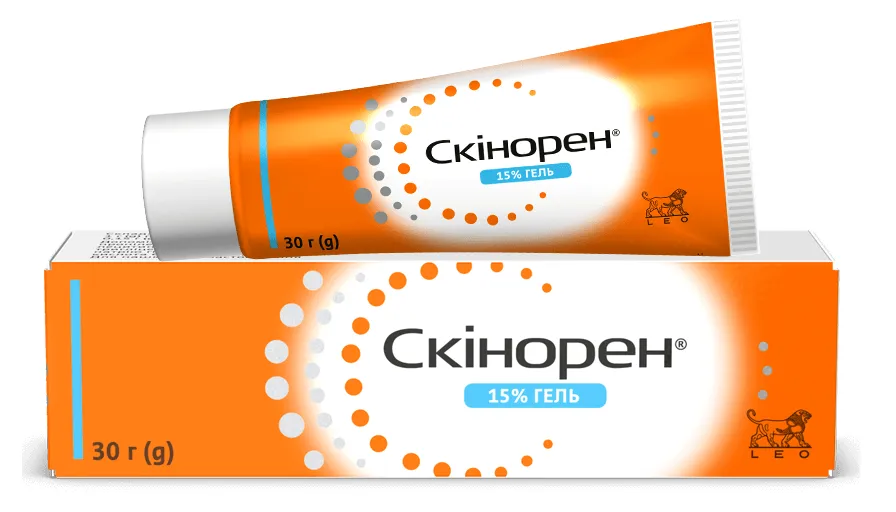
Table of Contents
INSTRUCTIONS FOR MEDICAL USE OF THE MEDICINAL PRODUCT SKINOREN® (SKINOREN®)
Composition:
Active ingredient: azelaic acid;
1 g of gel contains 0.15 g of azelaic acid;
Excipients: propylene glycol, polysorbate 80, lecithin, carbomer 980, medium-chain triglycerides, sodium hydroxide, disodium edetate, benzoic acid, purified water.
Pharmaceutical form. Gel.
Main physicochemical characteristics: opaque gel, white to yellowish-white in color.
Pharmacotherapeutic group.
Topical agents for the treatment of acne. Azelaic acid. ATC code D10AX03.
Pharmacological Properties
Pharmacodynamics
Acne
The therapeutic efficacy of Skinoren® gel in the treatment of acne is believed to be due to its antimicrobial activity and direct effect on follicular hyperkeratosis.
In vitro and in vivo, azelaic acid inhibits keratinocyte proliferation and normalizes the impaired terminal differentiation processes of the epidermis associated with acne.
Clinically, a significant reduction in the density of Propionibacterium acnes colonies and a significant decrease in the proportion of free fatty acids in lipids on the skin surface have been observed.
In two double-blind, randomized clinical studies, Skinoren® gel demonstrated significantly greater efficacy than placebo in reducing the median number of papules and pustules, and was 6% less effective compared to 5% benzoyl peroxide (p=0.056).
In these studies, the efficacy of Skinoren® gel in treating comedones was evaluated as a secondary endpoint. Skinoren® gel was more effective than placebo in reducing the median number of comedones, but less effective than 5% benzoyl peroxide.
Rosacea
Although the pathophysiology of rosacea is not yet fully understood, experts agree that inflammation involves increased levels of various effector molecules (such as kallikrein-5 and cathelicidin), as well as reactive oxygen species (ROS), which participate in pro-inflammatory reactions that are central to this disease.
Azelaic acid has been shown to modulate the inflammatory response in normal human keratinocytes by: activating peroxisome proliferator-activated receptors gamma (PPARγ); inhibiting nuclear factor kappa B (NF-kB) transactivation; inhibiting the production of pro-inflammatory cytokines; and inhibiting the release of reactive oxygen species (ROS) from neutrophils, as well as exerting a scavenging effect on existing ROS.
Furthermore, azelaic acid has been observed to directly inhibit the expression of kallikrein-5 and cathelicidin in three models: in vitro (human keratinocytes), in mouse skin, and in facial skin of patients with rosacea.
These anti-inflammatory properties of azelaic acid may be relevant in the treatment of rosacea.
While the clinical significance of these findings regarding kallikrein-5 and cathelicidin, and their impact on the pathophysiology of rosacea, has not yet been fully demonstrated within a single large-scale clinical trial, it is expected that initial human facial skin studies will confirm the results obtained in vitro and in mice.
In two 12-week placebo-controlled clinical trials of papulopustular rosacea, Skinoren® gel demonstrated statistically significant superiority over placebo in reducing inflammatory lesions based on the investigator’s global assessment and composite score for erythema intensity reduction.
In a clinical study comparing Skinoren® gel with 0.75% metronidazole gel in papulopustular rosacea, Skinoren® showed statistically significant superiority in reducing lesion count (72.7% vs. 55.8%) and in composite score for erythema intensity reduction (56% vs. 42%). The incidence of adverse skin reactions, mostly mild to moderate in severity, was 25.8% with Skinoren® gel and 7.1% with 0.75% metronidazole gel.
During these three clinical studies, no effect on telangiectasia was observed.
Pharmacokinetics
After topical application, azelaic acid penetrates all layers of human skin. Penetration occurs more rapidly in damaged skin than in intact skin. Overall, after a single topical application of 1 g of azelaic acid (5 g of 20% cream), 3.6% of the dose is absorbed through the skin. Clinical studies in acne patients have shown similar absorption rates of azelaic acid for both Skinoren® gel and cream.
A portion of the azelaic acid absorbed through the skin is excreted unchanged in urine. The remainder is metabolized via β-oxidation into shorter-chain dicarboxylic acids (C7, C5), which are also excreted in urine.
The steady-state plasma concentration of azelaic acid in patients with rosacea after 8 weeks of treatment with Skinoren® gel applied twice daily falls within the range observed in healthy volunteers and acne patients on a normal diet. This indicates that the extent of transdermal absorption of azelaic acid following twice-daily application of Skinoren® gel does not alter the systemic load of azelaic acid derived from dietary and endogenous sources.
Clinical characteristics.
Indications.
Treatment of papulopustular forms of mild to moderate facial acne, papulopustular form of rosacea.
Contraindications.
Hypersensitivity to the active substance or to any of the excipients of the gel.
Interaction with other medicinal products and other forms of interaction.
Interaction studies have not been conducted. The composition of Skinoren® gel does not suggest any undesirable interaction for individual components that could negatively affect the safety of the drug. During controlled clinical trials, no pharmacospecific interaction was observed.
Special precautions for use.
For external use only.
Skinoren® gel contains benzoic acid, which may cause mild irritation of the skin, eyes, and mucous membranes, and propylene glycol, which may also cause skin irritation. Skinoren® gel should not be allowed to come into contact with the eyes, mouth, or mucous membranes. If accidental contact occurs, rinse thoroughly with plenty of water immediately. If eye irritation persists, medical advice should be sought. Hands should be washed after each application of Skinoren®.
During treatment of papulopustular rosacea with Skinoren® gel, it is advisable to avoid using cleansing agents containing alcohol, alcoholic solutions, dyes, astringents, abrasive or exfoliating (peeling) products.
Rare cases of bronchial asthma exacerbation have been reported during post-marketing surveillance in patients receiving azelaic acid.
Specific clinical studies in patients with hepatic or renal impairment, as well as in patients aged 65 years and older, have not been conducted.
Use during pregnancy or breastfeeding.
Pregnancy
Adequate and well-controlled studies of topically applied azelaic acid in pregnant women have not been conducted.
Animal studies indicate a potential effect on pregnancy, embryonic/foetal development, parturition, or postnatal development. However, in animal studies using doses 3 to 32 times higher than the maximum recommended human dose based on body surface area, no adverse effects were observed. Skinoren® gel should be used with caution in pregnant women.
Breastfeeding
Newborns should not come into contact with skin or mammary glands to which Skinoren® gel has been applied.
It is not known whether azelaic acid is excreted in human breast milk in vivo. However, an in vitro experiment using equilibrium dialysis techniques has demonstrated that the active substance may pass into breast milk. The distribution characteristics of azelaic acid do not suggest significant changes in its levels in breast milk, as azelaic acid is not concentrated in breast milk and less than 4% of topically applied azelaic acid is systemically absorbed (without increasing endogenous exposure to the substance above physiological levels).
Nevertheless, Skinoren® gel should be used with caution in breastfeeding women.
Fertility
There are no available data on the effects of Skinoren® gel on human fertility. Animal studies have not shown any effects on fertility.
Ability to affect reaction speed while driving or operating machinery.
Skinoren® gel has no influence on the ability to drive or operate machinery.
Method of Administration and Dosage
Skinoren® gel is intended for topical application only.
Apply the medication twice daily (in the morning and evening) to affected skin areas and gently rub in. The amount of product sufficient for the entire facial area is a strip approximately 2.5 cm in length, corresponding to 0.5 g of gel. Before applying Skinoren® gel, the skin should be thoroughly washed with water or a mild cosmetic cleanser. Then, the skin must be completely dried before applying the gel.
Avoid wearing tight clothing or using occlusive dressings over the treated area. Hands should be thoroughly washed after applying the gel.
If skin irritation occurs, reduce the amount of gel applied each time or decrease the frequency of Skinoren® gel application to once daily until symptoms of irritation subside. If necessary, discontinue treatment for several days.
It is very important to use Skinoren® gel continuously throughout the entire treatment period.
The duration of treatment may vary individually for each patient and depends, among other factors, on the severity of the skin condition.
Acne
Noticeable improvement is usually observed after approximately 4 weeks. However, to achieve optimal results, regular use of Skinoren® gel for several months is recommended, depending on the clinical response. If no improvement is observed after 1 month, or if acne worsens, discontinue use of Skinoren® gel and initiate alternative treatment methods.
Rosacea
Noticeable improvement is usually observed after approximately 4 weeks. However, to achieve optimal results, regular use of Skinoren® gel for several months is recommended, depending on the clinical response. If no improvement is observed after 2 months, or if rosacea worsens, discontinue use of Skinoren® gel and initiate alternative treatment methods.
Children
No dose adjustment is required when using Skinoren® gel for acne treatment in children aged 12–18 years.
The safety and efficacy of Skinoren® gel for acne treatment in children under 12 years of age have not been established.
The safety and efficacy of Skinoren® gel for the treatment of papulopustular rosacea in children (under 18 years of age) have not been established.
Overdose
Due to the low toxicity of azelaic acid at both local and systemic levels, intoxication is unlikely to occur.
Adverse reactions.
During clinical studies, only local adverse effects related to treatment were reported. In most cases, symptoms were mild or moderate in severity; the frequency of irritation symptoms gradually decreased with continued therapy.
In clinical studies, the most commonly observed adverse effects included itching, burning, and pain at the application site.
The frequency of adverse reactions observed during clinical studies, listed in the table below, is defined according to MedDRA: very common (≥1/10); common (≥1/100 to <1/10); uncommon (≥1/1000 to <1/100); rare (≥1/10,000 to <1/1000).
Acne
| Organs and systems |
Very common |
Common |
Uncommon |
Single cases |
| Skin and subcutaneous tissue disorders |
Contact dermatitis |
Skin irritation, urticaria |
||
| General disorders and administration site reactions |
Burning, pain and itching at the application site |
Rash, paresthesia, dryness at the application site |
Erythema, peeling, sensation of warmth and skin color changes at the application site |
Rosacea
| Organs and systems |
Very common |
Common |
Uncommon |
Rare |
| Skin and subcutaneous tissue disorders |
Acne, contact dermatitis |
Skin irritation |
||
| General disorders and administration site reactions |
Burning, pain and itching at the application site |
Paraesthesia, dryness, rash and swelling at the application site |
Erythema, urticaria, discomfort at the application site |
Rarely, during post-marketing studies, immune system disorders have been reported: hypersensitivity reactions, which may manifest as one or more of the following adverse reactions: angioneurotic edema, eye swelling, facial swelling, dyspnea, exacerbation of bronchial asthma symptoms in patients treated with azelaic acid.
Other adverse reactions observed included seborrhea, cheilitis, skin depigmentation, irritation at the application site, eczema at the application site, ulceration at the application site.
Use in children
Treatment of acne in children aged 12–18 years.
In four phase II and II/III clinical trials involving children aged 12 to 17 years (120 out of 383; 31%), the overall frequency of adverse effects with Skinoren® gel was similar to that in the group aged 12–17 years (40%), the group aged 18 years and older (37%), and the entire patient population (38%). This similarity also applied to the group aged 12–20 years (40%).
Shelf life.
3 years.
Storage conditions.
Store at temperatures not above 25 °C. Keep out of reach of children.
Packaging.
5 g or 30 g of gel in a tube; 1 tube per cardboard box.
Availability.
Over-the-counter.
Manufacturer.
LEO Pharma Manufacturing Italia SRL
Manufacturer's address.
Via E. Schering, 21, 20054 Segrate (MI), Italy.