Sinarta
Ukraine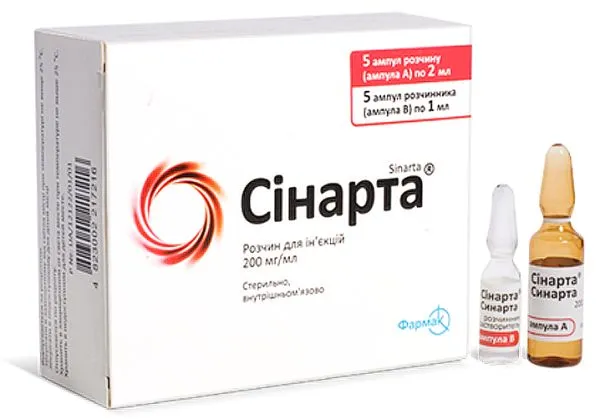
Table of Contents
INSTRUCTIONS FOR MEDICAL USE OF THE MEDICINAL PRODUCT SİNARTA® (SINARTA)
Composition:
Ampoule A
Active substance: sodium salt of glucosamine sulfate;
1 ml of solution contains 251.25 mg of sodium salt of glucosamine sulfate calculated as 100% substance, corresponding to 200 mg of glucosamine sulfate and 51.25 mg of sodium chloride;
Excipients: lidocaine hydrochloride, water for injections;
Ampoule B (solvent):
diethanolamine, water for injections.
Pharmaceutical form. Solution for injection.
Main physico-chemical properties:
Ampoule A: clear, colorless or light yellow liquid (at time of release). Clear, colorless or from light yellow to yellow liquid (throughout shelf life);
Ampoule B: clear, colorless liquid;
Ampoule A+B: clear, colorless or light yellow liquid (at time of release). Clear, colorless or from light yellow to yellow liquid (throughout shelf life).
Pharmacotherapeutic group.
Non-steroidal anti-inflammatory and antirheumatic agents.
ATC code M01AX05.
Pharmacological properties.
Pharmacodynamics.
The active substance, glucosamine sulfate, is a salt of the aminomonosaccharide glucosamine, which under physiological conditions is naturally present in the human body and is used together with sulfates for the biosynthesis of hyaluronic acid in synovial fluid and glycosaminoglycans of the ground substance of articular cartilage.
Thus, the mechanism of action of glucosamine sulfate involves stimulation of glycosaminoglycan synthesis and, consequently, of articular proteoglycans. In addition, glucosamine exerts anti-inflammatory effects and inhibits the process of articular cartilage degradation primarily due to its intrinsic metabolic properties and ability to suppress the activity of interleukin-1 (IL-1). This affects both the symptoms of osteoarthritis and potentially slows structural joint damage, as evidenced by data from long-term clinical studies.
Initial in vitro and in vivo studies indicate that exogenous administration of glucosamine sulfate stimulates proteoglycan biosynthesis, which is impaired in osteoarthritis, promotes fixation of sulfate ions during glycosaminoglycan synthesis, and improves the nutrition of articular cartilage.
Subsequent studies have shown that glucosamine sulfate inhibits the synthesis of tissue-destructive substances such as superoxide radicals, as well as the activity of lysosomal enzymes and other enzymes capable of degrading articular cartilage tissue, including collagenases and phospholipases A2. This action results in a moderate anti-inflammatory effect observed in animal models in vivo, including in some cases of experimental osteoarthritis, even without inhibition of cyclooxygenase, unlike nonsteroidal anti-inflammatory drugs (NSAIDs).
More recent studies have demonstrated that most of the aforementioned metabolic and anti-inflammatory effects may be related to the inhibition of intracellular signal transduction stimulated by IL-1, one of the cytokines involved in the pathogenesis of osteoarthritis, leading to subsequent suppression of cytokine-induced gene transcription. Glucosamine sulfate, at plasma and synovial fluid concentrations observed in patients with osteoarthritis, can actually inhibit IL-1-induced gene expression of a series of pro-inflammatory enzymes in joint tissues, as well as degenerative enzymes in cartilage, such as certain metalloproteinases, including aggrecanases. The potential influence of sulfate ions on these pharmacodynamic properties of glucosamine has not yet been fully elucidated.
All the above-mentioned properties have a favorable impact on the degenerative processes in cartilage that underlie the pathogenesis of osteoarthritis, as well as on the clinical presentation of the disease.
Short-term and medium-term studies have shown that the efficacy of glucosamine sulfate on osteoarthritis symptoms becomes apparent as early as 2–3 weeks after initiation of treatment.
On the other hand, the therapeutic efficacy of glucosamine sulfate on symptomatology, compared to conventional analgesics and nonsteroidal anti-inflammatory drugs, is optimal after a continuous treatment course of 6 months or after a 3-month treatment course with a clearly evident effect persisting for 2 months after discontinuation.
Results from clinical studies of daily continuous treatment over 3 years indicate a progressive increase in efficacy with regard to both symptoms and slowing of structural joint damage, as confirmed by radiographic evaluation.
Glucosamine sulfate has demonstrated good tolerability. No significant effects of glucosamine sulfate on the cardiovascular, respiratory, autonomic, or central nervous systems have been observed.
Pharmacokinetics.
Studies conducted in humans and animals have shown that after oral administration of 14C-glucosamine, radioactively labeled components are rapidly and almost completely absorbed systemically. In humans, approximately 90% of the radioactively labeled dose is absorbed. Absolute bioavailability of glucosamine in rats after oral administration of glucosamine sulfate was 26%, due to the first-pass liver effect. Absolute bioavailability in humans is unknown, but according to allometric calculations, it is similar to that observed in rats, i.e., between 20% and 30%.
In healthy volunteers, after repeated oral administration of glucosamine sulfate at a dose of 1500 mg per day, the maximum steady-state plasma concentration (Cmax,ss) was 1602 ± 425 ng/mL (8.9 µM). This concentration was reached within 1.5–4 hours (median: 3 hours) after administration (tmax). At steady state, the area under the plasma concentration-time curve (AUC) was 14,564 ± 4138 ng·h/mL. These parameters were obtained after administration of the drug on an empty stomach; therefore, it is unknown whether food intake may significantly affect drug absorption.
After oral administration, glucosamine is primarily distributed into the extravascular space (including synovial fluid), with a volume of distribution approximately 37 times higher than the total body water content. Protein binding of glucosamine has not been detected.
The metabolic profile of glucosamine has not been studied, as this medicinal product, being a natural substance present in the human body, is used for the biosynthesis of certain components of articular cartilage.
Only the terminal elimination half-life of glucosamine from human plasma has been determined, based on measurements of plasma glucosamine levels over 48 hours following oral administration. The calculated value was approximately 15 hours.
After oral administration of 14C-glucosamine, urinary excretion of radioactively labeled components in humans accounted for 10 ± 9% of the administered dose, while fecal excretion was 11.3 ± 0.1%. The level of unchanged glucosamine excreted in urine after oral administration in humans was on average low (approximately 1% of the administered dose). These results indicate that the kidneys do not play a significant role in the elimination of glucosamine and/or its metabolites and/or degradation products.
With repeated administration at doses of 750–1500 mg once daily, the pharmacokinetics of glucosamine were linear. However, at a dose of 3000 mg, plasma glucosamine levels were lower than expected based on dose escalation. The steady-state pharmacokinetics of glucosamine were time-independent, with no accumulation or reduction in bioavailability compared to the pharmacokinetic profile observed after single-dose administration.
The pharmacokinetics of glucosamine in men and women are similar. No differences in pharmacokinetics have been established between healthy volunteers and patients with knee osteoarthritis. In the latter group, the mean plasma concentration 3 hours after the last 1500 mg dose in repeated once-daily administration was 7.2 µM, similar to that observed in healthy volunteers, while the mean concentration in synovial fluid was only 25% lower and thus also within the 10 µM range. Pharmacokinetics of glucosamine have not been studied in patients with renal or hepatic impairment; however, considering the drug’s safety profile and the minor role of the kidneys in glucosamine elimination, dose reduction in these patient groups is not recommended.
Steady-state concentrations of glucosamine in plasma and synovial fluid after repeated once-daily administration of 1500 mg are within the range of 10 µM, corresponding to concentrations at which pharmacological activity has been demonstrated in in vitro experimental models, thereby confirming the mechanism of action and clinical efficacy of the medicinal product.
Clinical characteristics.
Indications.
Treatment of symptoms of osteoarthritis: pain and functional limitation.
Contraindications.
Individual hypersensitivity to the active substance or to any of the excipients, predisposition to bleeding.
Cinartha® should not be administered to patients with allergy to shellfish, as the active substance is derived from shellfish shells. Such patients may be more susceptible to allergic reactions to glucosamine, possibly exacerbating symptoms of their underlying condition.
The injectable form of the medicinal product contains the excipient lidocaine, which has the following contraindications: cardiogenic shock, pronounced arterial hypotension, severe forms of chronic heart failure, impaired left ventricular function, second- to third-degree atrioventricular block, severe bradycardia, coagulation disorders, Wolff-Parkinson-White syndrome, Adams-Stokes syndrome; history of seizures induced by lidocaine; sick sinus syndrome, severe hepatic dysfunction, hypovolemia, myasthenia gravis, infections at the injection site, hypersensitivity to other amide-type local anesthetics (due to an increased risk of cross-reactivity hypersensitivity reactions).
Interaction with other medicinal products and other forms of interaction.
Mixing the contents of the ampoules with other injectable medicinal products should be avoided.
Specific studies on drug interactions have not been conducted. However, considering the physicochemical and pharmacokinetic properties of glucosamine sulfate, a low potential for interactions can be assumed. Furthermore, glucosamine sulfate has been shown not to inhibit or induce the major human CYP450 enzymes.
The medicinal product does not compete for absorption mechanisms; after absorption, it does not bind to plasma proteins, but is metabolized either by incorporation as an endogenous substance into proteoglycans or by degradation without involvement of the cytochrome enzyme system, thus making interactions with other medicinal products unlikely.
Enhanced effects of coumarin anticoagulants have been reported in patients receiving concomitant glucosamine therapy. Therefore, monitoring of coagulation parameters is advisable in such patients.
The medicinal product is compatible with nonsteroidal anti-inflammatory drugs and glucocorticoids.
Possible enhancement of gastrointestinal absorption of tetracycline may occur.
The injectable form of the medicinal product contains the excipient lidocaine. Cimetidine, pethidine, bupivacaine, propranolol, quinidine, disopyramide, amitriptyline, nortriptyline, chlorpromazine, and imipramine increase lidocaine serum levels by reducing its hepatic metabolism. Norepinephrine has a synergistic effect when interacting with lidocaine.
Monoamine oxidase inhibitors (MAO inhibitors) should be used with caution, as they may increase the risk of arterial hypotension and prolong the local anesthetic effect of lidocaine.
Concomitant use with class IA antiarrhythmic agents (including quinidine, procainamide, disopyramide) may prolong the QT interval; in very rare cases, AV block or ventricular fibrillation may occur.
The cardiotonic effect of cardiac glycosides may be reduced.
When used concomitantly with sedatives, sedative effects are enhanced.
Phenytoin enhances the cardiodepressant effect of lidocaine.
Concomitant use with procainamide may result in delirium and hallucinations.
Lidocaine may potentiate the effects of drugs causing neuromuscular blockade, as these drugs reduce nerve impulse conduction. Ethanol enhances the respiratory depressant effect of lidocaine.
Special precautions for use.
The drug should be administered only by healthcare professionals.
The drug should be prescribed with caution to patients with glucose intolerance. At the beginning of treatment, it is advisable to monitor blood glucose levels in patients with diabetes mellitus.
The drug should be used with caution in patients suffering from bronchial asthma, as such patients may be more susceptible to allergic reactions to glucosamine, potentially exacerbating their symptoms.
One dose of the medicinal product contains 40.3 mg of sodium. This should be taken into account when prescribing to patients on a strict low-sodium diet.
To avoid accidental intravascular injection, an aspiration test is recommended.
The safety of lidocaine-type anesthetics is questionable in patients predisposed to malignant hyperthermia; therefore, their use should be avoided in such cases.
Before administering lidocaine in cardiac disorders (hypokalemia reduces lidocaine efficacy), it is necessary to normalize serum potassium levels and perform ECG monitoring.
Serum creatine phosphokinase activity may increase after intramuscular injection of the drug, which could lead to misdiagnosis of acute myocardial infarction.
In case of sinus node dysfunction, prolonged P-Q interval, widened QRS complex, or if arrhythmia develops or worsens, the dose should be reduced or the drug discontinued.
Particular caution is required when administering the drug to patients with circulatory insufficiency, arterial hypotension, history of arrhythmias, or moderate hepatic and/or renal dysfunction. Due to the presence of lidocaine in the formulation, caution is also required when prescribing to elderly patients, patients with epilepsy, conduction disorders of the heart, or respiratory insufficiency.
Use during pregnancy or breastfeeding.
There are no data available on the use of the drug during pregnancy or breastfeeding; therefore, the drug is contraindicated in these patient groups.
Ability to affect reaction speed when driving or operating machinery.
Studies on the effect of the drug on the ability to drive or operate machinery have not been conducted. Caution should be exercised when driving vehicles or performing tasks requiring attention. If somnolence, fatigue, dizziness, or visual disturbances occur, driving and operating machinery are prohibited.
Method of Administration and Dosage
For intramuscular use only! The preparation is not intended for intravenous administration.
Adult and elderly patients
Before use, mix solution B (solvent, 1 ml) with solution A (drug solution, 2 ml) in one syringe.
The prepared drug solution should be administered intramuscularly at 3 ml or 6 ml (solution A+B) three times a week for 4–6 weeks.
The presence of a yellowish tint in the solution in ampoule A does not affect the efficacy and tolerability of the medicinal product.
Injections of the drug may be combined with oral administration of the drug in powder form for solution preparation.
Glucosamine is not indicated for the treatment of acute pain syndrome.
Symptom relief (particularly reduction of pain) may occur only after several weeks of treatment, and in some cases even after a longer period.
Patients with renal and/or hepatic impairment: Dose adjustment recommendations are not provided, as appropriate studies have not been conducted.
Children
Do not use in children and adolescents, as the safety and efficacy of the drug have not been established in these patient groups.
Overdose
Cases of overdose have not been reported. In the event of overdose, symptomatic treatment aimed at restoring fluid and electrolyte balance should be administered.
The injectable form of the drug contains lidocaine as an excipient. Initial symptoms of lidocaine hydrochloride overdose affecting the central nervous system may include numbness of the tongue and lips, agitation, euphoria, anxiety, tinnitus, dizziness, blurred vision, nystagmus, tremor, depression, drowsiness, loss of consciousness, up to coma, and tonic-clonic seizures. According to literature data, symptoms related to lidocaine hydrochloride overdose affecting the cardiovascular system and respiratory function may include decreased arterial pressure, collapse, AV block, and respiratory depression. Cardiovascular and respiratory functions of the patient should be monitored.
Changes in these parameters may indicate drug overdose; therefore, immediate oxygen supply to the patient is required. All complications require symptomatic treatment.
Adverse Reactions
Gastrointestinal system: abdominal pain, flatulence, dyspepsia, diarrhea, constipation, nausea, vomiting; hyperglycemia in patients with impaired glucose tolerance;
Nervous system: headache, drowsiness, increased fatigue, dizziness;
Immune system: hypersensitivity reactions, including allergic reactions, exacerbation of bronchial asthma;
Eye disorders: visual disturbances;
Skin and subcutaneous tissue: erythema, itching, rash; angioneurotic edema, urticaria, alopecia, abscess;
Local reactions: reactions at the injection site.
The injectable form of the drug contains lidocaine. In rare cases, adverse reactions characteristic of this component may occur:
Gastrointestinal system: nausea, vomiting;
Nervous system: numbness of lips and tongue, photophobia, diplopia, headache, confusion, muscle twitching; at high doses – tinnitus, excited state, anxiety, paresthesia, seizures, loss of consciousness, coma, hyperacusis;
Eye disorders: visual disturbances, conjunctivitis; at high doses – nystagmus;
Psychiatric disorders: sleep disturbances;
Cardiovascular system: arterial hypotension, atrioventricular block; increased blood pressure; at high doses – arrhythmia, bradycardia, slowed cardiac conduction, cardiac arrest, peripheral vasodilation, collapse, tachycardia, chest pain;
Immune system: immune suppression, allergic reactions, including swelling, skin reactions, itching; urticaria, hypersensitivity reactions, including anaphylactoid reactions (including anaphylactic shock), generalized exfoliative dermatitis;
Respiratory system: respiratory depression or respiratory arrest, dyspnea;
Other: sensation of heat, cold or numbness in extremities, malignant hyperthermia; at high doses – rhinitis;
Local reactions: skin tingling at injection site, abscess, mild burning sensation (disappears within 1 minute as anesthetic effect develops), thrombophlebitis.
Shelf life
2 years.
Do not use the drug after the expiry date stated on the packaging.
The prepared solution should be used immediately.
Storage conditions
Store in a light-protected place at a temperature not exceeding 25°C. Keep out of reach of children.
Packaging
Ampoule A: 2 ml solution in a brown transparent glass ampoule.
Ampoule B: 1 ml solvent in a colorless transparent glass ampoule.
5 ampoules A and 5 ampoules B respectively in blisters.
1 blister with ampoules A and 1 blister with ampoules B per carton.
Prescription status
By prescription only.
Manufacturer
JSC "Farmak"
Manufacturer's address and place of business
74, Kyrylivska Street, Kyiv, 04080, Ukraine