Sedasen
Ukraine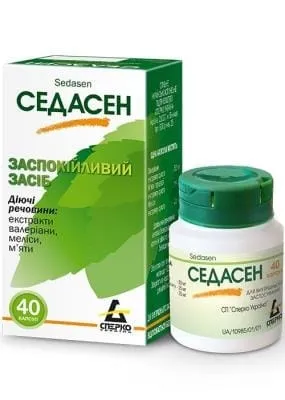
Table of Contents
INSTRUCTIONS FOR MEDICAL USE OF THE MEDICINAL PRODUCT SEDASEN (SEDASEN)
Composition:
Active substances: 1 capsule contains 50 mg of dry extract of valerian (Valeriana officinalis L.) (3-8:1) (extractant – ethanol 80%); 25 mg of dry extract of peppermint (Mentha piperita L.) (4-6:1) (extractant – ethanol 50%); 25 mg of dry extract of lemon balm (melissa) (Melissa officinalis L.) (6-8:1) (extractant – ethanol 70%).
Excipients: anhydrous lactose, talc, anhydrous colloidal silicon dioxide.
Capsule shell composition: titanium dioxide (E 171), yellow iron oxide (E 172), indigotine (E 132), gelatin.
Pharmaceutical form. Capsules.
Main physicochemical properties: hard gelatin capsules. The capsule contents are a powder or granules ranging from light brown to brown in color with a characteristic odor. A yellowish or grayish tint, as well as the presence of dark and white specks, may be observed.
Pharmacotherapeutic group. Hypnotics and sedatives. ATC code N05CM.
Pharmacological properties.
Pharmacodynamics.
Sedasen is a combined herbal medicinal product, whose action is determined by the synergistic effects of the components contained in its composition.
Biologically active substances of valerian (esters of borneol and isovaleric acid, valeropotriates, alkaloids valerine and chotinine) reduce excitability of the central and autonomic nervous systems, have pronounced sedative and hypnotic effects, exert spasmolytic and choleretic actions, enhance secretory activity of the gastrointestinal mucosa, and potentiate the action of other hypnotic and sedative agents. In addition, the complex of biologically active substances of valerian exerts a positive neuroregulatory effect on cardiac muscle function (slows heart rate and dilates coronary vessels).
Peppermint has a broad spectrum of pharmacological activity. Peppermint leaves contain 1–3 % essential oil, which includes menthol (up to 70 %) and its esters, ketone menthone, oleic and ursolic acids, flavonoids. When administered internally, these components of peppermint exert moderate spasmolytic, sedative, hypnotic, and choleretic effects, reduce nausea, mildly stimulate secretion of digestive glands, and dilate coronary vessels.
The main active substances of lemon balm (Melissa) – components of essential oil (0.06–1 %): citral (up to 62 %), geraniol, menaloool, perillal, caryophyllene – exhibit sedative, anticonvulsant, hypotensive, antiarrhythmic, spasmolytic, and antiemetic effects. In addition, active components of Melissa improve digestive processes, exert a mild choleretic effect, normalize reduced appetite, promote restoration of saprophytic intestinal flora, and stimulate secretion of digestive enzymes.
The medicinal product does not cause dependence. The drug should be used in neuroses when administration of potent sedatives is inappropriate. Indications for its use are based solely on long-term experience of application.
Pharmacokinetics.
Data are lacking.
Clinical characteristics.
Indications.
Neuroses accompanied by the following symptoms:
- nervous excitement;
- restlessness;
- stress-induced tension;
- sleep disorders.
Contraindications.
Hypersensitivity to any component of the drug, pronounced arterial hypotension, bronchial asthma. Depression or other conditions associated with suppression of central nervous system activity.
Interaction with other medicinal products and other forms of interaction.
Data regarding interactions with other medicinal products are limited. Consult a physician before using this drug concomitantly with other medicinal products.
Clinically significant interactions with active substances metabolized by cytochrome CYP2D6, CYP3A4/5, CYP1A2, or CYP2E1 have not been reported. Concomitant use with synthetic sedatives (benzodiazepines) is not recommended without consulting a physician. When used concurrently, an enhanced effect of other sedatives, hypnotics, spasmolytics, analgesics, anxiolytics, and alcohol is possible.
Special precautions for use
Do not exceed the recommended doses of the drug.
The drug should be used with caution in patients with severe hepatic impairment or a history of severe liver disease.
Patients with gastroesophageal reflux (heartburn) should avoid medicinal products containing peppermint leaves, as this may worsen their condition.
Medicinal products containing peppermint leaves should be administered with special caution to patients with gallstone disease or other disorders of the biliary tract.
The drug contains lactose and therefore should not be used in patients with rare hereditary galactose intolerance, lactase deficiency, or glucose-galactose malabsorption syndrome.
Alcoholic beverages should be avoided during treatment with this drug.
Use during pregnancy or breastfeeding
The efficacy and safety of using this combination of herbal extracts during pregnancy or breastfeeding have not been established; therefore, the drug is not recommended for use during these periods.
Ability to influence reaction speed when driving or operating machinery
The drug may affect the ability to drive or operate machinery. Therefore, it is recommended to refrain from driving or operating machinery until individual sensitivity to the drug is determined.
Dosage and Administration
For adults and children aged 12 years and older, the recommended dosage is 1–2 capsules 2–3 times daily during periods of mental strain, excitement, or irritability. For insomnia, take 1–2 capsules 1 hour before bedtime. The maximum daily dose for adults is 6 capsules, divided into 3 doses. The effect of the drug develops gradually. To achieve optimal therapeutic effect, it should be used for at least 14 days. There is no restriction on the duration of treatment. No dependence has been observed even with prolonged use. No withdrawal syndrome occurs after discontinuation. If there is no improvement in condition within 14 days, a physician should be consulted.
Children.
There is no data on the use of this combination of herbal extracts in children under 12 years of age; therefore, its use is not recommended in this age group.
Overdose.
Symptoms. Ingestion of a single dose of approximately 20 g of valerian root may cause mild symptoms such as fatigue, abdominal cramps, chest tightness, dizziness, hand tremor, and pupil dilation, which resolve within 24 hours. Overdose with preparations containing valerian may also cause headache, drowsiness, lethargy, general weakness, abdominal pain, nausea, reduced hearing and visual acuity, bradycardia or tachycardia, decreased attention, and enhanced sedative effect.
There are no reports of overdose cases with lemon balm leaves or peppermint.
Treatment. There is no specific antidote; treatment is symptomatic (gastric lavage, administration of activated charcoal).
Adverse reactions.
Gastrointestinal tract: nausea, abdominal cramps, possible exacerbation of heartburn.
Central nervous system: drowsiness, lethargy, asthenic manifestations (weakness, lowered mood, emotional blunting), decreased work capacity and attention concentration, dizziness, depression.
General reactions: hypersensitivity reactions – rash, itching, urticaria, skin redness and swelling. In such cases, consult a physician.
Shelf life.
2 years. Do not use the medicinal product after the expiry date stated on the packaging.
Storage conditions.
Store at a temperature not exceeding 25°C. Keep out of reach of children.
Packaging.
40 hard gelatin capsules in a plastic container and a cardboard box.
Prescription status.
Over-the-counter (without prescription).
Manufacturer.
Ukrainian-Spanish joint venture "Sperco Ukraine".
Manufacturer's address and place of business.
21027, Ukraine, Vinnytsia, 600-richchia St., 25.
Tel.: + 38(0432)52-30-36. E-mail: [email protected]
www.sperco.com.ua