Samitol®
Ukraine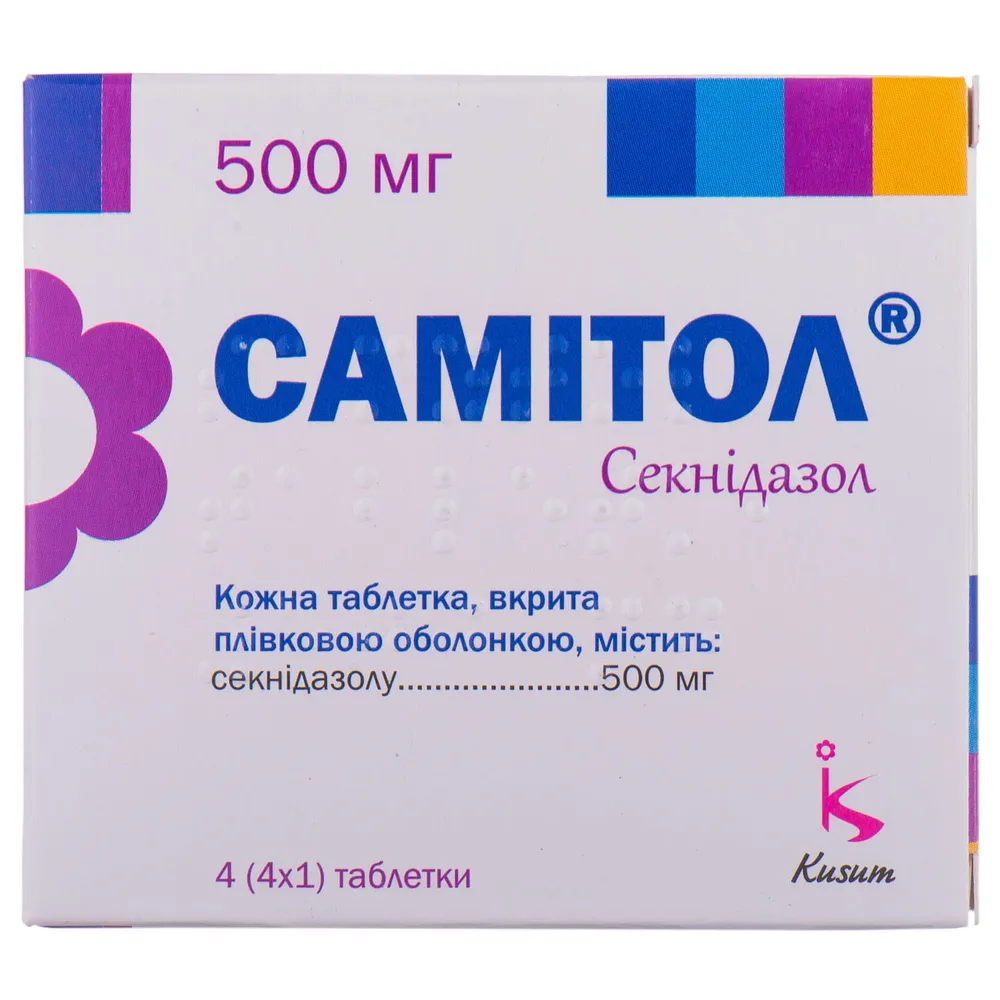
Table of Contents
INSTRUCTION FOR MEDICAL USE OF THE MEDICINAL PRODUCT SAMITOL® (SAMITOL®)
Composition:
Active substance: secnidazole;
One film-coated tablet contains 500 mg of secnidazole;
Excipients: microcrystalline cellulose, colloidal anhydrous silicon dioxide, sodium starch glycolate (type A), magnesium stearate, hypromellose, polyethylene glycol.
Pharmaceutical form. Film-coated tablets.
Main physicochemical properties: round, biconvex, smooth on both sides, film-coated tablets of white to almost white color.
Pharmacotherapeutic group. Antiprotozoal agents. Nitroimidazole derivatives.
ATC code P01AB07.
Pharmacological Properties.
Pharmacodynamics.
Mechanism of action.
Secnidazole is an antiprotozoal agent of the nitroimidazole group with antibacterial activity. Secnidazole is characterized by bactericidal (against gram-positive and gram-negative anaerobic bacteria) and amoebicidal (both intestinal and extraintestinal) effects. Secnidazole is particularly active against Trichomonas vaginalis, Entamoeba histolytica, and Giardia lamblia. Penetrating into the microbial cell, secnidazole is activated by reduction of the 5-nitro group, enabling it to interact with cellular DNA. This leads to disruption of its helical structure, strand breakage, inhibition of nucleotide synthesis, and cell death.
Pharmacokinetics.
Absorption.
After oral administration, secnidazole is rapidly and completely absorbed from the gastrointestinal tract. Bioavailability is nearly 100%. Following a single 2 g oral dose, peak plasma concentrations of secnidazole are reached within 3 hours.
Distribution.
Protein binding of secnidazole to plasma proteins is approximately 15%. Secnidazole crosses the blood-brain barrier and penetrates into breast milk.
Metabolism.
Secnidazole is primarily metabolized in the liver.
Elimination.
The elimination half-life of secnidazole is approximately 25 hours. Secnidazole is primarily excreted in the urine. Elimination is slow: 16% of the administered dose is excreted within 72 hours, and 50% within 120 hours.
Clinical characteristics.
Indications.
- Trichomonad urethritis and vaginitis (caused by Trichomonas vaginalis);
- bacterial vaginosis;
- intestinal amoebiasis (caused by Entamoeba histolytica);
- hepatic amoebiasis (caused by Entamoeba histolytica);
- giardiasis (caused by Giardia lamblia).
Contraindications.
- Hypersensitivity to secnidazole or to any of the excipients or to other nitroimidazole derivatives;
- organic central nervous system (CNS) disorders;
- first trimester of pregnancy;
- blood dyscrasias, including history thereof.
Interaction with other medicinal products and other forms of interaction.
Disulfiram: concomitant use with secnidazole may cause paranoid reactions and psychoses.
Alcohol: combination with alcohol causes symptoms of a disulfiram-like reaction (abdominal cramps, nausea, vomiting, headache, flushing), delirious episodes and dizziness are possible.
Anticoagulants: secnidazole enhances the effect of indirect anticoagulants (coumarin and indandione derivatives) when used concomitantly, increasing the risk of bleeding. Monitoring of prothrombin time and dose adjustment if necessary are required.
Lithium preparations: concomitant use with secnidazole increases lithium plasma concentration.
Cyclosporine: risk of increased cyclosporine levels in blood serum. Monitoring of cyclosporine and creatinine levels is necessary when secnidazole is used concomitantly with cyclosporine.
Non-depolarizing muscle relaxants (vecuronium bromide): combination with secnidazole is not recommended.
Amoxicillin: concomitant use with secnidazole increases activity against Helicobacter pylori (amoxicillin suppresses the development of resistance).
5-Fluorouracil: concomitant use with secnidazole decreases 5-fluorouracil clearance, leading to increased toxicity.
Special precautions.
Alcohol
Consumption of alcohol is contraindicated during treatment with the drug and for 72 hours after its discontinuation to prevent adverse reactions similar to those observed with disulfiram (skin flushing, colicky abdominal pain, vomiting, and tachycardia).
Prolonged use
If prolonged administration of secnidazole beyond the recommended duration is required, patients should undergo monitoring of blood parameters (particularly leukocyte count). Medical supervision is also recommended due to the risk of developing adverse reactions affecting the central and peripheral nervous systems (paresthesias, ataxia, dizziness, seizures).
Hepatic encephalopathy
Secnidazole should be administered with caution in patients with hepatic encephalopathy. Treatment must be discontinued if impaired motor coordination, dizziness, or altered consciousness occurs.
Sexual intercourse
Abstinence from sexual intercourse is recommended during treatment with secnidazole.
Use during pregnancy or breastfeeding
The drug should not be used during pregnancy or breastfeeding.
Ability to influence reaction rate when driving or operating machinery
Secnidazole does not affect the ability to drive or operate machinery.
Method of Administration and Dosage
Samitol® should be taken orally immediately before meals, swallowed with a small amount of water.
Dosage for adults
Genitourinary trichomoniasis, bacterial vaginosis: 4 tablets of 500 mg administered as a single dose once daily or in two divided doses every 12 hours (total dose – 2 g).
Acute intestinal amoebiasis and giardiasis: 4 tablets of 500 mg administered as a single dose once daily or in two divided doses every 12 hours (total dose – 2 g).
Chronic cyst carriers or asymptomatic amoebiasis: 3 tablets of 500 mg administered as a single dose or in several doses over 3 days.
Hepatic amoebiasis: 3 tablets of 500 mg administered as a single dose or in several doses over 5 days.
Dosage for children*
As determined by the physician – 25 to 30 mg/kg/day. The duration of treatment depends on the indication and is similar to that in adults.
*This medicinal product is intended for use in children with body weight over 20 kg.
Dosage in patients with renal or hepatic impairment
Dosage adjustments in patients with renal or hepatic impairment depend on general recommendations for nitro-5-imidazole derivatives.
Moderate to severe renal impairment: dose adjustment is generally not required, especially during short-term treatment.
Severe hepatic impairment: daily dose reduction is necessary, depending on the patient's condition.
Children.
The drug is permitted for use in children according to dosage recommendations specified in the section "Method of Administration and Dosage," considering that this pharmaceutical form can be used in children with body weight over 20 kg.
Overdose.
Symptoms: possible intensification of adverse reactions, particularly those affecting the nervous system.
Treatment: no specific antidote is available. Symptomatic therapy or hemodialysis should be administered if necessary.
Adverse Reactions
Immune system disorders: hypersensitivity reactions, including hyperemia (erythema), rash, urticaria, angioneurotic edema, bronchospasm, fever, and anaphylactic reactions.
Blood and lymphatic system disorders: mild reversible leukopenia, reversible neutropenia, agranulocytosis, thrombocytopenia.
Cardiovascular disorders: palpitations.
Gastrointestinal disorders: epigastric and/or abdominal pain, nausea, vomiting, diarrhea, constipation, glossitis, stomatitis, taste disturbances (metallic taste), anorexia.
Hepatobiliary disorders: hepatitis.
Nervous system disorders: headache, seizures, dizziness, loss of consciousness, paresthesia, neuropathy (sensory peripheral neuropathy and sensorimotor polyneuritis), encephalopathy*, cerebellar syndrome* (ataxia, dysarthria, impaired motor coordination, nystagmus, tremor).
Psychiatric disorders: psychosis, confusion, hallucinations.
General disorders: general weakness.
Note: * Symptoms resolve after discontinuation of treatment.
Reporting suspected adverse reactions.
Reporting suspected adverse reactions after marketing authorization of the medicinal product is important. It allows continuous monitoring of the benefit-risk balance of the medicinal product. Healthcare professionals, pharmacists, patients, and their legal representatives should report all suspected adverse reactions and lack of efficacy through the Automated Pharmacovigilance Information System at the following link: https://aisf.dec.gov.ua.
Shelf life.
3 years.
Storage conditions.
Store in the original packaging at a temperature not exceeding 25 °C.
Keep out of reach of children.
Packaging.
4 tablets in a blister pack. 1 blister pack in a cardboard box.
Prescription status.
Prescription only.
Manufacturer.
Kusum Healthcare Pvt Ltd.
Manufacturer's address and location of operations.
SP-289 (A), RIICO Industrial Area, Chopanki, Bhiwadi, Dist. Alwar (Rajasthan), India.