Salofalk
Ukraine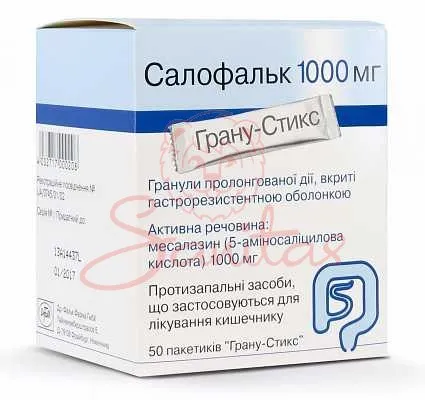
Table of Contents
INSTRUCTIONS FOR MEDICAL USE OF THE MEDICINAL PRODUCT SALOFALK (SALOFALK®)
Composition:
Active substance: mesalazine (5-aminosalicylic acid);
1 sachet (2.79 g granules) contains 1.5 g mesalazine or 1 sachet (5.58 g granules) contains 3 g mesalazine;
Excipients: microcrystalline cellulose, hypromellose, colloidal anhydrous silicon dioxide, polyacrylate dispersion, magnesium stearate, simethicone emulsion.
Coating I: methacrylic acid – methyl methacrylate copolymer (1:1), triethyl citrate, talc, titanium dioxide (E 171), magnesium stearate.
Coating II: hypromellose, talc.
Final coating: sodium carboxymethylcellulose, titanium dioxide (E 171), aspartame (E 951), anhydrous citric acid, sweet vanilla flavor, talc, povidone.
Pharmaceutical form. Gastric-resistant prolonged-release granules.
Main physico-chemical properties: rounded particles of elongated or round shape, greyish-white in color, packed in sachets made of composite aluminum foil.
Pharmacotherapeutic group. Anti-inflammatory agents used in the treatment of intestinal disorders. ATC code A07EC02.
Pharmacological properties.
Pharmacodynamics.
Mechanism of action
The mechanism of anti-inflammatory action is unknown. Results of in vitro studies suggest that inhibition of lipoxygenase may play a certain role.
An effect on the concentration of prostaglandins in the intestinal mucosa has also been demonstrated. Mesalazine (5-aminosalicylic acid/5-ASA) scavenges free radicals.
Pharmacodynamic effect
Orally administered mesalazine acts predominantly locally on the intestinal mucosa and submucosal tissue from the luminal side of the gut. Therefore, it is important that mesalazine is available at the sites of inflammation. Systemic bioavailability and plasma concentrations are thus not relevant for determining the therapeutic effect and are rather factors for assessing safety. To achieve this effect, Salofalk granules are resistant to gastric juice, and mesalazine is released from them in a pH-dependent manner due to Eudragit® L coating (coating I); prolonged release is ensured by the matrix structure of the granules.
Pharmacokinetics.
General properties of mesalazine
Absorption
Absorption of mesalazine is highest in the proximal part of the intestine and lowest in the distal part.
Biological transformation
Mesalazine is metabolized both presystemically in the intestinal mucosa and in the liver to pharmacologically inactive N-acetyl-5-aminosalicylic acid (N-Ac-5-ASA). Acetylation appears to be independent of the patient's acetylator phenotype. Some acetylation also occurs due to the action of colonic bacteria. Protein binding of mesalazine and N-Ac-5-ASA is 43% and 78%, respectively.
Elimination/Excretion
Mesalazine and its metabolite N-Ac-5-ASA are excreted in feces (main portion), in urine (ranging between 20% and 50%, depending on the mode of administration, pharmaceutical form, and release pathway of mesalazine) and in bile (minor portion). Renal excretion occurs predominantly as N-Ac-5-ASA. Approximately 1% of the total orally administered dose of mesalazine passes into breast milk, primarily as N-Ac-5-ASA.
Specific properties of Salofalk granules
Distribution
Due to the size of the granules (approximately 1 mm), they rapidly pass from the stomach into the duodenum.
A combined pharmacoscintigraphic/pharmacokinetic study showed that the compound reaches the ileocecal region within 3 hours and the ascending colon approximately 4 hours after administration. Total transit time through the colon is approximately 20 hours.
Approximately 80% of the orally administered dose is available in the colon, sigmoid colon, and rectum.
Absorption
Release of mesalazine from Salofalk granules begins after a lag phase of about 2–3 hours. Peak plasma concentration is reached approximately 4–5 hours after administration. Systemic bioavailability of mesalazine after oral administration is approximately 15–25%.
Food intake delays absorption by 1–2 hours but does not alter its rate or extent.
Elimination
When mesalazine is administered at a daily dose of 3 × 500 mg, the total rate of renal elimination of mesalazine and N-Ac-5-ASA at steady state was approximately 25%. The fraction of unmetabolized mesalazine was about 1% of the oral dose. The terminal half-life observed after administration of a single dose of 3 * 500 mg or 3 * 1000 mg of Salofalk granules was 10.5 hours.
Clinical characteristics.
Indications.
Treatment of mild to moderate exacerbations and prevention of relapses of ulcerative colitis.
Contraindications.
Salofalk granules must not be used in patients with:
- hypersensitivity to salicylic acid and its derivatives or to any component of the medicinal product;
- severe impairment of liver or kidney function.
Interaction with other medicinal products and other forms of interaction.
No specific interaction studies have been conducted.
Interactions may occur during treatment with Salofalk granules when used concomitantly with the following medicinal products (most of these potential interactions are anticipated based on theoretical considerations):
|
possible reduction of anticoagulant effect. |
|
possible increase in adverse gastrointestinal effects. |
|
possible enhancement of blood glucose-lowering effects. |
|
possible increase in methotrexate toxicity. |
|
possible reduction of uricosuric effect. |
|
possible reduction of diuretic effect. |
|
possible reduction of antituberculosis effect. |
|
possible reduction of mesalazine release from granules due to decreased pH caused by bacterial metabolism of lactulose. |
Patients who are concurrently taking azathioprine, 6-mercaptopurine, or thioguanine should be aware of the potential for enhanced myelosuppressive effects of azathioprine, 6-mercaptopurine, or thioguanine.
Special precautions for use.
The physician should decide whether to perform blood tests (formed elements; liver function parameters such as ALT or AST; serum creatinine) and urine tests (dipstick testing, sediment) during and after treatment. Testing is recommended approximately 14 days after initiation of therapy, followed by 2–3 additional tests at 4-week intervals. If test results remain within normal limits, preventive monitoring may be performed every three months. In case of new or additional symptoms, tests should be performed urgently.
Use with caution in patients with impaired liver function.
Mesalazine is not recommended for patients with impaired renal function.
Renal function should be monitored during treatment, as mesalazine-induced nephrotoxicity should be considered in case of worsening renal function. In such cases, treatment with Salofalk granules should be discontinued immediately.
Cases of nephrolithiasis, including formation of stones containing 100% mesalazine, have been reported during mesalazine therapy. Adequate fluid intake is recommended throughout treatment.
Mesalazine may cause red-brown discoloration of urine upon contact with sodium hypochlorite-based bleach (e.g., in toilets cleaned with sodium hypochlorite-containing bleaching agents).
Very rare cases of serious blood dyscrasias have been reported with mesalazine use. Hematological investigations should be performed if patients experience unexplained bleeding, bruising, purpura, anemia, fever, or pharyngolaryngeal pain. Treatment with Salofalk granules should be discontinued if blood dyscrasia is suspected or confirmed.
Rare cases of hypersensitivity reactions affecting the heart (myocarditis and pericarditis) have been reported with mesalazine. In such cases, Salofalk granules should be discontinued immediately.
Patients with pulmonary disorders, particularly asthma, should be closely monitored during mesalazine therapy.
Serious skin reactions
Serious skin adverse reactions (SSARs), including drug reaction with eosinophilia and systemic symptoms (DRESS syndrome), Stevens-Johnson syndrome (SJS), and toxic epidermal necrolysis (TEN), have been reported in association with mesalazine therapy. Mesalazine should be discontinued at the first signs or symptoms of severe skin reactions, such as skin rash, mucosal lesions, or any other signs of hypersensitivity.
Idiopathic intracranial hypertension
Idiopathic intracranial hypertension (pseudotumor cerebri) has been reported in patients taking mesalazine. Patients should be informed about the signs and symptoms of idiopathic intracranial hypertension, including severe or recurrent headache, visual disturbances, or tinnitus. If idiopathic intracranial hypertension occurs, discontinuation of mesalazine should be considered.
Patients who have had adverse reactions to sulfasalazine-containing drugs should be closely monitored from the beginning of mesalazine therapy. If acute intolerance symptoms such as seizures, acute abdominal pain, fever, severe headache, or rash occur, treatment should be discontinued immediately.
Each Salofalk granule sachet containing 500 mg/1000 mg/1500 mg/3000 mg includes 1 mg/2 mg/3 mg/6 mg of aspartame. Aspartame is a source of phenylalanine and may be harmful to patients with phenylketonuria (PKU).
Salofalk granules contain sucrose. This medicinal product is contraindicated in patients with rare hereditary fructose intolerance, glucose-galactose malabsorption, or sucrase-isomaltase deficiency.
This medicinal product contains less than 1 mmol of sodium (23 mg) per sachet, i.e., it is practically sodium-free.
Use during pregnancy or breastfeeding
There are insufficient data on the use of prolonged-release mesalazine granules in pregnant women. However, limited data from a small number of pregnant women suggest no adverse effects of mesalazine on pregnancy or fetal or neonatal health. Currently, other epidemiological data on the drug are not available. In a single case, neonatal renal failure was reported after prolonged use of high-dose mesalazine (2–4 g orally) during pregnancy.
Animal studies with oral administration of mesalazine have not shown direct or indirect adverse effects on pregnancy, embryonic/fetal development, parturition, or postnatal development.
Salofalk granules should be used during pregnancy only if the expected benefit outweighs the potential risk.
N-acetyl-5-aminosalicylic acid, and to a lesser extent mesalazine, are excreted in breast milk. Experience with use in breastfeeding women is limited. Hypersensitivity reactions such as diarrhea in infants cannot be excluded. Therefore, Salofalk granules should be used during breastfeeding only if the expected benefit outweighs the potential risk. If diarrhea develops in a breastfed infant, breastfeeding should be discontinued.
Ability to affect the speed of reactions when driving or operating machinery
Generally, no influence on the ability to drive or operate machinery has been observed. However, if dizziness occurs during treatment, patients should refrain from driving vehicles or operating machinery.
Method of Administration and Dosage
Adults and Elderly Patients
Treatment of Acute Exacerbations of Ulcerative Colitis
One sachet of Salofalk 3 g, or 1–2 sachets of Salofalk 1.5 g (equivalent to a daily dose of 1.5–3.0 g of mesalazine), should be taken once daily, preferably in the morning, according to individual clinical needs.
For Maintenance of Remission in Ulcerative Colitis
One sachet of Salofalk 1.5 g once daily.
For patients at higher risk of relapse, the dosage regimen may be adjusted to 3.0 g of mesalazine as a single daily dose, preferably taken in the morning.
Children under 6 years of age
Salofalk granules must not be used in children under 6 years of age due to lack of experience with the use of the drug in this age group.
Children aged 6 years and older
Depending on the severity of the disease during exacerbation, a dose of 30–50 mg mesalazine/kg body weight should be administered once daily, preferably in the morning, or divided into three doses. The maximum dose is 75 mg mesalazine/kg body weight/day. The total dose must not exceed the maximum adult dose.
For Prevention of Relapses (maintenance therapy), 15–30 mg mesalazine/kg body weight/day should be given in several divided doses.
Children with body weight below 40 kg should receive half the adult dose, while children with body weight above 40 kg should receive the standard adult dose.
Treatment of acute episodes of ulcerative colitis usually lasts 8 weeks. The duration of treatment should be determined by the physician.
Salofalk granules must not be chewed. The contents of the "Granu-Stix" sachet should be poured onto the tongue and swallowed whole with sufficient liquid, without chewing.
Both during treatment of acute inflammatory episodes and during long-term therapy, Salofalk granules should be taken regularly and continuously to achieve the desired therapeutic effect.
Children. Salofalk granules must not be used in children under 6 years of age due to lack of experience with the use of the drug in this age group. Data on use in children aged 6–18 years are limited.
Overdose.
Rare cases of overdose have been reported (e.g., intentional self-poisoning with high oral doses of mesalazine), which did not indicate renal or hepatic toxicity. There is no specific antidote; treatment should be symptomatic and supportive.
Adverse reactions.
| System organ class |
Frequency according to MedDRA convention |
||||
| Common (≥ 1/100, but < 1/10) |
Uncommon (≥ 1/1000, but < 1/100) |
Rare (≥ 1/10,000, but < 1/1000) |
Very rare (< 1/10,000) |
Frequency not known (cannot be estimated from available data) |
|
| Blood and lymphatic system disorders |
Blood count changes (aplastic anaemia, agranulocytosis, pancytopenia, neutropenia, leucopenia, thrombocytopenia) |
||||
| Immune system disorders |
Hypersensitivity reactions such as allergic rash, drug fever, lupus-like syndrome, pancolitis |
||||
| Nervous system disorders |
Headache |
Dizziness |
Peripheral neuropathy |
Idiopathic intracranial hypertension (see section "Special warnings and precautions for use") |
|
| Cardiac disorders |
Myocarditis, pericarditis |
||||
| Respiratory, thoracic and mediastinal disorders |
Allergic and fibrotic lung reactions (including dyspnoea, cough, bronchospasm, alveolitis, pulmonary eosinophilia, pulmonary infiltration, pneumonitis) |
||||
| Gastrointestinal disorders |
Abdominal pain, diarrhoea, dyspepsia, flatulence, nausea, vomiting, acute pancreatitis |
||||
| Hepatobiliary disorders |
Cholestatic hepatitis |
Hepatitis |
|||
| Skin and subcutaneous tissue disorders |
Rash, pruritus |
Increased sensitivity of the skin to sunlight and ultraviolet rays (photosensitivity) |
Alopecia |
Drug reaction with eosinophilia and systemic symptoms (DRESS), Stevens-Johnson syndrome (SJS), toxic epidermal necrolysis (TEN) |
|
| Musculoskeletal and connective tissue disorders |
Arthralgia |
Myalgia |
|||
| Renal and urinary disorders |
Renal function impairment, including acute and chronic interstitial nephritis and renal failure |
Nephrolithiasis* |
|||
| Reproductive system and breast disorders |
Oligospermia (reversible) |
||||
| General disorders |
Asthenia, fatigue |
||||
| Investigations |
Changes in liver function tests (elevated transaminases and cholestasis markers), changes in pancreatic enzymes (elevated lipase and amylase levels), increased eosinophil count |
||||
*For more detailed information, see section "Special precautions for use".
Severe cutaneous adverse reactions (SCARs), including drug reaction with eosinophilia and systemic symptoms (DRESS), Stevens-Johnson syndrome (SJS), and toxic epidermal necrolysis (TEN), have been reported in association with mesalazine treatment (see section "Special precautions for use").
Photosensitivity
Severe reactions have been reported in patients with skin disorders such as atopic dermatitis and atopic eczema.
Reporting of suspected adverse reactions
Reporting of suspected adverse reactions after authorization of the medicinal product is important. It allows continued monitoring of the benefit-risk balance of the medicinal product. Healthcare professionals and patients, as well as their legal representatives, are encouraged to report any suspected adverse reactions and lack of efficacy of the medicinal product via the Automated Pharmacovigilance Information System at the following link: https://aisf.dec.gov.ua.
Shelf life. 4 years. Do not use after the expiry date stated on the packaging.
Storage conditions. No special storage conditions required. Keep out of reach and sight of children.
Packaging.
5.58 g of granules in a "Granu-Stix" sachet; 50 sachets in a cardboard box for Salofalk 3 g granules.
2.79 g of granules in a "Granu-Stix" sachet; 35 sachets in a cardboard box for Salofalk 1.5 g granules.
Prescription status. Prescription only.
Manufacturer.
Dr. Falk Pharma GmbH.
Manufacturer's address and place of business.
Leinenweberstrasse 5, 79108 Freiburg im Breisgau, Germany.