Rinotyss nasal spray
Ukraine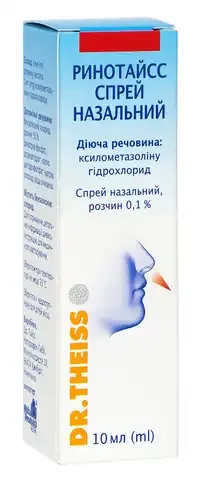
Table of Contents
INSTRUCTIONS FOR MEDICAL USE OF THE MEDICINAL PRODUCT RHINOTAISS NASAL SPRAY
Composition:
Active substance: xylometazoline hydrochloride;
1 ml of solution contains 1 mg xylometazoline hydrochloride;
1 spray (approximately 0.09 ml) contains approximately 0.09 mg xylometazoline hydrochloride;
Excipients: benzalkonium chloride, 50% solution; disodium phosphate dodecahydrate; potassium dihydrogen phosphate; sodium chloride; purified water.
Pharmaceutical form. Nasal spray, solution.
Main physicochemical properties: clear, almost colorless liquid.
Pharmacotherapeutic group. Agents used in nasal disorders. Decongestants and other agents for local use in nasal disorders. Sympathomimetics, simple preparations.
ATC Code R01A A07.
Pharmacological properties.
Pharmacodynamics.
Xylometazoline hydrochloride is an imidazole derivative and belongs to the group of alpha-adrenergic sympathomimetic agents.
The drug exerts vasoconstrictive action and reduces swelling of the mucous membrane. The onset of action usually occurs within 5–10 minutes after administration, manifested by relief of nasal breathing due to reduced mucosal swelling and improved drainage of secretions.
Pharmacokinetics.
The effect of xylometazoline hydrochloride begins within a few minutes and lasts for several hours, on average 6–8 hours.
The amount absorbed following nasal administration may occasionally be sufficient to cause systemic effects, i.e. effects on the central nervous system and cardiovascular system.
There are no pharmacokinetic studies conducted in volunteers.
Clinical characteristics.
Indications.
Symptomatic treatment of nasal congestion in rhinitis, vasomotor rhinitis, and allergic rhinitis.
Contraindications.
Hypersensitivity to xylometazoline hydrochloride or to any other component of the medicinal product, closed-angle glaucoma, transsphenoidal hypophysectomy, history of surgical interventions exposing the meninges, dry rhinitis (rhinitis sicca), or atrophic rhinitis.
Interaction with other medicinal products and other forms of interaction.
Monoamine oxidase inhibitors (MAO inhibitors). Xylometazoline may potentiate the effect of MAO inhibitors or other medicinal products that increase blood pressure and may induce a hypertensive crisis. Xylometazoline should not be used in patients who are taking or have taken these medicinal products within the last two weeks.
Tricyclic and tetracyclic antidepressants. Concomitant use of xylometazoline and tricyclic or tetracyclic antidepressants may enhance the sympathomimetic effect of xylometazoline; therefore, simultaneous use of these agents is not recommended.
Concomitant use with β-blockers may cause bronchospasm or reduction in blood pressure.
Special precautions for use.
The medicinal product should not be used for longer than 7 consecutive days. Prolonged or excessive use may lead to diminished effect, recurrence of nasal congestion, and/or reactive hyperemia of the nasal mucosa (medicamentous rhinitis), as well as atrophy of the nasal mucosa. To ensure at least partial nasal breathing, treatment with sympathomimetics should be discontinued first in one nostril, and after symptoms have resolved – in the other.
Like other sympathomimetics, this medicinal product should be administered with caution to patients who exhibit strong reactions to adrenergic agents, such as insomnia, dizziness, tremor, cardiac arrhythmia, or increased blood pressure.
Patients with prolonged QT interval syndrome who are treated with xylometazoline may be at increased risk of serious ventricular arrhythmias.
The recommended dosage should not be exceeded, especially when treating children and elderly patients.
This medicinal product should be prescribed only after careful assessment of the benefit-risk ratio in patients with cardiovascular disorders, arterial hypertension, diabetes mellitus, hyperthyroidism, pheochromocytoma, porphyria, benign prostatic hyperplasia, and should not be used in patients receiving concomitant treatment with monoamine oxidase inhibitors (MAOIs), tricyclic and tetracyclic antidepressants, or other medicinal products that may increase blood pressure, as well as within 2 weeks after discontinuation of such treatments.
The medicinal product contains the preservative benzalkonium chloride. This may cause, particularly with prolonged use, swelling of the nasal mucosa. If such a reaction is suspected (persistent nasal congestion), nasal medicinal products without preservatives should be used whenever possible. If preservative-free nasal medicinal products are unavailable, another pharmaceutical form of the drug should be used.
Use during pregnancy or breastfeeding.
Data on the use of the medicinal product during the first trimester of pregnancy do not indicate any adverse effects of xylometazoline on pregnancy or on the health of the fetus/newborn. No other significant epidemiological data are available. Therefore, the decision to use the medicinal product during pregnancy should be made by a physician after careful assessment of the benefit-risk ratio. Since overdose may impair fetal blood supply, the recommended dose should not be exceeded when used during pregnancy.
It is unknown whether xylometazoline passes into breast milk. Therefore, the medicinal product should be used during breastfeeding only on medical advice and after careful assessment of the benefit-risk ratio. Since overdose may reduce breast milk production, the recommended dose should not be exceeded when used in breastfeeding women.
Ability to affect reaction speed while driving or operating machinery.
When used correctly, no influence on the ability to drive or operate machinery is expected. However, the possibility of adverse reactions affecting the nervous system should be taken into account.
Method of Administration and Dosage
For adults and children aged 12 years and older, administer 1 spray into each nostril 2–3 times daily. The recommended single dose should not be used more than 3 times a day.
Before use, remove the protective cap from the nozzle. Before the first use, press the pump at least 4 times until a uniform spray appears. The nasal spray is then ready for use. If the nasal spray bottle has not been used for several days, repeat this priming procedure.
To use the medication, insert the spray nozzle into one nostril, administer one spray, and simultaneously inhale gently through the nose. Repeat the procedure in the other nostril. After use, wipe the spray nozzle with a clean tissue and replace the protective cap.
The last dose of the day should preferably be administered immediately before bedtime, if possible.
For hygienic reasons and to prevent contamination, the bottle should be used by only one person.
The duration of use should not exceed 7 consecutive days.
Children
This medication must not be used in children under 12 years of age.
Overdose
The clinical picture of intoxication with imidazole derivatives may be unclear, as phases of excitation may alternate with phases of depression of the central nervous and cardiovascular systems. Symptoms of central nervous system excitation include restlessness, agitation, hallucinations, and seizures. Symptoms due to central nervous system depression include decreased body temperature, lethargy, drowsiness, and coma.
Other possible symptoms include miosis, mydriasis, fever, sweating, pallor, cyanosis, nausea, vomiting, tachycardia, bradycardia, cardiac arrhythmia, cardiac arrest, arterial hypertension, arterial hypotension, pulmonary edema, dyspnea, apnea, and psychogenic disorders.
In cases of overdose, particularly in children, predominant central nervous system effects such as seizures and coma, bradycardia, apnea, as well as hypertension (which may later shift to hypotension), are frequently observed.
All patients suspected of overdose should receive appropriate supportive measures and, if necessary, immediate symptomatic treatment under medical supervision. Medical care should include monitoring of the patient’s condition for several hours. In cases of severe overdose accompanied by cardiac arrest, resuscitation efforts should continue for at least 1 hour.
Side effects
Classification of side effects by frequency of occurrence: very common (≥ 1/10); common (≥ 1/100 to < 1/10); uncommon (≥ 1/1000 to < 1/100); rare (≥ 1/10,000 to < 1/1000); very rare (< 1/10,000); frequency not known (frequency cannot be estimated from available data).
From the nervous system
Common: headache. Rare: anxiety, insomnia, fatigue (drowsiness, sedative effect), hallucinations (mainly in children).
From the cardiovascular system
Rare: palpitations, tachycardia, arterial hypertension. Very rare: arrhythmia, rapid heartbeat.
From the respiratory system, thoracic organs and mediastinum
Common: dryness or discomfort of nasal mucosa, sneezing. Uncommon: after reduction of therapeutic effect – increased nasal mucosal swelling, epistaxis (nosebleed). Very rare: apnea in infants and newborns.
From the musculoskeletal and connective tissue system
Very rare: cramps (especially in children).
From the immune system
Very rare: hypersensitivity reactions (angioedema, skin rash, pruritus).
From the visual organs
Very rare: temporary visual disturbances.
From the gastrointestinal system
Common: nausea.
General disorders and administration site reactions
Common: burning sensation at the site of application.
Reporting of suspected adverse reactions
Reporting of suspected adverse reactions after marketing authorization of the medicinal product is important. It allows continuous monitoring of the benefit-risk balance of the medicinal product. Healthcare professionals and patients, as well as their legal representatives, are encouraged to report any suspected adverse reactions and lack of efficacy of the medicinal product via the Automated Pharmacovigilance Information System at the following link: https://aisf.dec.gov.ua
Shelf life. 3 years.
Storage conditions.
Store at temperatures not exceeding 25 °C. Keep out of reach of children.
Packaging.
10 ml in a glass bottle with a spray pump. 1 bottle per cardboard box.
Supply category. Over-the-counter.
Manufacturer.
Dr. Theiss Naturwaren GmbH.
Manufacturer's address and location of operations.
Michelinstrasse 10, 66424 Homburg, Germany.