Rhinomistin
Ukraine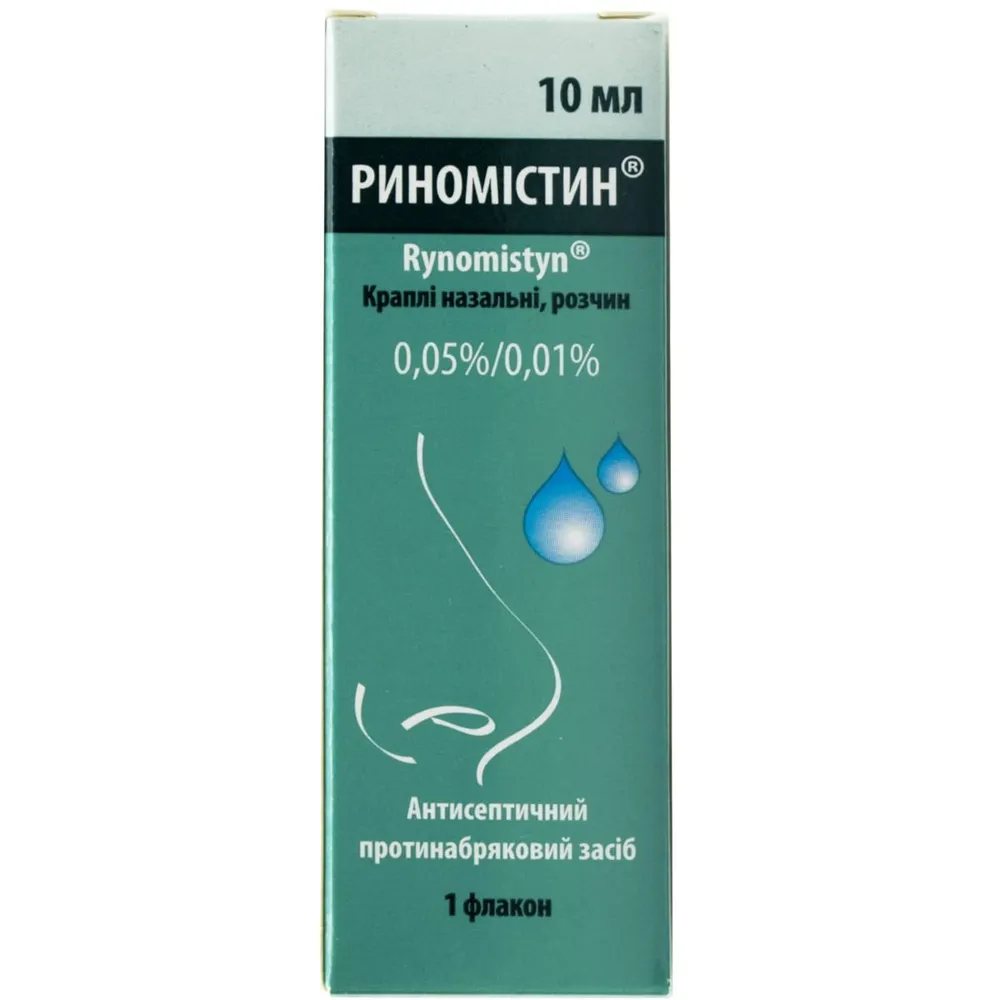
Table of Contents
INSTRUCTIONS FOR MEDICAL USE OF THE MEDICINAL PRODUCT RYNOMISTYN® (RYNOMISTYN®)
Composition:
Active substances: xylometazoline, benzyl dimethyl [3-(myristoylamino)propyl] ammonium chloride monohydrate;
1 ml of solution contains xylometazoline hydrochloride 0.5 mg, benzyl dimethyl [3-(myristoylamino)propyl] ammonium chloride monohydrate (calculated as anhydrous substance) 0.1 mg;
Excipients: disodium edetate (EDTA); sodium dihydrogen phosphate dihydrate, sodium hydrogen phosphate dodecahydrate; sorbitol (E 420); purified water.
Pharmaceutical form. Nasal drops, solution.
Main physicochemical properties: clear, colorless liquid.
Pharmacotherapeutic group.
Anti-edematous and other drugs for local use in nasal cavity diseases. Sympathomimetics in combination with other agents.
ATC code R01AB06.
Pharmacological Properties
Pharmacodynamics. Xylometazoline is a locally acting α-adrenergic agonist, an imidazoline derivative. It causes vasoconstriction of the nasal mucosa blood vessels, eliminates hyperemia and edema, and reduces exudation. The effect of xylometazoline develops within 10–15 minutes; the therapeutic effect lasts for 5–6 hours, while vasoconstriction persists for up to 8–12 hours.
Benzyl dimethyl [3-(myristoylamino)propyl] ammonium chloride monohydrate is an antiseptic belonging to the group of cationic surfactants – detergents. Its mechanism of action is based on direct hydrophobic interaction with microbial membrane lipids, resulting in membrane destabilization, increased permeability for high-molecular-weight substances, and disruption of microbial enzymatic systems, leading to inhibition of microbial viability and cytolysis.
Unlike other antiseptics, benzyl dimethyl [3-(myristoylamino)propyl] ammon游戏副本
Clinical characteristics.
Indications.
Acute and chronic forms of rhinitis, sinusitis, rhinosinusitis, accompanied by nasal congestion and complicated by microbial infection.
Complex therapy of acute otitis media and eustachitis (to restore patency of the Eustachian tube).
Prevention of infectious complications during rhinoscopy and other procedures in the nasopharyngeal area.
Contraindications.
Hypersensitivity to any component of the medicinal product; acute coronary diseases, coronary asthma, hyperthyroidism, closed-angle glaucoma; dry rhinitis (rhinitis sicca) or atrophic rhinitis; transsphenoidal hypophysectomy and surgical interventions exposing the meninges in medical history. Concomitant use with monoamine oxidase inhibitors (MAOIs) and within 2 weeks after discontinuation of their use.
Interaction with other medicinal products and other types of interactions.
MAO inhibitors: xylometazoline may potentiate the effect of MAO inhibitors and induce a hypertensive crisis. Do not use xylometazoline in patients taking or who have taken MAO inhibitors within the previous 2 weeks.
Tricyclic and tetracyclic antidepressants: when tricyclic or tetracyclic antidepressants are used concomitantly with sympathomimetic agents, the sympathomimetic effect of xylometazoline may be enhanced; therefore, concomitant use of these agents is not recommended.
Concomitant use of xylometazoline with other sympathomimetic agents (e.g., ephedrine, pseudoephedrine) should be avoided due to their combined effects.
β-adrenergic blockers: when used together with β-blockers, it may cause bronchospasm or reduction in blood pressure.
When used concomitantly, the drug may enhance the efficacy of locally acting antibiotics.
Special precautions for use.
The bottle is intended for individual use only – it should not be passed on to other individuals to prevent the possible spread of infection.
Use with caution in patients with cardiovascular diseases, arterial hypertension, diabetes mellitus, thyroid disorders, pheochromocytoma, prostate hyperplasia, or urinary retention.
The medicinal product should be prescribed with caution to patients who experience strong reactions to adrenergic agents, manifested as insomnia, dizziness, tremor, cardiac arrhythmia, or increased arterial pressure.
Patients with prolonged QT interval syndrome may have an increased risk of serious ventricular arrhythmias when using xylometazoline.
Do not exceed the recommended dosage or duration of treatment of 7 consecutive days. Prolonged use of the drug may lead to rebound effect.
Use in children aged 1 to 12 years is recommended only under adult supervision.
Do not exceed the recommended dose of the drug.
Use during pregnancy or breastfeeding.
The medicinal product should not be used during pregnancy due to its potential vasoconstrictive effects.
There is no evidence of any adverse effect on the infant. It is unknown whether xylometazoline passes into breast milk; therefore, use during breastfeeding is not recommended.
Fertility.
There are no adequate data regarding the effect of the medicinal product Rhinomistin® on fertility. Since systemic exposure to the drug is very low, the likelihood of an effect on fertility is extremely small.
Ability to affect reaction speed when driving or operating machinery.
The drug usually has no effect or only a minimal effect on the ability to drive or operate machinery.
Administration and Dosage
Before administering the medication, the nasal cavity should be thoroughly cleaned.
The medicinal product is intended for use in children aged 1 to 11 years.
For children aged 1 to 5 years, administer (under adult supervision) 1–2 drops into each nostril 1–2 times daily, but not more than 3 times per day into each nostril.
For children aged 6 to 11 years, administer (under adult supervision) 2–4 drops into each nostril 2–3 times daily.
Do not administer more than 3 times per day into each nostril.
The duration of treatment depends on the course of the disease, usually lasting 3–5 days and should not exceed 7 consecutive days.
Children
The medicinal product is not intended for use in children under 1 year of age.
Overdose
Prolonged use of the medication may lead to the development of secondary, treatment-resistant rhinitis (rhinitis medicamentosa). Significant overdose or accidental oral ingestion of the medication, especially by children, may result in sedative effects, visual disturbances, headache, irritability, cardiac arrhythmias, insomnia, respiratory depression, and occasionally, impaired consciousness. There is no specific antidote. Appropriate supportive measures should be initiated, and symptomatic treatment under medical supervision is indicated.
Adverse reactions.
Immune system side effects: hypersensitivity reactions, including angioneurotic edema, rash, itching.
Nervous system side effects: headache.
Eye disorders: transient visual disturbances.
Cardiovascular system side effects: irregular or rapid heartbeat.
Respiratory system side effects: dryness or discomfort of the nasal mucosa, burning sensation.
Gastrointestinal side effects: nausea.
General disorders and administration site reactions: burning sensation at the application site.
Shelf life.
3 years. Shelf life after opening the bottle – 28 days.
Storage conditions.
Store in the original packaging at a temperature not exceeding 30 °C. Do not freeze.
Keep out of reach of children.
Packaging.
10 ml in polymer bottles with dropper. One bottle per carton.
Availability category.
Over-the-counter (without prescription).
Manufacturers.
- LLC "VALARTIN PHARMA" (batch release).
- JSC "FARMAC" (manufacturing, packaging, quality control).
Manufacturers' addresses and locations of their operations.
- 60, Hrushevskoho St., village Chayky, Kyiv-Sviatoshyn district, Kyiv region, 08135, Ukraine.
- 74, Kyrylivska St., Kyiv, 04080, Ukraine.
Marketing Authorization Holder. KNVMP "ISNA".
Address of the Marketing Authorization Holder.
8, Dubrovytska St., bldg. 1, apt. 160, Kyiv, 04114, Ukraine.