Rinofluimucil
Ukraine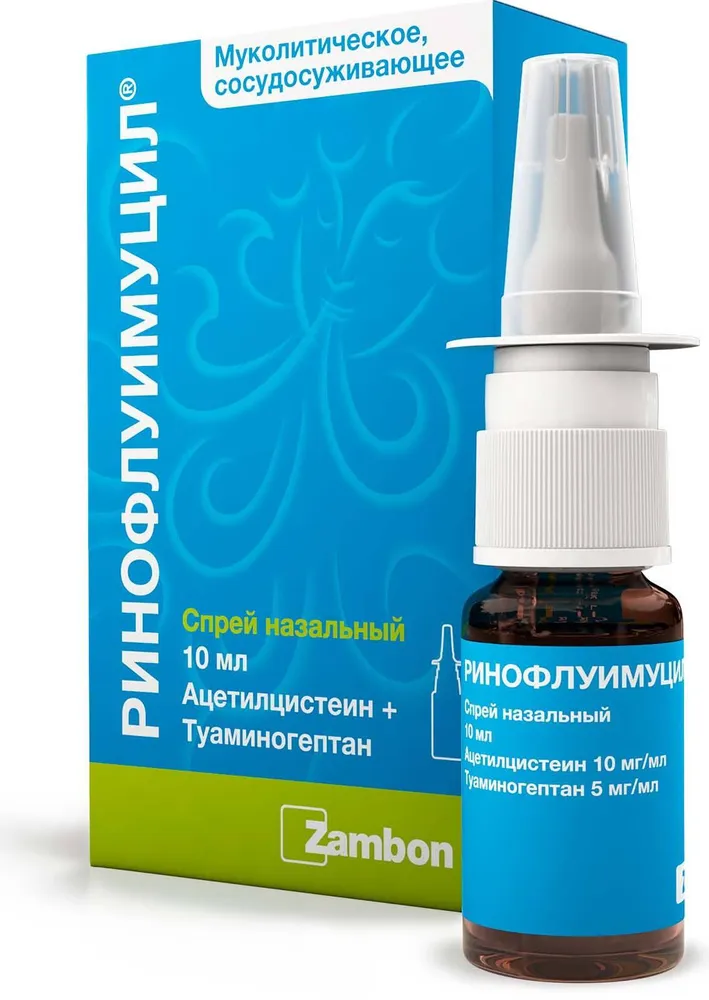
Table of Contents
INSTRUCTIONS FOR MEDICAL USE OF THE MEDICINAL PRODUCT RINOFLOUMUCIL
Composition:
Active substances: 1 ml of the preparation contains: acetylcysteine – 10 mg, tuaminoheptane sulfate – 5 mg;
Excipients: benzalkonium chloride, hypromellose, disodium edetate, sodium dihydrogen phosphate monohydrate, sodium hydrogen phosphate dodecahydrate, dithiothreitol, sorbitol (E 420), peppermint flavor, ethanol 96 %, sodium hydroxide, water for injections.
Pharmaceutical form. Nasal spray, solution.
Main physicochemical properties: practically clear, colorless solution with a characteristic peppermint odor.
Pharmacotherapeutic group. Agents used in diseases of the nasal cavity. Decongestants and other agents for local use. Sympathomimetics in combination with other agents (excluding corticosteroids).
ATC code R01A B08.
Pharmacological properties.
Pharmacodynamics.
The drug exerts mucolytic and anti-edema effects, which are explained by the pharmacological properties of the active substances.
Acetylcysteine has a mucolytic effect due to the presence of a free sulfhydryl group, which breaks the disulfide bonds of glycoproteins in mucus, thereby reducing the viscosity of nasopharyngeal secretions.
Tuaminoheptane sulfate is a sympathomimetic amine that, when applied locally, produces vasoconstrictive effects without systemic effects.
Pharmacokinetics.
The active components of the drug are not absorbed into the bloodstream in significant amounts upon systemic administration.
Clinical characteristics.
Indications.
Acute and subacute rhinitis with thick purulent-mucous secretion, chronic rhinitis, vasomotor rhinitis, sinusitis.
Contraindications.
- Hypersensitivity to the active ingredient or to any of the other components of the medicinal product;
- pheochromocytoma;
- angle-closure glaucoma;
- hyperthyroidism;
- age under 12 years;
- cardiovascular diseases, including hypertension;
- concomitant use of other sympathomimetic agents, including other intranasal decongestants;
- concomitant use or use within 2 weeks after discontinuation of monoamine oxidase inhibitors (MAOIs), including reversible MAOIs;
- pituitary gland removal or previous surgeries with access to the dura mater;
- history of cerebrovascular diseases, including presence of significant risk factors (due to α-sympathomimetic activity);
- history of seizures.
Interaction with other medicinal products and other forms of interaction.
Despite the low degree of systemic absorption of tuaminoheptane following intranasal administration, the following potential interactions should be considered:
− MAO inhibitors, including reversible ones, increase the risk of hypertensive crisis;
− antihypertensive agents (including adrenergic neuron blockers and β-blockers) reduce the antihypertensive effect;
− cardiac glycosides increase the risk of arrhythmias;
− ergot alkaloids increase the risk of ergotism;
− antiparkinsonian agents increase the risk of cardiovascular toxicity;
− oxytocin increases the risk of arterial hypertension.
Special precautions for use
The drug should be used with caution in patients suffering from occlusive vascular diseases, bronchial asthma, diabetes mellitus, and in those taking β-blockers. Rinothymilumicil should also be used with caution in children, bearing in mind that the drug is contraindicated in children under 12 years of age.
Prolonged use of drugs containing vasoconstrictive substances may alter the normal function of the nasal mucosa and paranasal sinuses, thereby causing drug dependence. Therefore, frequent long-term use may lead to the development of adverse effects.
The drug should be used with caution in elderly individuals and in patients with prostatic hyperplasia due to the risk of urinary retention.
Use, especially prolonged use, of locally acting vasoconstrictors may result in harmful effects; in such cases, treatment should be discontinued and, if necessary, appropriate therapy initiated.
If no full therapeutic effect is observed after several days of treatment, the patient should consult a physician. In general, the duration of treatment should not exceed 7 days.
The drug may be combined with appropriate antibacterial therapy at the physician's discretion.
Patients should be informed about the necessity to discontinue treatment if they develop arterial hypertension, tachycardia, palpitations, cardiac arrhythmias, nausea, or neurological signs and symptoms (such as headache or worsening of headache).
Tuaminoheptane sulfate may yield a positive result in doping tests.
This drug is not intended for ophthalmic use.
Important information about certain excipients
Rinothymilumicil contains 0.005 mg of benzalkonium chloride per spray dose (1 spray actuation), which has an irritating effect and may cause skin reactions or bronchospasm. Prolonged use may lead to swelling of the nasal mucosa.
The peppermint flavoring in this medicinal product contains D-limonene, which may cause allergic reactions. In addition to possible allergic reactions in patients sensitive to the allergen, patients not previously sensitive may become sensitized.
Avoid contact of the medicinal product with the eyes.
Use during pregnancy or breastfeeding
Pregnancy
Individual data on the use of acetylcysteine during pregnancy do not indicate any adverse effects of this medicinal product on the course of pregnancy or on fetal or neonatal health. Significant epidemiological data are currently lacking. Animal studies have not shown any direct or indirect harmful effects of acetylcysteine on reproductive function.
There are no data on the effects of tuaminoheptane or the combination of acetylcysteine and tuaminoheptane during pregnancy, nor are there data from similar animal studies.
The use of this drug during pregnancy is not recommended.
Breastfeeding
There are no data on the excretion of acetylcysteine or tuaminoheptane into breast milk; therefore, a risk to the infant cannot be excluded.
This drug should not be used during breastfeeding.
Fertility
There are no animal study data on the effects of acetylcysteine + tuaminoheptane on fertility.
There are also no data on effects in humans.
Ability to affect reaction speed when driving or operating machinery
There are no data indicating that the drug affects attention or reaction speed. However, patients should be informed about reported effects such as hallucinations.
Method of administration and dosage.
The medication is administered into the nasal cavity using a special spray dispenser.
Adults – 2 spray doses (2 actuations of the pump) into each nostril 3–4 times daily.
Children aged 12 years and older – 1 spray dose (1 actuation of the pump) into each nostril 3–4 times daily.
Do not exceed the recommended doses.
After the first opening of the bottle, the medication may be used for up to 20 days.
Before administering the spray, it is necessary to:
- Remove the cap from the solution bottle.
- Remove the protective cap from the spray pump.
- Attach the spray pump to the bottle.
- Remove the cover from the spray pump.
- Prime the spray pump by repeated actuation.
Children.
The medication is intended for children aged 12 years and older.
Overdose.
Symptoms: possible development of arterial hypertension, photophobia, severe headache, sensation of chest tightness; in children, hypothermia with pronounced suppression of consciousness may occur.
Such reactions require immediate and appropriate medical treatment.
Treatment: symptomatic.
Side effects.
Prolonged use of the medicinal product may affect the normal function of the nasal mucosa and paranasal sinuses, causing nasal congestion and inducing tolerance to the drug's action.
Frequent use of the drug at high doses may lead to the development of sympathomimetic-type adverse effects (increased excitability, rapid heartbeat, tremor, etc.). Occasionally, dryness of the nasal and throat mucosa, as well as inflammation of sebaceous glands, may occur. These effects completely resolve after discontinuation of treatment.
The above-mentioned adverse reactions may be associated with the use of Rhinofluimucil; their frequency is unknown (cannot be estimated based on available data).
Immune system: hypersensitivity.
Psychiatric disorders (especially with prolonged and/or excessive use): anxiety, hallucinations, delirium.
Nervous system (especially with prolonged and/or excessive use): headache, restlessness, excitement, insomnia, tremor.
Cardiovascular system (especially with prolonged and/or excessive use): palpitations, tachycardia, arrhythmias, arterial hypertension.
Respiratory system (especially with prolonged and/or excessive use): dryness of the nasal cavity and throat, nasal discomfort, nasal congestion.
Gastrointestinal tract: nausea.
Skin and subcutaneous tissue: urticaria, skin rashes.
Kidneys and urinary system: urinary retention.
General disorders and administration site conditions (especially with prolonged and/or excessive use): irritability, tolerance to the drug's effect.
Reporting of side effects
Reporting of adverse reactions after drug registration is important. It allows continuous monitoring of the benefit-risk balance of the medicinal product. Medical and pharmaceutical professionals, as well as patients or their legal representatives, should report all suspected adverse reactions and lack of drug efficacy via the automated pharmacovigilance information system at the following link: https://aisf.dec.gov.ua.
Shelf life. 2.5 years.
Do not use after the expiry date.
After first opening of the bottle, the medicinal product should be stored for no more than 20 days.
Storage conditions.
Store at a temperature not exceeding 25°C.
Packaging.
10 ml in a bottle; 1 bottle with a spray pump in a cardboard box.
Availability category. Over-the-counter.
Manufacturer.
Zambon S.P.A. / Zambon S.P.A.
Manufacturer's address and location of operations.
Via della Chimica, 9 - 36100 Vicenza (Vicenza province), Italy / Via della Chimica, 9 - 36100 Vicenza (VI), Italy.
Marketing authorization holder.
Zambon S.P.A. / Zambon S.P.A.
Address of the marketing authorization holder.
Via Lillo del Duca, 10-20091 Bresso, Milan, Italy / Via Lillo del Duca, 10-20091 Bresso, Milan, Italy.