Ryativnyk®
Ukraine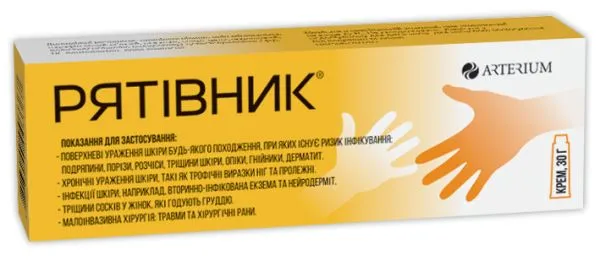
Table of Contents
INSTRUCTION FOR MEDICAL USE OF THE MEDICINAL PRODUCT RYATIVNIK® (RJATIVNIK)
Composition:
Active substances: 1 g of cream contains dexpanthenol, calculated as 100 % substance, 50 mg; chlorhexidine bigluconate 20 % solution, calculated as 20 % solution, 38.8 mg;
Excipients: propylene glycol, mineral oil, white soft paraffin, squalane, cetostearyl alcohol, polyethylene glycol (macrogol) cetostearyl ether, DL-pantolactone, purified water.
Pharmaceutical form. Cream.
Main physicochemical characteristics: cream of white or almost white color.
Pharmacotherapeutic group.
Dermatologicals. Antiseptics and disinfectants. Chlorhexidine, combinations.
ATC code D08AC52.
Pharmacological properties.
Pharmacodynamics
Chlorhexidine dihydrochloride is an antiseptic agent exerting bactericidal activity against gram-positive bacteria, particularly against sensitive strains of Staphylococcus aureus—microorganisms most commonly associated with skin infections. Chlorhexidine dihydrochloride is less active against gram-negative pathogenic microorganisms. Some strains of Pseudomonas and Proteus are resistant to chlorhexidine. It has weak activity against fungi and is not active against viruses.
Dexpanthenol, the active ingredient of the medicinal product Riativnyk®, is rapidly converted into pantothenic acid within cells and acts as a vitamin. Dexpanthenol is absorbed more rapidly than pantothenic acid upon topical application.
Pantothenic acid is a component of coenzyme A (CoA). In this form, acetyl-coenzyme A (CoA) plays a key role in the metabolism of every cell. Thus, pantothenic acid is essential for the formation and healing of damaged skin and mucous membranes.
Pharmacokinetics
Absorption of chlorhexidine through intact skin has not been detected.
Little is known about the distribution of chlorhexidine in organs and tissues due to its minimal absorption through the skin. After oral administration at a dose of 300 mg in healthy adults, the maximum plasma concentration of 0.2 μg/mL can be detected within 30 minutes.
Chlorhexidine is practically not absorbed following topical cutaneous application. After oral administration, chlorhexidine is almost completely excreted in feces.
Dexpanthenol is rapidly absorbed through the skin. In skin cells, it is quickly converted into pantothenic acid and replenishes endogenous stores of this vitamin.
In blood, pantothenic acid binds to plasma proteins (mainly β-globulin and albumin). In healthy adults, the concentration is approximately 500–1000 μg/L in whole blood and 100 μg/L in serum, respectively.
Pantothenic acid undergoes no biotransformation in the body and is excreted unchanged. 60–70% of an oral dose is excreted in urine, the remainder in feces. In adults, 2–7 mg is excreted daily in urine, in children 2–3 mg per day.
Clinical characteristics.
Indications.
- Superficial skin lesions of any origin with risk of infection: scratches, cuts, excoriations, skin fissures, burns, abscesses, dermatitis.
- Chronic skin lesions such as leg ulcers and pressure sores.
- Skin infections, e.g., secondarily infected eczema and neurodermatitis.
- Nipple fissures in breastfeeding women.
- Minor surgical procedures: injuries and surgical wounds.
Contraindications.
Hypersensitivity to dexpanthenol and/or chlorhexidine, or to any other components of the medicinal product.
Application on a perforated eardrum is prohibited.
Special precautions.
Contact with eyes, ears, and mucous membranes should be avoided. If the cream gets into the eyes, they should be rinsed thoroughly with water.
Rescue® is not recommended for treating skin irritations with low risk of infection. It should not be used for allergic skin disorders without infectious complications.
Extensive, heavily contaminated, or deep wounds, as well as wounds resulting from bites or punctures, require medical intervention (risk of tetanus). If wound size remains large or the wound does not heal within 10–14 days, the appropriateness of continuing treatment should be reassessed. This is also necessary if pronounced perifocal hyperemia, swelling, severe pain, increased purulent exudation, or fever occurs (risk of sepsis). The product should not be used for treating infected wounds with abundant purulent exudation.
If symptoms persist or the condition worsens, consult a physician.
Interaction with other medicinal products and other forms of interaction.
Chlorhexidine is incompatible with anionic surfactants and other anionic compounds. Rescue® should not be used simultaneously with other antiseptics to avoid mutual interference (antagonism or inactivation).
Special precautions for use.
Use during pregnancy or breastfeeding.
Animal reproductive studies have revealed no risks to the fetus. However, during pregnancy, the use of Riativnyk® on large skin areas is not recommended, as there are no controlled studies in pregnant women.
The drug can be used by women during breastfeeding, but application to large skin areas should be avoided. If the drug is used to treat nipple fissures, it should be washed off before breastfeeding.
Ability to affect reaction rate while driving or operating machinery.
No effect.
Method of Administration and Dosage
For adults and children aged 1 year and older, apply the medication once or several times daily, as needed, to previously cleansed affected areas of the skin.
The daily dose during repeated application should not exceed 5 g of cream.
If necessary, dressings may be used.
The frequency of cream application and duration of treatment are determined individually according to the physician's recommendation, depending on the clinical signs of skin damage.
Children.
The medication may be used in children aged 1 year and older.
Overdose.
Cases of overdose with topical application of the medication are unknown.
Dexpanthenol is well tolerated even at high doses and is considered non-toxic. Hypervitaminosis has not been reported.
There is a report of increased aminotransferase levels following self-poisoning with chlorhexidine.
Repeated topical application to the same skin areas may often cause irritation. The medication is intended for the treatment of superficial skin injuries. Application to large skin areas should be avoided.
Side effects.
Immune system, skin and subcutaneous tissue disorders. Allergic reactions, including skin allergic reactions such as contact dermatitis, allergic dermatitis, pruritus, erythema, eczema, rash, urticaria, edema, skin irritation, vesicles. Hypersensitivity, anaphylactic reactions and anaphylactic shock (potentially life-threatening) with corresponding laboratory and clinical manifestations, including asthma syndrome, reactions ranging from mild to moderate severity, potentially affecting the skin, respiratory system, gastrointestinal tract, cardiovascular system, including cardiorespiratory failure.
Shelf life. 3 years.
Storage conditions. Store in the original packaging at a temperature not exceeding 25 °C. Do not freeze. Keep out of reach of children.
Packaging. 15 g or 30 g in a tube. 1 tube per carton.
Availability. Over-the-counter.
Manufacturer.
JSC "Kyivmedpreparat".
Manufacturer's location and address of business activity.
139 Saksaganskogo St., Kyiv, 01032, Ukraine.