Ringer-lactate solution
Ukraine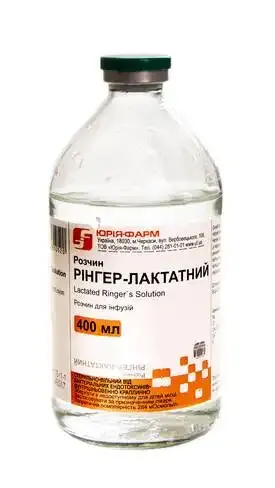
Table of Contents
INSTRUCTIONS FOR MEDICAL USE OF THE MEDICINAL PRODUCT RINGER-LACTATE SOLUTION (LACTATED RINGER'S SOLUTION)
Composition:
Active substances: sodium chloride, sodium lactate, potassium chloride, calcium chloride dihydrate;
1 ml of solution contains: sodium chloride – 6 mg; sodium lactate (calculated as 100 % substance) – 3.2 mg; potassium chloride – 0.4 mg; calcium chloride dihydrate (calculated as calcium chloride) – 0.203 mg;
Excipient: water for injections.
Pharmaceutical form. Infusion solution.
Main physicochemical properties: clear, colorless or slightly yellowish liquid.
Ion composition: Na+ − 131.2 mmol/l; Cl– − 111.7 mmol/l; C3H5O3– − 28.6 mmol/l; Ca2+ − 1.8 mmol/l; K+ − 5.4 mmol/l. Theoretical osmolarity 279 mosmol/l.
Pharmacotherapeutic group. Solutions for correction of electrolyte balance disorders. Electrolytes. ATC code B05B B01.
Pharmacological Properties
Pharmacodynamics
Ringer-Lactate Solution is a balanced electrolyte saline solution. It replenishes the deficit of circulating blood volume. Lactate contained in the medicinal product is metabolized into bicarbonate anions, which slightly shifts blood pH toward alkalinity. The solution also has a detoxifying effect due to reduction of toxic metabolite concentrations in blood and stimulation of diuresis. The solution is close to isotonic.
Pharmacokinetics
The drug penetrates into tissues approximately within half an hour. The components of the drug are excreted in urine.
Clinical characteristics.
Indications.
Correction of water-electrolyte imbalances due to dehydration resulting from fluid loss in diarrhea, insufficient fluid intake, biliary and intestinal fistulas; restoration of water-electrolyte balance in patients during preoperative preparation and in the postoperative period. Metabolic acidosis.
Contraindications.
Hypervolemia, hypernatremia, hyperkalemia, hyperchloremia, alkalosis, lactic acidosis, severe arterial hypertension, decompensated heart failure, oliguria, anuria, liver failure (due to reduced bicarbonate formation from lactate), acute renal failure; hypercalcemia; extracellular hyperhydration, pulmonary edema, cerebral edema, hypersensitivity to components of the medicinal product.
Interaction with other medicinal products and other types of interactions.
When potassium-sparing diuretics, angiotensin-converting enzyme (ACE) inhibitors, and potassium-containing preparations are used, the risk of developing hyperkalemia increases. When the medicinal product Ringer-Lactate Solution is administered concurrently with cardiac glycosides, the toxic effect of the latter is enhanced due to the presence of Ca++ ions in the solution.
The product is incompatible with cefamandole, amphotericin, ethyl alcohol, thiopental, aminocaproic acid, metaraminol, ampicillin, vibramycin, and monocycline. It is not recommended to use Ringer-Lactate Solution as a diluent for antibiotics administered by infusion, or for dilution of anti-inflammatory agents.
Possible increase in sodium retention in the body when used concomitantly with the following medicinal products: nonsteroidal anti-inflammatory drugs, androgens, anabolic hormones, estrogens, corticotropin, mineralocorticoids, vasodilators, or ganglion blockers.
Due to the presence of lactate, which alkalinizes pH, the medicinal product should be used with caution in combination with drugs whose renal elimination depends on pH. Renal clearance of salicylates, barbiturates, and lithium may be reduced, while that of sympathomimetics and stimulants (such as dexamphetamine sulfate, phenylpropanolamine hydrochloride) may be increased.
Special precautions for use.
During infusion therapy with Ringer-Lactate Solution, the patient's clinical condition should be assessed by monitoring electrolyte concentrations, fluid and electrolyte balance, pH and pCO₂, and lactate levels (in case of massive infusions).
Administration of intravenous solutions may lead to fluid overload, hyperhydration, congestion, and pulmonary edema. The risk of developing dilutional effects is inversely proportional to the electrolyte concentration. The risk of developing volume overload causing congestion with peripheral edema and pulmonary edema is directly proportional to the electrolyte concentration.
If any signs of hypersensitivity reactions occur, administration of the solution must be stopped immediately and appropriate treatment initiated.
Since the preparation contains sodium lactate, it should be administered with special caution to patients predisposed to hypernatremia (e.g., those with adrenocortical insufficiency, non-diabetic diabetes, or massive tissue injury) and to patients with heart disease. Due to its sodium ion content, the solution should be used cautiously in elderly patients, patients with arterial hypertension, renal and cardiovascular insufficiency, congestive heart failure—especially in the postoperative period—as well as in patients with hypoxia, hepatic insufficiency, and those with clinical conditions associated with sodium retention and edema.
Sodium-containing solutions should be used cautiously in patients receiving corticosteroids or corticotropin.
The potassium content requires caution when administering the solution to patients with heart disease and clinical conditions associated with potassium retention. Calcium administration requires monitoring of cardiac function via ECG, especially in patients receiving digitalis. Serum calcium levels do not always reflect tissue calcium levels.
In patients with impaired renal excretory function, administration of the solution may lead to sodium or potassium retention.
Due to the presence of calcium ions, caution is required when administering blood products concomitantly, as coagulation may occur.
Patients receiving cardiac glycosides require special attention when calcium is administered parenterally.
Lactate is a substrate for gluconeogenesis; therefore, blood glucose levels should be carefully monitored in patients with type II diabetes mellitus.
Use during pregnancy or breastfeeding.
Studies on the use of Ringer-Lactate Solution in pregnant women have not been conducted.
There are no data on the passage of the drug into breast milk; however, the drug should be prescribed with caution during lactation.
Ability to influence reaction rate when driving or operating machinery.
Data are unavailable due to the exclusive use of the drug under hospital conditions.
Method of Administration and Dosage.
Administer intravenously by drip infusion. The dose is determined by the physician according to the patient's condition. The maximum daily dose for adults is 40 ml/kg/day (on average, 2500 ml at a rate of 60 drops per minute). The duration of treatment depends on the patient's condition.
Children.
Do not use in pediatrics due to lack of clinical trials.
Overdose.
Overdose or too rapid administration of the solution may lead to disturbances in water-electrolyte balance, manifestations of alkalosis, and cardiorespiratory decompensation. In such cases, administration of the drug should be immediately discontinued. Symptomatic therapy should be initiated.
Excessive lactate administration may lead to the development of metabolic alkalosis, which in turn may be accompanied by hypokalemia.
Symptoms: mood changes, fatigue, dyspnea, muscle weakness, polydipsia, polyuria, impaired cognition, arrhythmia. Increased muscle tone, twitching, and tetanic seizures may develop in patients with hypocalcemia.
Side effects.
Electrolyte imbalance disorders:
- changes in serum electrolyte levels (potassium, calcium, sodium, chloride);
- metabolic alkalosis;
- chloride acidosis.
General, systemic reactions:
- hypervolemia;
- allergic or anaphilactoid reactions, including hyperthermia, itching, cough, sneezing, dyspnea, localized or generalized urticaria, angioneurotic edema.
Infusion site reactions: inflammation, swelling, rash, itching, erythema, pain, burning, numbness at the infusion site.
Psychiatric disorders: panic attack.
If adverse reactions occur, infusion should be discontinued, the patient's condition assessed, and appropriate medical care provided.
Shelf life. 2 years.
Storage conditions.
Store in a place inaccessible to children. Store at a temperature not exceeding 25 °C. Do not freeze.
Incompatibility.
The medicinal product must not be mixed with phosphate- or carbonate-containing solutions.
Packaging.
200 ml and 400 ml in glass bottles.
Prescription category. Prescription only.
Manufacturer. LLC "Yuria-Pharm".
Manufacturer's address and location of business activity.
108, Kobzarska Street, Cherkasy, Cherkasy region, 18030, Ukraine. Tel.: (044) 281-01-01.