Rizamigren
Ukraine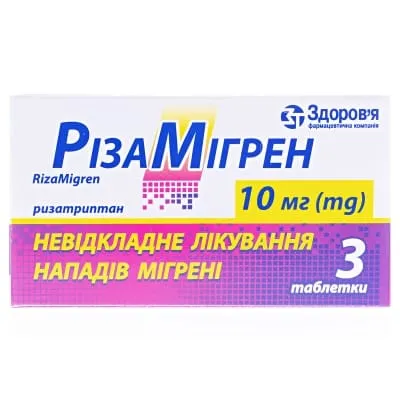
Table of Contents
INSTRUCTIONS FOR MEDICAL USE of the medicinal product RIZAMIGREN (RIZAMIGREN)
Composition:
Active substance: rizatriptan;
One tablet contains rizatriptan benzoate equivalent to rizatriptan 5 mg or 10 mg;
Excipients: lactose monohydrate; pregelatinized starch; microcrystalline cellulose; magnesium stearate.
Pharmaceutical form. Tablets.
Main physicochemical properties: tablets are white or almost white, round, flat cylindrical, with a bevel.
Pharmacotherapeutic group. Medicinal products used in migraine. Selective 5-HT₁ serotonin receptor agonists. Rizatriptan. ATC code N02CC04.
Pharmacological properties.
Pharmacodynamics. Rizatriptan selectively binds with high affinity to human 5-HT1B- and 5-HT1D-receptors and exhibits negligible or no pharmacological effect on 5-HT2-, 5-HT3-, adrenergic α1, α2 or β, dopaminergic D1, D2, H1-histaminergic, muscarinic, or benzodiazepine receptors.
The therapeutic effect of rizatriptan in the treatment of migraine headache may be due to its agonist activity at 5-HT1B- and 5-HT1D-receptors located on extracerebral intracranial blood vessels, which dilate during a migraine attack, and on the trigeminal nerve innervating them. Activation of these 5-HT1B- and 5-HT1D-receptors may lead to constriction of intracranial blood vessels causing pain and to inhibition of neuropeptide release, resulting in reduced inflammation in sensitive tissues and attenuation of pain signal transmission by the central trigeminal system.
The drug reduces functional disability and alleviates nausea, photophobia, and phonophobia associated with migraine attacks. The drug is effective in the treatment of menstrual migraine, i.e. migraine occurring within 3 days before or after the onset of menstruation.
Pharmacokinetics.
Absorption. Rizatriptan is rapidly and completely absorbed after oral administration. The mean bioavailability is approximately 40–45%. The mean peak plasma concentration (Cmax) is reached within 1–1.5 hours (Tmax). Administration of the drug with a high-fat breakfast did not affect the extent of rizatriptan absorption, but absorption was delayed by approximately one hour.
Distribution. Rizatriptan is minimally bound (14%) to plasma proteins. The volume of distribution is approximately 140 liters in males and 110 liters in females.
Metabolism. The main metabolic pathway of rizatriptan is oxidative deamination by monoamine oxidase-A (MAO-A) to an indoleacetic acid metabolite, which is pharmacologically inactive. N-monodesmethylrizatriptan, a metabolite with activity at 5-HT1B/1D receptors similar to the parent compound, is formed in small amounts and does not significantly contribute to the pharmacodynamic activity of rizatriptan. The plasma concentration of N-monodesmethylrizatriptan is approximately 14% of the parent compound, and it is eliminated at a similar rate. Other metabolites formed in negligible amounts include N-oxide, 6-hydroxy derivative, and sulfate conjugate of the 6-hydroxymetabolite. None of these metabolites are pharmacologically active. After oral administration of carbon-14 labeled rizatriptan, rizatriptan accounted for approximately 17% of the radioactive compounds in circulating plasma.
Elimination. The elimination half-life of rizatriptan in males and females is on average 2–3 hours. The plasma clearance of rizatriptan is about 1000–1500 ml/min in males and 900–1100 ml/min in females; approximately 20–30% of this is renal clearance. After oral administration of carbon-14 labeled rizatriptan, approximately 80% of the radioactive substances were excreted in urine and about 10% of the dose was excreted in feces. This indicates that metabolites are primarily eliminated via the kidneys. Considering presystemic metabolism, approximately 14% of the orally administered dose excreted in urine consists of unchanged rizatriptan, while 51% is the indoleacetic acid metabolite. No more than 1% is excreted in urine as the N-monodesmethyl metabolite.
With administration of rizatriptan at the maximum dosing regimen, accumulation in plasma does not occur.
Clinical characteristics.
Indications. Acute treatment of migraine headache with or without aura.
Contraindications. Hypersensitivity to rizatriptan or to any excipient of the medicinal product. Concomitant use of MAO inhibitors or use within two weeks after discontinuation of MAO inhibitor therapy. Severe hepatic or severe renal impairment. Transient ischemic attacks or transient ischemic attack (TIA). Moderate or severe arterial hypertension or uncontrolled mild arterial hypertension. Coronary artery disease, including ischemic heart disease (angina pectoris, history of myocardial infarction, documented silent myocardial ischemia); symptoms typical of ischemic heart disease; Prinzmetal's angina. Peripheral vascular disease. Concomitant use of ergotamine, its derivatives (including methysergide), or other 5-HT1B/1D receptor agonists.
Interaction with other medicinal products and other types of interactions.
Ergotamine, its derivatives (including methysergide), other 5-HT1B/1D receptor agonists (sumatriptan, zolmitriptan, naratriptan). Due to additive effects, concomitant use with rizatriptan increases the risk of coronary artery vasoconstriction and hypertensive effect. This combination is contraindicated (see section "Contraindications").
MAO inhibitors. Rizatriptan is primarily metabolized by MAO-A. Plasma concentrations of rizatriptan and its active N-monodesmethyl metabolite increase when co-administered with selective reversible MAO-A inhibitors. Similar or more pronounced effects are expected with non-selective reversible (linezolid) or irreversible MAO inhibitors. Due to the risk of coronary artery vasoconstriction and hypertensive effect, rizatriptan is contraindicated in patients taking MAO inhibitors (see section "Contraindications").
Beta-blockers. Plasma concentration of rizatriptan may increase when co-administered with propranolol. This increase is likely due to presystemic metabolic interaction between the two drugs, as MAO-A is involved in the metabolism of both rizatriptan and propranolol. This interaction results in an average increase in AUC and Cmax by 70–80%. Patients taking propranolol should receive a rizatriptan dose of 5 mg.
It is known that nadolol and metoprolol do not alter rizatriptan plasma concentrations.
Selective serotonin reuptake inhibitors/serotonin-norepinephrine reuptake inhibitors (SSRIs/SNRIs). Symptoms of serotonin syndrome (including changes in mental status, autonomic instability, and neuromuscular disturbances) have been observed following concomitant use of drugs from these classes and triptans.
Rizatriptan inhibits cytochrome P450 (CYP) 2D6 in vitro. Potential interactions should be considered when prescribing rizatriptan to patients taking drugs metabolized by CYP 2D6.
Special precautions for use.
The drug should be prescribed only to patients with a clearly established diagnosis of migraine. The drug should not be prescribed to patients with basilar or hemiplegic migraine.
The drug should not be taken for the treatment of atypical headache that may be associated with potentially dangerous medical conditions (acute cerebrovascular accident, aneurysm rupture), in which cerebral vasoconstriction may worsen the condition.
Administration of rizatriptan may be associated with transient symptoms including chest pain and sensation of chest tightness, which may intensify and spread to the throat. If such symptoms suggest ischemic heart disease, the drug should be discontinued and appropriate evaluation initiated.
Like other 5-HT1B/1D receptor agonists, rizatriptan should not be prescribed without prior cardiovascular evaluation to patients with suspected heart disease or those at risk of ischemic heart disease (including patients with arterial hypertension, diabetes mellitus, smokers or patients receiving nicotine replacement therapy, men aged 40 years and older, postmenopausal women, patients with bundle branch block, and patients with a family history of ischemic heart disease). Not every case of heart disease can be detected by cardiac evaluation, and very rarely, serious cardiac events have occurred in patients without diagnosed cardiovascular disorders following administration of 5-HT1B/1D receptor agonists, including rizatriptan. The drug should not be prescribed in cases of ischemic heart disease.
Administration of 5-HT1B/1D receptor agonists has been associated with coronary vasospasm. Rare cases of myocardial ischemia or infarction have been observed during treatment with 5-HT1B/1D receptor agonists, including rizatriptan. Concomitant use with other 5-HT1B/1D receptor agonists (including sumatriptan) is not recommended.
A minimum interval of 6 hours should be observed between administration of rizatriptan and ergot-derived medications (ergotamine, dihydroergotamine, or methysergide). After using ergot derivatives, rizatriptan should not be administered earlier than 24 hours later. Although additive vasospastic effects were not observed in healthy males receiving oral rizatriptan and parenteral ergotamine, such additive effects are theoretically possible.
Serotonin syndrome (including mental status changes, autonomic instability, and neuromuscular abnormalities) has been reported with concomitant use of triptans, SSRIs, and SNRIs. These reactions may be serious. If concomitant treatment with rizatriptan and SSRIs or SNRIs is clinically justified, appropriate patient monitoring is recommended, especially at the beginning of treatment, during dose escalation, or when adding another serotonergic agent.
Adverse effects may occur more frequently with concomitant use of triptans (5-HT1B/1D receptor agonists) and St. John's wort (Hypericum perforatum).
Angioedema (facial, tongue, or laryngeal swelling) may occur in patients treated with triptans, including rizatriptan. If swelling of the tongue or larynx occurs, medical supervision is required until symptoms resolve. The drug should be discontinued immediately, and therapy should be switched to a medication from another pharmacological class.
The drug contains lactose; therefore, if a patient has a known intolerance to certain sugars, consultation with a physician is advised before taking this medication.
Potential drug interactions should be considered when prescribing rizatriptan to patients taking medications metabolized by CYP2D6.
Prolonged use of analgesics may exacerbate headache. If this occurs, medical advice should be sought, and rizatriptan therapy should be discontinued. Medication-overuse headache should be suspected in patients with frequent (or daily) headaches, despite (or because of) regular use of headache medications.
Use during pregnancy or breastfeeding.
Fertility. The effect on human fertility has not been studied. It is known that in animals, minimal effects on fertility were observed at plasma concentrations substantially exceeding therapeutic concentrations in humans (more than 500 times higher).
Pregnancy. A moderate amount of data in pregnant women (from 300 to 1000 pregnancy cases) indicates no evidence of malformative toxicity following exposure during the first trimester. Animal studies do not indicate reproductive toxicity.
Data on the use of rizatriptan during the second and third trimesters of pregnancy are limited. Rizatriptan may be considered during pregnancy if clinically necessary.
Breastfeeding. Rizatriptan is excreted in breast milk at low concentrations, with a mean relative infant dose of <1% (less than 6% in the worst-case scenario based on Cmax in breast milk). Rizatriptan should be used with caution in breastfeeding women. Infant exposure may be minimized by avoiding breastfeeding for 12 hours after drug administration.
Ability to affect reaction speed when driving or operating machinery. Both migraine and administration of rizatriptan may cause somnolence. Dizziness has also been reported with rizatriptan use. Patients should assess their ability to perform complex tasks during migraine attacks or while taking the medication.
Administration and Dosage
The medicinal product should not be used for prophylaxis.
Tablets should be swallowed whole with water.
When taken concomitantly with food, absorption of rizatriptan is delayed by approximately 1 hour, resulting in a corresponding delay in therapeutic effect.
The recommended dose for adults is 10 mg. The interval between doses should be at least 2 hours; no more than 2 doses should be taken within 24 hours.
Recurrent headache within the following 24 hours. If headache recurs after relief of the first migraine attack, a second dose may be taken, observing the above dosage recommendations.
Absence of response to treatment. If the patient does not respond to the first dose, a second dose should not be taken for the same migraine attack. However, patients who do not respond to treatment during one attack are still likely to respond to treatment during a subsequent attack.
Some patients should receive a lower dose (5 mg) of the drug, particularly:
- Patients taking propranolol; administration of rizatriptan should be delayed by at least 2 hours after propranolol intake;
- Patients with mild or moderate renal impairment;
- Patients with mild or moderate hepatic impairment.
An interval of at least 2 hours should be maintained between doses, and no more than two doses should be taken within a 24-hour period.
Patients aged 65 years and older. The safety and efficacy of rizatriptan in patients aged 65 years and older have not been systematically evaluated.
Children. The safety and efficacy of the drug for treatment in children have not been established.
Overdose. Rizatriptan at a dose of 40 mg (administered as a single dose or as two doses with a 2-hour interval between them) was generally well tolerated in adult patients; dizziness and somnolence were the most common adverse reactions associated with rizatriptan use.
When rizatriptan was administered to adults at a total cumulative dose of 80 mg (taken within 4 hours), vomiting, bradycardia, dizziness (including transient), loss of consciousness, grade III atrioventricular block (responsive to atropine), incontinence, and a 5-second systolic pause on ECG immediately after painful venipuncture were observed.
Furthermore, considering the pharmacological properties of rizatriptan, hypertension or other more serious cardiovascular disturbances may occur in case of overdose. In suspected overdose, gastrointestinal decontamination should be performed (gastric lavage with activated charcoal). Clinical and ECG monitoring should be conducted for at least 12 hours, even in the absence of clinical symptoms.
The effect of hemodialysis or peritoneal dialysis on rizatriptan serum concentration is unknown.
Adverse Reactions
Adverse reactions are classified according to frequency of occurrence: very common (≥1/10), common (≥1/100, <1/10), uncommon (≥1/1000, <1/100), rare (≥1/10,000, <1/1000), very rare (<1/10,000), frequency not known (frequency cannot be estimated from available data).
Immune system disorders: rare – hypersensitivity reactions, anaphylaxis/anaphylactoid reactions.
Psychiatric disorders: uncommon – disorientation, insomnia, irritability.
Nervous system disorders: common – dizziness, somnolence, paresthesia, headache, hypesthesia, decreased mental alertness, tremor; uncommon – ataxia, vertigo, dysgeusia/taste disturbances; rare – syncope; frequency not known – seizures, serotonin syndrome.
Eye disorders: uncommon – blurred vision.
Cardiac disorders: common – palpitations, tachycardia; uncommon – arrhythmia, ECG abnormalities; rare – bradycardia; frequency not known – myocardial ischemia or infarction (most of these adverse effects were observed in patients with increased risk of ischemic heart disease).
Vascular disorders: common – flushing; uncommon – hypertension; rare – cerebral circulation disorders (most of these adverse effects occurred in patients with established risk factors for ischemic heart disease); frequency not known – peripheral vascular ischemia.
Respiratory, thoracic and mediastinal disorders: common – throat discomfort, dyspnea; rare – wheezing.
Gastrointestinal disorders: common – nausea, dry mouth, vomiting, diarrhea; uncommon – thirst, dyspepsia; frequency not known – ischemic colitis.
Skin and subcutaneous tissue disorders: common – hyperemia, sweating; uncommon – pruritus, urticaria, angioedema (facial, tongue, or pharyngeal swelling), rash; frequency not known – toxic epidermal necrolysis.
Musculoskeletal and connective tissue disorders: common – heaviness sensation; uncommon – neck pain, stiffness in various areas, rigidity, muscle weakness, facial pain, myalgia.
General disorders: common – asthenia/fatigue, abdominal or chest pain.
Shelf life. 2 years.
Storage conditions. Store in the original packaging at a temperature not exceeding 25 °C. Keep out of reach of children.
Packaging. Tablets, 1 tablet, 3×1 tablets in a blister pack in a box.
Prescription category. Prescription only.
Manufacturer. LIMITED LIABILITY COMPANY "CORPORATION "ZDOROV'YA".
Manufacturer's address and location of business activity. 22 Shevchenka Street, Kharkiv, Kharkiv Oblast, 61013, Ukraine.