Rezload
Ukraine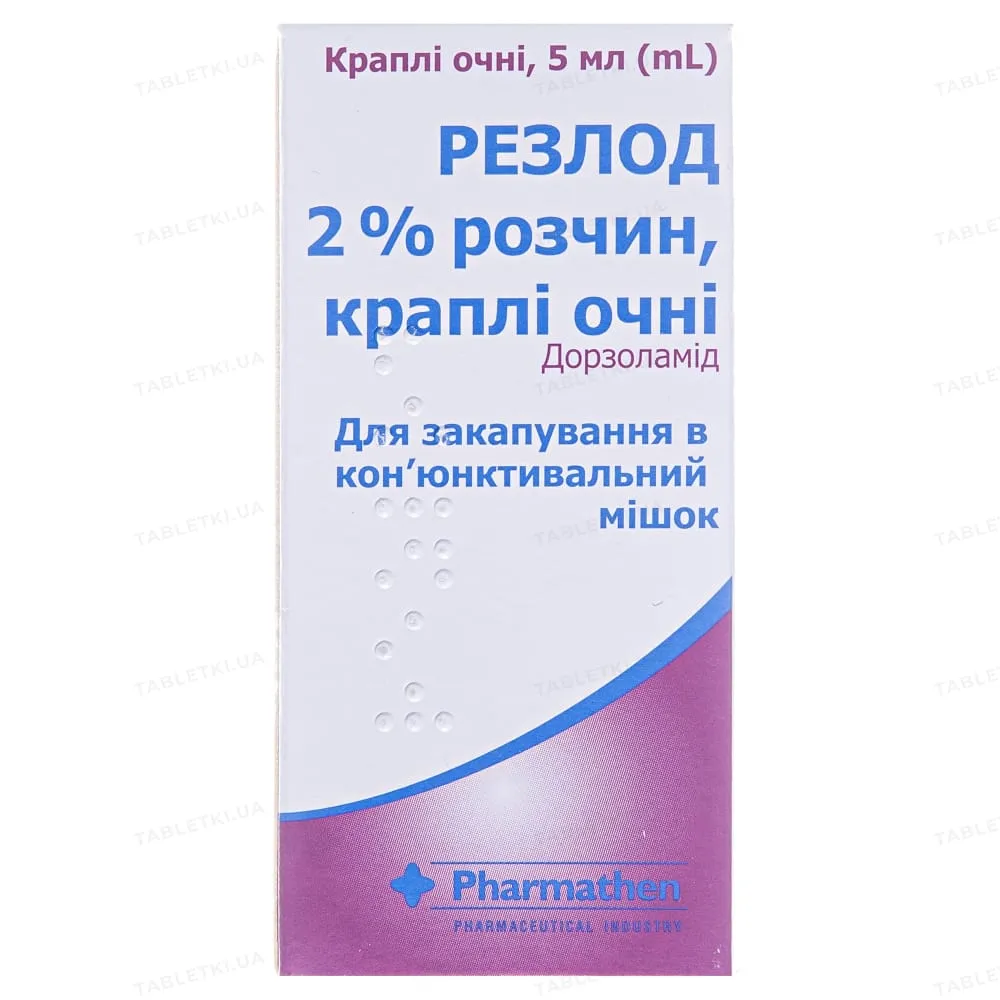
Table of Contents
INSTRUCTIONS FOR MEDICAL USE OF THE MEDICINAL PRODUCT REZLOD (REZLOD)
Composition:
Active substance: dorzolamide;
1 ml of solution contains 20 mg of dorzolamide (as dorzolamide hydrochloride);
Excipients: mannitol (E 421), benzalkonium chloride, hydroxyethylcellulose, sodium citrate, sodium hydroxide, water for injections.
Pharmaceutical form. Eye drops, solution.
Main physico-chemical properties: clear, slightly viscous, colorless aqueous solution.
Pharmacotherapeutic group. Antiglaucoma preparations and miotics. Carbonic anhydrase inhibitors. Dorzolamide. ATC code S01E C03.
Pharmacological Properties
Pharmacodynamics
The Resold preparation contains dorzolamide hydrochloride, a potent inhibitor of human carbonic anhydrase II (CA-II). After topical ophthalmic administration, dorzolamide reduces elevated intraocular pressure, whether associated or not associated with glaucoma, which is a major risk factor in the pathogenesis of optic nerve damage and visual field loss. Dorzolamide does not cause pupillary constriction and reduces intraocular pressure without inducing side effects such as night blindness or accommodative spasm. Dorzolamide has minimal or no effect on heart rate or blood pressure.
Since the mechanism of action of dorzolamide differs from that of beta-adrenergic receptor blockers, combination therapy with these agents results in a synergistic effect, leading to additional reduction in intraocular pressure.
Pharmacokinetics
Unlike oral carbonic anhydrase inhibitors, dorzolamide hydrochloride acts directly in the eye when administered topically and at substantially lower doses, resulting in significantly less systemic activity. In clinical studies, this led to reduction in intraocular pressure without the acid-base imbalances or electrolyte disturbances typically associated with oral carbonic anhydrase inhibitors.
Following topical administration, dorzolamide reaches the systemic circulation. To assess the potential for systemic carbonic anhydrase inhibition after topical use, concentrations of dorzolamide and its metabolites in erythrocytes and plasma were measured, along with inhibition of carbonic anhydrase in erythrocytes.
With prolonged administration, dorzolamide accumulates in erythrocytes due to selective binding to CA-II, while plasma concentrations of free active substance remain extremely low. Dorzolamide forms one N-desethyl metabolite, which inhibits CA-II to a lesser extent than the parent compound but also inhibits the less active isoenzyme CA-I. This metabolite likewise accumulates in erythrocytes, where it binds predominantly to CA-I. Dorzolamide is moderately bound to plasma proteins (approximately 33%) and is excreted in urine (primarily in unchanged form), as is its metabolite. After discontinuation of treatment, nonlinear elimination of dorzolamide from erythrocytes occurs, initially resulting in a rapid decline in dorzolamide concentrations, followed by a slower elimination phase with a half-life of approximately 4 months.
In studies simulating maximum systemic exposure to dorzolamide following prolonged topical ophthalmic administration via oral dosing, steady state was reached within 13 weeks. At steady state, neither free active substance nor metabolite was practically detectable in plasma; carbonic anhydrase inhibition in erythrocytes was less than what is considered necessary for pharmacological effects on renal function or respiration. Similar pharmacokinetic findings were observed after prolonged topical administration of dorzolamide.
However, in some elderly patients with impaired renal function (creatinine clearance of 30–60 mL/min), concentrations of the metabolite in erythrocytes were higher, although this was not accompanied by significant differences in carbonic anhydrase inhibition. Clinically significant systemic adverse reactions directly related to these findings were not observed.
Clinical characteristics.
Indications.
Reslod is indicated:
- as monotherapy in patients with elevated intraocular pressure who are contraindicated for beta-adrenergic receptor blockers, or who do not respond to beta-adrenergic receptor blocker therapy, for the treatment of:
- intraocular hypertension;
- open-angle glaucoma;
- pseudoexfoliative glaucoma;
- as adjunctive therapy when used with beta-adrenergic receptor blockers.
Contraindications.
Hypersensitivity to the active substance or to any of the excipients of the medicinal product.
The use of dorzolamide has not been studied in patients with severe renal impairment (creatinine clearance < 30 ml/min) or with hyperchloremic acidosis. Since dorzolamide and its metabolites are primarily excreted by the kidneys, the use of the medicinal product is contraindicated in such patients.
Interaction with other medicinal products and other forms of interaction.
No specific studies on drug interactions of the medicinal product have been conducted.
In clinical studies, dorzolamide was administered concomitantly with the following medicinal products without occurrence of adverse interactions: timolol or betaxolol ophthalmic solutions, and systemically acting medicinal products such as ACE inhibitors, calcium antagonists, diuretics, nonsteroidal anti-inflammatory drugs including acetylsalicylic acid, and hormones (e.g., estrogen, insulin, thyroxine).
Interactions between dorzolamide and miotics or adrenergic receptor agonists during anti-glaucoma therapy have not been fully studied.
Special precautions for use
The use of dorzolamide in patients with impaired liver function has not been studied; therefore, the drug should be used with caution in such patients.
Treatment of patients with acute angle-closure glaucoma requires therapeutic intervention in addition to therapy with ophthalmic hypotensive agents. The use of dorzolamide in patients with acute angle-closure glaucoma has not been studied.
Dorzolamide contains a sulfonamide group, which is also present in systemic sulfonamides, and therefore it is absorbed into the systemic circulation even with topical administration. Because of this, when the drug is administered topically, the same types of adverse reactions typical for sulfonamides may occur, including serious reactions such as Stevens-Johnson syndrome and toxic epidermal necrolysis. If signs of serious reactions or hypersensitivity reactions occur, the drug should be discontinued.
Therapy with oral carbonic anhydrase inhibitors, especially in patients with a history of urinary tract stones, has led to the development of nephrolithiasis due to disturbances in acid-base balance. Although disturbances in acid-base balance have not been observed with dorzolamide use, there have been isolated reports of nephrolithiasis in patients receiving this treatment. Since dorzolamide is a topical carbonic anhydrase inhibitor that is absorbed into the systemic circulation, the risk of developing nephrolithiasis may be increased in patients with a history of urinary tract stones during dorzolamide therapy.
If allergic reactions (e.g., conjunctivitis or eyelid reactions) occur, discontinuation of therapy should be considered.
Since there is a possibility of a synergistic effect on the known systemic effects of carbonic anhydrase inhibition when oral carbonic anhydrase inhibitors are used concomitantly with dorzolamide, such combined use is not recommended.
Cases of corneal edema and irreversible corneal decompensation have been reported during use of the drug in patients with pre-existing chronic corneal defects and/or a history of ophthalmic surgical procedures. Therefore, dorzolamide topical preparations should be used with caution in such patients.
There have been reports of cases of choroidal detachment associated with intraocular hypotony following aqueous suppressant therapy after filtration procedures.
The product contains the preservative benzalkonium chloride, which may cause eye irritation, and may discolor soft contact lenses. Therefore, contact lenses should be removed prior to instillation of the product and should not be reinserted earlier than 15 minutes after administration.
Benzalkonium chloride has been reported to cause eye irritation, symptoms of dry eye syndrome, and may affect the tear film and corneal surface. Therefore, the drug should be used with caution in patients with dry eye syndrome and in patients at risk of corneal damage.
Patients should remain under medical supervision during prolonged use of the drug.
Use during pregnancy or breastfeeding
Pregnancy
Dorzolamide preparations should not be used during pregnancy. There are no adequate clinical data on the use of the drug during pregnancy. In rabbits, dorzolamide caused teratogenic effects when administered at doses toxic to the mother.
Breastfeeding
It is unknown whether dorzolamide passes into human breast milk. In rats during lactation, reduced weight gain in offspring was observed. If treatment with dorzolamide is necessary, breastfeeding is not recommended.
Ability to affect the speed of reactions when driving vehicles or operating machinery
Studies on the effect of the drug on patients' ability to drive vehicles or operate machinery have not been conducted. Possible adverse reactions such as dizziness and visual disturbances may affect patients' ability to drive vehicles or operate machinery.
Method of Administration and Dosage.
When used as monotherapy, instill 1 drop of the medication into the conjunctival sac of the affected eye three times daily.
When used as adjunctive therapy in combination with ophthalmic beta-adrenergic receptor blocking agents, instill 1 drop of the medication into the conjunct游戏副本
Adverse Reactions
The most common reason for discontinuation of treatment in clinical trials with dorzolamide was the development of drug-related adverse reactions affecting the eye, primarily conjunctivitis and eyelid reactions.
Adverse reactions observed during clinical trials or post-marketing surveillance of dorzolamide ophthalmic drops are listed below by system organ class.
Nervous system disorders: headache, dizziness, paresthesia.
Eye disorders: burning and stinging, superficial punctate keratitis, tearing, conjunctivitis, eyelid inflammation, eye itching, eyelid irritation, blurred vision, iridocyclitis, eye irritation (including redness), eye pain, eyelid skin peeling, transient myopia (which resolves upon discontinuation of treatment), corneal edema, intraocular hypotony, choroidal detachment following filtration surgery, sensation of foreign body in the eye.
Cardiac disorders: palpitations, tachycardia with frequency "not known".
Vascular disorders: hypertension with frequency "not known".
Respiratory, thoracic and mediastinal disorders: epistaxis, dyspnea.
Gastrointestinal disorders: nausea, bitter taste, throat irritation, dry mouth.
Skin and subcutaneous tissue disorders: contact dermatitis, Stevens-Johnson syndrome, toxic epidermal necrolysis.
Renal and urinary disorders: nephrolithiasis.
General disorders and administration site conditions: asthenia/weakness, local and systemic hypersensitivity reactions, including angioedema, urticaria, pruritus, rash, dyspnea, bronchospasm.
Shelf life. 2 years.
Do not use after the expiry date stated on the package. Use within 28 days after first opening the bottle.
Storage conditions. Store at temperatures not exceeding 30 °C. Keep in the original packaging to protect from light. Keep out of reach and sight of children.
Packaging. 5 mL of solution in dropper bottles closed with tamper-evident caps. One dropper bottle per cardboard box.
Prescription status. Prescription only.
Manufacturer. Pharmathen S.A.
Manufacturer's address and place of business.
Dervenakion 6, Pallini Attiki 15351, Greece / Dervenakion 6, Pallini Attiki 15351, Greece.