Respix l®
Ukraine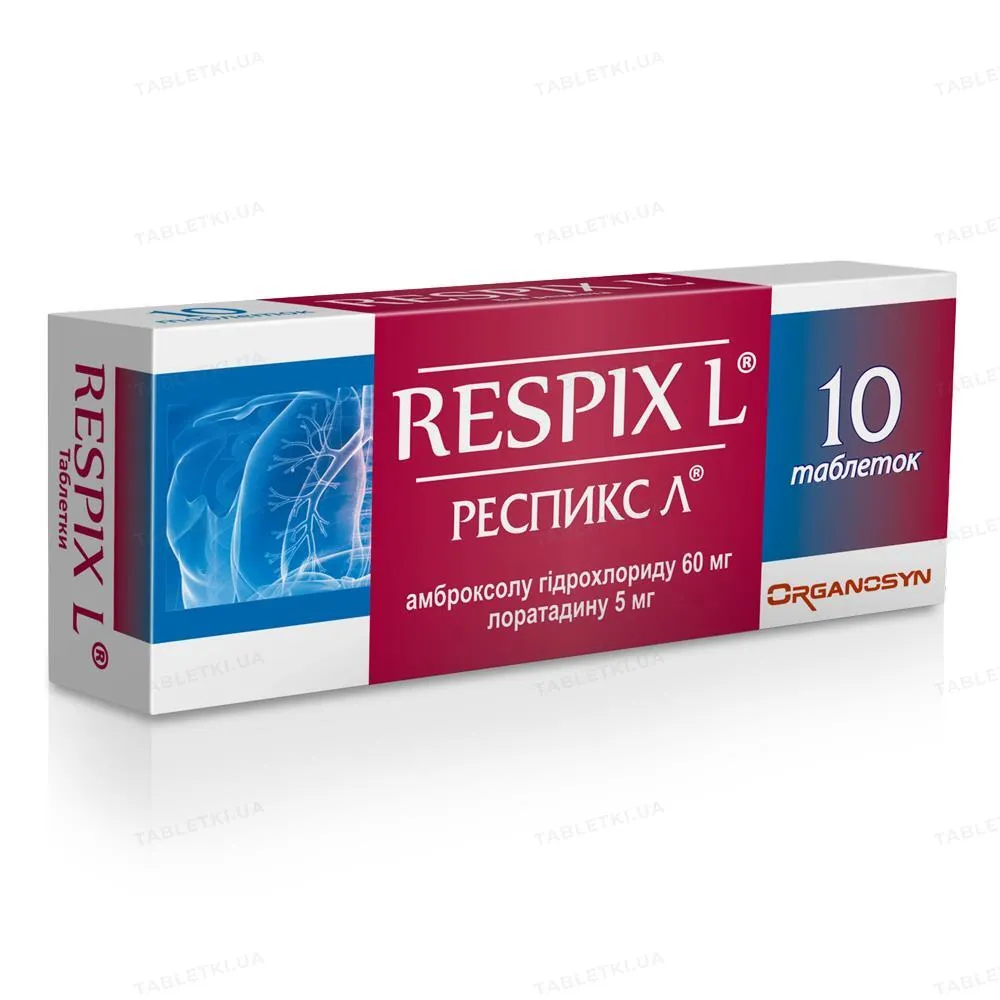
Table of Contents
INSTRUCTIONS FOR MEDICAL USE OF THE MEDICINAL PRODUCT RESPIXL® (RESPIXL®)
Composition:
Active substances: ambroxol hydrochloride, loratadine;
One tablet contains 60 mg of ambroxol hydrochloride and 5 mg of loratadine;
Excipients: lactose monohydrate, corn starch, microcrystalline cellulose, povidone, magnesium stearate, colloidal anhydrous silicon dioxide, sodium starch glycolate.
Pharmaceutical form. Tablets.
Main physicochemical properties: flat, round, almost white tablets with a score line on one side, uncoated.
Pharmacotherapeutic group.
Medicinal products used in cough and colds. Expectorants, excluding combination products containing antitussives.
ATC code R05C.
Pharmacological Properties
Pharmacodynamics
Ambroxol
Ambroxol increases secretion of the bronchial glands, enhances pulmonary surfactant release through direct action on type II pneumocytes in alveoli and Clara cells in bronchioles, and stimulates ciliary activity, thereby facilitating mucus expectoration and clearance (mucociliary clearance).
Activation of fluid secretion and increased mucociliary clearance promote mucus elimination and ease coughing.
Improved mucociliary clearance has been demonstrated in clinical and pharmacological studies.
In vitro studies have shown that ambroxol possesses local anesthetic activity. This effect may be explained by its sodium channel-blocking properties (binding was reversible and concentration-dependent).
In vitro studies have also demonstrated ambroxol’s anti-inflammatory effect, associated with reduced cytokine release from blood and tissue, and binding to mononuclear and polymorphonuclear cells.
Ambroxol administration increases the concentration of antibiotics (amoxicillin, cefuroxime, erythromycin, and doxycycline) in bronchopulmonary secretions and sputum.
Loratadine
Loratadine is a selective tricyclic blocker of peripheral H1-histamine receptors. When administered at the recommended dose, it does not produce clinically significant sedative or anticholinergic effects. During long-term treatment, no clinically significant changes have been observed in vital function parameters, laboratory test results, physical examination findings, or electrocardiograms. Loratadine has no significant effect on H2-histamine receptor activity. It does not inhibit norepinephrine uptake and has virtually no effect on the cardiovascular system or pacemaker activity.
Pharmacokinetics
Ambroxol
After oral administration, ambroxol hydrochloride is almost completely absorbed from the gastrointestinal tract. Maximum plasma concentration is reached within 1–2.5 hours. Following oral intake, distribution of ambroxol hydrochloride from blood to tissues is rapid and extensive, with the highest concentration of the active substance found in the lungs. Plasma protein binding is 85% (80–90%). Ambroxol hydrochloride penetrates into cerebrospinal fluid, crosses the placental barrier, and is excreted into breast milk.
Due to first-pass metabolism, the absolute bioavailability of ambroxol hydrochloride is reduced by one-third. It is metabolized in the liver. Approximately 90% of ambroxol hydrochloride is excreted by the kidneys as metabolites, and less than 10% is excreted unchanged in urine.
The plasma half-life is approximately 10 hours. Total clearance is within the range of 660 mL/min. Renal clearance accounts for approximately 83% of total clearance.
Dialysis or forced diuresis is not expected to enhance elimination of ambroxol hydrochloride due to its high plasma protein binding, large volume of distribution, and slow redistribution from tissues into blood.
Special patient populations
In patients with impaired liver function, elimination of ambroxol hydrochloride is reduced, resulting in 1.3–2 times higher plasma levels. However, since the therapeutic range of ambroxol hydrochloride is sufficiently wide, dosage adjustment is not required.
Age and gender have no clinically significant effect on the pharmacokinetics of ambroxol hydrochloride; therefore, no dose adjustment is necessary.
Food intake does not affect the bioavailability of ambroxol hydrochloride.
Loratadine
After oral administration, loratadine is well absorbed from the gastrointestinal tract and metabolized primarily by CYP3A4 and CYP2D6 enzymes into desloratadine. Time to reach maximum plasma concentration of loratadine and desloratadine is 1–1.5 hours and 1.5–3.7 hours, respectively. Loratadine and its metabolite are highly bound to plasma proteins. The bioavailability of loratadine and desloratadine is directly proportional to the dose. Food intake slightly prolongs the absorption time of loratadine but does not affect its clinical efficacy.
The elimination half-life of loratadine and its metabolite is 24 hours and 37 hours, respectively, and increases with the severity of liver disease.
Special patient populations
The pharmacokinetic profile of loratadine and its metabolites in healthy adult volunteers is comparable to that in elderly volunteers.
In patients with chronic renal insufficiency, pharmacokinetic parameters were not increased compared to patients with normal renal function. The elimination half-life was not significantly altered, and hemodialysis did not affect the pharmacokinetics of loratadine and its metabolites.
In patients with alcoholic liver disease, pharmacokinetic parameters of loratadine were doubled, whereas the pharmacokinetic profile of the metabolite remained unchanged compared to patients with normal liver function.
Clinical characteristics.
Indications. Symptomatic treatment of respiratory tract diseases with an allergic component associated with impaired bronchial secretion and impaired mucus clearance.
Contraindications.
Hypersensitivity to the active substances or to other components of the medicinal product.
Children under 12 years of age.
Interaction with other medicinal products and other forms of interaction.
Concomitant use of ambroxol with alcohol or other central nervous system (CNS) depressants may result in drowsiness.
Ambroxol is metabolized by CYP3A4 and CYP2D6 enzymes; therefore, it should be used with caution when co-administered with drugs metabolized by these enzymes (e.g. cimetidine, ketoconazole, quinidine, fluconazole, fluoxetine) due to the potential for increased adverse reactions. Concomitant use of ambroxol and cough suppressants may lead to excessive mucus accumulation due to suppression of the cough reflex. Therefore, such combination should only be used after careful assessment by a physician of the benefit-risk ratio.
Administration of ambroxol hydrochloride increases the concentration of antibiotics (amoxicillin, cefuroxime, erythromycin, and doxycycline) in bronchopulmonary secretions and sputum. To date, this finding has not demonstrated any clinical significance.
There are no reports of adverse interactions with other medicinal products.
Loratadine does not potentiate the depressant effect of alcohol on psychomotor performance.
Concomitant use of loratadine with inhibitors of CYP3A4 or CYP2D6 may lead to increased loratadine levels, thereby enhancing adverse effects.
When loratadine was co-administered with ketoconazole, erythromycin, or cimetidine, increased plasma concentrations of loratadine were observed; however, this increase had no clinical manifestations, including on electrocardiogram (ECG) findings.
Special precautions for use
There have been only a few reports of severe skin reactions: Stevens-Johnson syndrome and toxic epidermal necrolysis (Lyell's syndrome) associated with the use of expectorants such as ambroxol. In most cases, these reactions could be explained by the severity of the underlying disease in patients and/or concomitant use of other medicinal products. There have also been reports of other severe skin reactions such as erythema multiforme and acute generalized exanthematous pustulosis associated with ambroxol use. If skin rashes develop or progress (sometimes associated with blistering or mucosal involvement), ambroxol should be discontinued immediately and medical advice should be sought.
At the initial stage of Stevens-Johnson syndrome or Lyell's syndrome, patients may present with non-specific, flu-like symptoms such as fever, malaise, rhinitis, cough, and sore throat. These non-specific, flu-like symptoms may lead to inappropriate symptomatic treatment with cough and cold remedies. Therefore, if new skin lesions or mucosal involvement occur, immediate medical attention should be sought and treatment with ambroxol hydrochloride should be discontinued.
The drug should be discontinued no later than 48 hours before performing skin allergy diagnostic tests to prevent false test results.
The drug should be used with caution in patients with impaired bronchial motility and increased mucus secretion (e.g., in rare conditions such as primary ciliary dyskinesia), as ambroxol may enhance mucus secretion.
Patients with impaired renal function or severe hepatic insufficiency should use the drug only after consultation with a physician. When ambroxol, like any active substance metabolized in the liver and subsequently excreted by the kidneys, is administered, metabolites formed in the liver may accumulate in patients with severe renal insufficiency.
Patients with known sensitivities to certain sugars should consult their physician before taking this medicinal product.
The product contains lactose and therefore should not be used in patients with rare hereditary problems of galactose intolerance, Lapp lactase deficiency, or glucose-galactose malabsorption.
Use during pregnancy or breastfeeding
The drug is not recommended for use during pregnancy or breastfeeding.
Effects on ability to drive and use machines
Clinical studies on the effect of ambroxol on the ability to drive or operate machinery have not been conducted.
Clinical studies with loratadine have not shown any effect on the ability to drive or operate machinery. However, patients should be informed about the very rare occurrence of somnolence, which may affect the ability to drive or operate machinery.
Dosage and Administration.
Adults and children aged 12 years and older: the recommended dose is 1 tablet twice daily.
However, considering the varying body weight in children, regardless of the patient's age, the dose of ambroxol should be calculated according to body weight and amounts to 1.2–1.6 mg/kg/day, given in two divided doses. Tablets should be taken after meals with sufficient amount of liquid. The drug should not be used for longer than 4–5 days without consulting a physician. In general, there are no restrictions regarding duration of treatment; however, prolonged therapy should be conducted under medical supervision.
Children.
The drug is indicated for children aged 12 years and older.
Overdose.
Overdose of loratadine increases the frequency of occurrence of anticholinergic symptoms.
Symptoms observed in loratadine overdose include drowsiness, tachycardia, and headache.
Symptoms of ambroxol overdose are known from single reports of overdose and/or accidental drug administration and correspond to known adverse reactions.
Treatment: symptomatic and supportive therapy. Standard measures to remove the drug from the gastrointestinal tract are recommended: gastric lavage and administration of activated charcoal. Loratadine is not removed by hemodialysis; it is also unknown whether loratadine is removed by peritoneal dialysis.
Adverse Reactions
Cardiovascular system: tachycardia, palpitations, feeling of heart pounding.
Nervous system: drowsiness, headache, increased appetite, insomnia, dizziness, seizures, dysgeusia, nervousness, fatigue.
Respiratory system, thoracic organs and mediastinum: rhinorrhea, dyspnea (as a hypersensitivity reaction).
Gastrointestinal tract: nausea, vomiting, diarrhea, abdominal pain, dyspepsia, constipation, dryness of mouth and throat, hypersalivation, gastritis, decreased oral mucosal sensitivity.
Hepatobiliary system: liver function abnormalities.
Urinary system: dysuria.
Immune system, skin and subcutaneous tissue: hypersensitivity reactions, including rash, mucosal reactions, urticaria, dyspnea, angioedema, pruritus, anaphylactic reactions (including anaphylactic shock), erythema, alopecia, severe skin reactions: Stevens-Johnson syndrome and toxic epidermal necrolysis (Lyell’s syndrome), erythema multiforme and acute generalized exanthematous pustulosis.
General manifestations: increased fatigue, fever, mucosal reactions.
Laboratory findings: weight gain.
Reporting of adverse reactions after drug registration is of great importance. It enables continuous monitoring of the benefit-risk balance of the medicinal product. Healthcare and pharmacy professionals, as well as patients or their legal representatives, should report all suspected adverse reactions and lack of efficacy through the automated pharmacovigilance information system at the following link: https://aisf.dec.gov.ua
Shelf life. 3 years.
Storage conditions.
Store in original packaging at a temperature not exceeding 25 °C.
Keep out of reach and sight of children.
Packaging.
10 tablets in a blister. 1 or 2 blisters per carton.
Availability category. Over-the-counter.
Manufacturer.
Evertogen Life Sciences Limited.
Manufacturer's address and place of business.
Plot No: S-8, S-9, S-13/P & S-14/P TSIIC, Pharma SEZ, Green Industrial Park, Polepally (V), Jadcherla (M), Mahabubnagar, Telangana, IN-509 301, India