Reopolyglucin-novopharm
Ukraine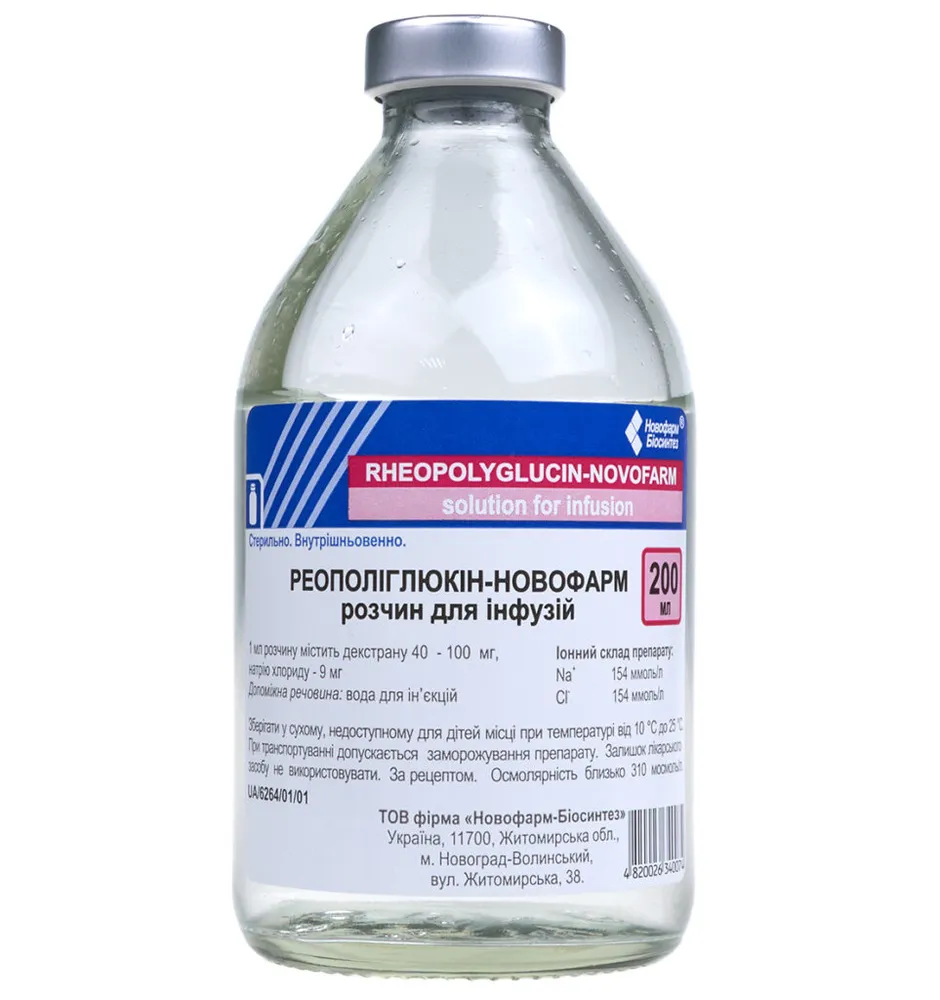
Table of Contents
INSTRUCTIONS FOR MEDICAL USE OF THE MEDICINAL PRODUCT RHEOPOLYGLUCIN-NOVOFARM
Composition:
Active substances: dextran 40, sodium chloride;
1 ml of solution contains dextran 40 – 100 mg, sodium chloride – 9 mg;
Excipient: water for injections.
Pharmaceutical form. Infusion solution.
Main physicochemical properties: clear, colorless or slightly yellowish liquid.
Pharmacotherapeutic group. Plasma substitutes and perfusion solutions.
ATC code B05A A05.
Pharmacological properties.
Pharmacodynamics.
Dextran (a glucose polymer) is a plasma-substituting colloid solution, whose pharmacological action is manifested in improving blood rheological properties, reducing blood viscosity, restoring microcirculatory blood flow, preventing and eliminating aggregation of blood cells, and normalizing arterial and venous circulation. When administered rapidly, the drug can increase blood plasma volume by an amount nearly twice the volume of the administered solution, as every 10 mL of the drug promotes redistribution of 20–25 mL of fluid from tissues into the bloodstream.
Pharmacokinetics.
The half-life is 6 hours. The drug is primarily excreted by the kidneys: approximately 60% within the first 6 hours and 70% within 24 hours. The remaining amount enters the reticuloendothelial system and the liver, where it is gradually broken down by alpha-glucosidase into glucose; however, it does not serve as a source of carbohydrate nutrition.
Clinical characteristics.
Indications.
Prevention and treatment of hypovolemic and distributive shock.
Vascular and plastic transplant surgeries.
Supplement to perfusion fluid in heart-lung machines during cardiac surgeries.
Contraindications.
Hyperhydration; hypervolemia; thrombocytopenia (platelet count 80×109/L and below); kidney diseases accompanied by oliguria, anuria; uncompensated cardiovascular insufficiency stage II–III; DIC syndrome; predisposition to severe allergic reactions; hypersensitivity to dextran. Reopoliglyukin-Novofarm with 0.9% sodium chloride solution should not be administered in case of pathological kidney changes, and with 5% glucose solution – in case of carbohydrate metabolism disorders, especially in diabetes mellitus.
Conditions where administration of large volumes of fluid is contraindicated.
Interaction with other medicinal products and other forms of interaction.
When used concomitantly with anticoagulants, their doses should be reduced. The presence of dextran in blood may affect the results of bilirubin, protein, and blood group determinations. Therefore, these tests should be performed before administration of the drug.
Special precautions for use.
Use only under medical supervision and with availability of medications to manage all possible allergic reactions.
During the first 5–10 minutes of intravenous administration, closely monitor the patient's condition: after slowly infusing the first 10 drops, stop the infusion for 3–5 minutes; then infuse another 30 drops and again pause for 3–5 minutes. If no signs of allergic reactions occur, continue the administration of the medicinal product.
Use with caution in patients with impaired renal excretory function. When sodium chloride intake must be restricted, administer Reopoliglyukin-Novofarm with 5% glucose solution. In patients with carbohydrate metabolism disorders or other conditions where carbohydrate administration is contraindicated, Reopoliglyukin-Novofarm should be administered with 0.9% sodium chloride solution. Use with caution in patients with hypertension due to possible increase in arterial pressure, and in patients with impaired cardiac function.
The contents of one vial should be used for a single patient only. After the vial seal is broken, any unused portion must be discarded.
Use during pregnancy or breastfeeding.
The medicinal product may be used when clinically indicated and based on consideration of the benefit–risk ratio.
Ability to affect reaction speed when driving or operating machinery.
Not studied.
However, the possible occurrence of adverse effects such as general weakness and dizziness should be taken into account.
Method of Administration and Dosage
Administer intravenously by drip infusion. Before administration, warm the solution to 35–37 °C. Dosages and infusion rate are determined individually by the physician.
In capillary circulation disorders (various forms of shock), the maximum daily dose is 20 ml/kg for adults and 5–10 ml/kg for children (if necessary, up to ̄15 ml/kg).
During surgeries with cardiopulmonary bypass, add to blood at a dosage of 10–20 ml/kg to fill the oxygenator pump; the dextran concentration in the perfusion solution must not exceed 3 %. In the postoperative period, administer the medicinal product at the same dosages as used for capillary circulation disorders.
The medicinal product should be administered without mixing with other medicinal agents. In life-threatening situations, the agent may be administered rapidly, even by bolus injection, at a dosage of 15 ml/kg.
In patients with hemorrhagic stroke or traumatic brain injury, the medicinal product should be administered at a dosage of 10–15 ml/kg and no more!
Children
The medicinal product may be used in children; dosage should be calculated based on body weight.
Overdose
Hyperhydration and hypocoagulation may occur.
Treatment: Symptomatic therapy.
Adverse reactions.
Allergic reactions: anaphylactic shock, angioneurotic edema, rash, pruritus, sensation of heat, chills, increased sweating, hypersensitivity reactions.
Cardiovascular system: fluctuations in arterial pressure, tachycardia, dyspnea, edema.
Gastrointestinal tract: nausea, vomiting, dry mouth, abdominal pain.
Nervous system: headache, dizziness, tremor.
Urinary system: usually, especially in hypovolemia, the drug causes an increase in diuresis. However, sometimes when using Reopoliglyukin-Novofarm, a decrease in diuresis may occur and urine becomes viscous, indicating patient's dehydration. In such cases, intravenous crystalloid solutions should be administered to restore and maintain plasma osmolarity.
When the drug is administered at a dose exceeding 15 ml/kg, hyperosmolarity may develop, which can lead to tubular necrosis with subsequent development of acute renal failure. Accordingly, a decrease in diuresis and viscous urine may be observed.
Blood system: acrocyanosis, hyperemia, decreased platelet function. The drug complicates blood group determination.
Other: general weakness, limb edema, back pain, retrosternal pain, sensation of air hunger, seizures.
In case of adverse reactions (depending on the clinical situation), the infusion should be immediately stopped and, without removing the needle from the vein, all emergency measures prescribed by relevant instructions for managing transfusion reactions should be initiated (administration of cardiovascular agents, corticosteroids, antihistamines, crystalloid solutions; in case of collapse − vasopressors and cardiotonics).
Shelf life. 4 years.
Storage conditions. Store in a dry place, out of reach of children, at a temperature between 10 °C and 25 °C.
Freezing during transportation is permissible.
Incompatibility.
Due to possible physicochemical incompatibility, no other medicinal products should be added to the Reopoliglyukin-Novofarm solution.
Packaging.
200 ml, 250 ml, 400 ml, or 500 ml in bottles.
Prescription status. Prescription only.
Manufacturer. Limited liability company "Novofarm-Biosyntez".
Manufacturer's address and location of business activity.
38, Zhytomyrska Street, town of Zviahel, Zviahel district, Zhytomyr region, 11700, Ukraine.