Rennie® with menthol flavour
Ukraine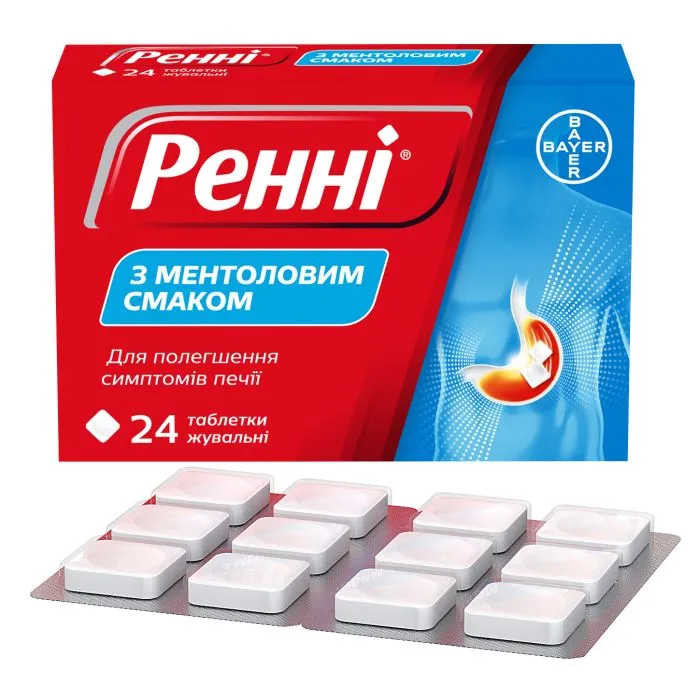
Table of Contents
INSTRUCTION FOR MEDICAL USE OF THE MEDICINAL PRODUCT RENNIE® WITH MENTHOL FLAVOR
Composition:
Active substances: calcium carbonate, magnesium carbonate;
One tablet contains 680 mg of calcium carbonate (272 mg of elemental calcium) and 80 mg of heavy magnesium carbonate;
Excipients: sucrose, pregelatinized corn starch, potato starch, talc, magnesium stearate, light mineral oil, peppermint flavoring, lemon flavoring.
Pharmaceutical form. Chewable tablets.
Main physicochemical properties: cream-white square tablets with concave surfaces, embossed with the inscription "RENNIE" on both sides, with a menthol odor.
Pharmacotherapeutic group. Antacids, other combinations. ATC code A02AX.
Pharmacological properties.
Pharmacodynamics.
Rennie® with peppermint flavor is a combination of two antacids: calcium carbonate and magnesium carbonate, which exert a local effect by neutralizing gastric acid, independent of systemic absorption. Calcium carbonate has prolonged and strong neutralizing activity. This effect is enhanced by magnesium carbonate, which also has potent neutralizing activity.
The total acid-neutralizing capacity of the drug in vitro is 16 mEq H+ (titration to the endpoint pH of 2.5).
In vitro acid neutralization studies (artificial stomach model) have shown that Rennie® with peppermint flavor increases gastric pH from 1.5–2 to 3 within 40 seconds, and pH 4 can be achieved within 1 minute 13 seconds. The maximum pH level reached in the model was 5.24.
Pharmacokinetics.
In the stomach, calcium carbonate and magnesium carbonate react with gastric juice and form water and soluble mineral salts.
CaCO3 + 2HCl → CaCl2 + H2O + CO2
MgCO3 + 2HCl → MgCl2 + H2O + CO2
Calcium and magnesium may be absorbed in the form of their soluble salts. The extent of absorption of calcium and magnesium from these compounds depends on the dose of the drug. Maximum absorption levels are 10% for calcium and 15–20% for magnesium. In healthy volunteers, a small amount of absorbed calcium and magnesium is excreted by the kidneys. In case of impaired renal function, plasma concentrations of calcium and magnesium may increase. During intestinal digestion, insoluble compounds are formed from the soluble salts and are eliminated in the feces.
Preclinical studies of Rennie® medicinal products have not been conducted. Available preclinical data on calcium carbonate and magnesium carbonate (repeated-dose toxicity, genotoxicity and/or carcinogenic potential, reproductive toxicity data in rodents), described in the scientific literature, do not contain information beyond that provided in other sections of this instruction.
Clinical characteristics.
Indications.
For adults and children aged 15 years and older, to relieve symptoms associated with increased gastric acidity (e.g., heartburn, gastroesophageal reflux) leading to digestive disturbances and dyspepsia.
Contraindications.
- Hypersensitivity to the components of the drug;
- hypercalcemia and/or conditions leading to hypercalcemia;
- calcium-containing kidney stones (nephrolithiasis);
- severe renal impairment (creatinine clearance below 30 mL/min);
- hypophosphatemia.
Interaction with other medicinal products and other forms of interaction.
Other medicinal products should be administered 1–2 hours before or after taking Rennie® with peppermint flavor.
Since reduced gastrointestinal absorption of certain concomitantly administered drugs may occur, a precautionary measure is to maintain a 2-hour interval between administration of Rennie® with peppermint flavor and acetylsalicylic acid, estramustine, H2-antagonist antihistamines, atenolol, metoprolol or propranolol, chloroquine, diflunisal, digoxin, bisphosphonates, fexofenadine, glucocorticoids (prednisolone and dexamethasone, except hydrocortisone in replacement therapy), indomethacin, ketoconazole, phenothiazine neuroleptics, penicillamine, thyroid hormones (thyroxine), ethambutol, isoniazid, lansoprazole, sulpiride, and tetracyclines.
Changes in gastric acidity, for example during treatment with antacids, may impair the rate and extent of absorption of other drugs taken concomitantly. When Rennie® with peppermint flavor is used concomitantly with antibiotics (tetracyclines, quinolones, lincosamides) and cardiac glycosides (digoxin), bisphosphonates, dolutegravir (the antacid should be administered either 2 hours after or 6 hours before dolutegravir), compounds containing phosphorus, strontium, or zinc, levothyroxine, and eltrombopag, the absorption of these agents is reduced.
Thiazide diuretics reduce urinary excretion of calcium and increase its serum levels. Due to the increased risk of hypercalcemia with concomitant use of thiazide diuretics, serum calcium levels should be monitored regularly.
Calcium salts reduce the absorption of fluorides and iron-containing preparations. Also, calcium and magnesium salts may interfere with phosphate absorption.
It should be noted that concomitant use may lead to enhanced renal excretion of salicylates due to urinary alkalinization.
Sodium polystyrene sulfonate – a cation-exchange resin: the ability of the resin to bind potassium is reduced, increasing the risk of metabolic alkalosis in renal impairment.
Special precautions for use
If symptoms do not disappear, persist partially, or worsen after 10 days of treatment, a medical examination should be performed to determine their cause and to reassess the treatment regimen. The treatment course with Rennie® should not exceed 10 days. Adverse reactions have been observed when used concomitantly with thiazide diuretics (see section "Interaction with other medicinal products and other forms of interaction"). Prolonged use of the medicinal product in high doses may lead to adverse reactions such as hypercalcemia, hypermagnesemia, and milk-alkali syndrome, particularly in patients with renal insufficiency. The product should not be taken simultaneously with large amounts of milk or dairy products. Prolonged use of Rennie® may increase the risk of kidney stone formation. When using 4 to 5 tablets per day, the treatment course should be short, and treatment should be discontinued immediately after symptoms resolve.
Medical advice should be sought in cases of weight loss, swallowing difficulties, or persistent discomfort in the stomach, signs of digestive disorders, if they have newly appeared or changed in character, and in cases of renal impairment (calcium and magnesium levels should be monitored).
Calcium carbonate and magnesium carbonate should not be used in patients with hypercalciuria. This medicinal product should be used with caution in patients with impaired renal function. If calcium carbonate and magnesium carbonate must be administered to such patients, regular monitoring of plasma levels of calcium, phosphorus, and magnesium is required.
This product should not be administered to patients with hereditary conditions associated with fructose intolerance, glucose-galactose malabsorption, or sucrose-isomaltase deficiency, as it contains 475 mg of sucrose. This should also be taken into account in patients with diabetes mellitus.
Use during pregnancy or breastfeeding
Pregnancy
Animal studies have not revealed any direct or indirect harmful effects on reproductive function.
To date, in clinical practice, no specific congenital malformations or fetotoxic effects have been observed with the use of calcium carbonate and magnesium carbonate at recommended doses. However, there is insufficient clinical experience during pregnancy with this combination to exclude all risks.
It should be considered that the presence of magnesium salts may cause diarrhea, and prolonged use of high doses of calcium may increase the risk of hypercalcemia with calcification of various organs, including the kidneys. Rennie® with peppermint flavor should be used during pregnancy only if necessary.
It should also be noted that during pregnancy or breastfeeding, calcium carbonate and magnesium carbonate provide a significant amount of calcium as a supplement to dietary intake.
To prevent calcium overload, the maximum recommended daily dose of Rennie® with peppermint flavor should not be exceeded, use should be limited to 1 week, and consumption of milk (1 liter contains up to 1.2 g of elemental calcium) and dairy products should be avoided during treatment to prevent excess calcium intake, which may lead to the so-called milk-alkali syndrome (Burnett's syndrome)—a rare but serious condition requiring medical intervention.
Lactation
Calcium and magnesium are excreted in breast milk, but when Rennie® with peppermint flavor is used at therapeutic doses, no effects on newborns or infants who are breastfed are expected.
Breastfeeding is possible while using this medicinal product, provided the product is used according to the instructions; however, prolonged use of high doses should be avoided.
Fertility
There is no information available on the effect of the product on fertility.
Ability to affect reaction speed when driving or operating machinery
No effect.
Dosage and Administration.
For oral use in adults and children aged 15 years and older.
Take 1–2 chewable tablets as a single dose by dissolving or chewing one hour after meals, or when experiencing pain or heartburn, or before bedtime.
The dose may be increased for a short period up to a maximum of 5 tablets per day.
The treatment duration should not exceed 10 days (see section "Special Warnings and Precautions for Use").
Children.
Do not use in children under 15 years of age.
Overdose.
Prolonged use of high doses of calcium carbonate and magnesium carbonate, especially in patients with renal insufficiency, may lead to hypermagnesemia, hypercalcemia, and alkalosis, manifested by gastrointestinal symptoms (nausea, vomiting, diarrhea or constipation) and muscle weakness. In such cases, the drug should be discontinued and adequate fluid intake ensured. In severe cases of overdose (e.g., Burnett's syndrome), additional rehydration measures (infusion) may be required.
Side effects.
Immune system disorders.
Very rarely, hypersensitivity reactions have been reported, manifesting as rashes, urticaria, itching, angioneurotic edema, dyspnea, and anaphylaxis.
Metabolism and nutrition disorders.
In patients, especially those with impaired renal function, prolonged use of high doses may lead to hypermagnesemia (with magnesium-containing antacids) or hypercalcemia and alkalosis, which may present as gastrointestinal symptoms and muscle weakness. There is also a risk of kidney stone formation and development of renal failure.
Gastrointestinal disorders.
Nausea, vomiting, gastric discomfort, constipation, and diarrhea may occur.
Musculoskeletal and connective tissue disorders.
Muscle weakness is possible.
Side effects observed only in milk-alkali syndrome (Burnett's syndrome):
- Gastrointestinal disorders (ageusia);
- General disorders (calcinosis and asthenia);
- Nervous system disorders (headache);
- Renal and urinary disorders (azotemia).
Reporting of suspected adverse reactions after drug registration is of great importance. It allows continuous monitoring of the benefit-risk balance of the medicinal product. Healthcare and pharmaceutical professionals, as well as patients or their legal representatives, should report all suspected adverse reactions and lack of efficacy via the Automated Pharmacovigilance Information System at: https://aisf.dec.gov.ua.
Shelf life. 5 years.
Storage conditions.
Store in the original packaging at a temperature not exceeding 25 ºC.
Keep out of reach of children.
Packaging.
6 tablets in blisters made of PVC and aluminum, 2 or 4 blisters per cardboard box; or 12 tablets in perforated blisters made of PVC and aluminum, 1 or 2 blisters per cardboard box.
Availability.
Over-the-counter.
Manufacturer.
Delpharm Gaillard /
Delpharm Gaillard
Manufacturer's address and place of business.
33 rue de l’Industrie, 74240, Gaillard, France /
33 rue de l’Industrie, 74240, Gaillard, France