Relief pro
Ukraine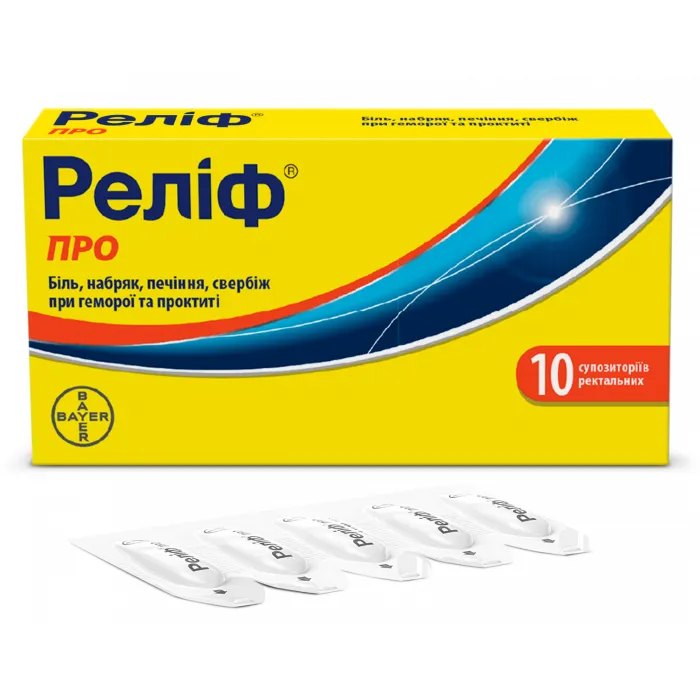
Table of Contents
INSTRUCTIONS FOR MEDICAL USE OF THE MEDICINAL PRODUCT RELIEF® PRO (RELIEF®PRO)
Composition:
Active substances: 1 suppository contains: 1 mg fluocortolone pivalate and 40 mg micronized lidocaine hydrochloride monohydrate;
Excipients: hard fat.
Dosage form. Rectal suppositories.
Main physicochemical properties: yellowish-white suppositories.
Pharmacotherapeutic group. Agents for the treatment of hemorrhoids and anal fissures for topical use. Corticosteroids. Fluocortolone. ATC code C05AA08.
Pharmacological Properties
Pharmacodynamics
Fluocortolone pivalate suppresses inflammatory and allergic skin reactions and also alleviates subjective symptoms such as itching, burning sensation, and pain; reduces capillary dilation, interstitial cell edema and tissue infiltration, and inhibits capillary proliferation.
Lidocaine hydrochloride is a standard local anesthetic agent that has been used in medical practice for many years. Due to its analgesic effect, it is effective when administered in suppositories and ointments intended for the treatment of disorders associated with hemorrhoidal disease. Pain and itching relief are associated with inhibition of afferent nerve impulses.
Pharmacokinetics
After a single rectal administration of the suppository to healthy male volunteers, the maximum systemic absorption was approximately 5% of the fluocortolone pivalate dose and approximately 24% of the lidocaine hydrochloride dose.
Clinical characteristics.
Indications.
For symptomatic treatment of pain and inflammation in cases of:
- hemorrhoids;
- proctitis.
Contraindications.
The use of Relief**®** Pro is contraindicated in local infections at the site of application, as well as in the presence of clear symptoms of the following pathological conditions in the relevant areas:
- specific skin lesions (syphilis, tuberculosis);
- varicella (chickenpox);
- post-vaccination reactions;
- genital herpes;
- smallpox;
- other viral infections;
- primary bacterial or fungal infections;
- secondary skin infections in the absence of appropriate antibiotic therapy.
Contraindicated in patients with hypersensitivity to other local anesthetics of amide type (e.g., bupivacaine, mepivacaine, and lidocaine).
Relief**®** Pro should not be used in patients with hypersensitivity to the active substances or to any of the excipients.
Special precautions.
Contact of Relief**®** Pro suppositories with the eyes must be avoided. Hands should be thoroughly washed after administration.
Additional specific antifungal therapy is required in case of fungal lesions.
Scientific literature reports cases of cataract development in patients using corticosteroids over a prolonged period. Therefore, in order to exclude systemic effects of corticosteroids, the potential role of corticosteroids in cataract development should be considered.
Use with caution in debilitated patients, elderly patients, and in patients with severe heart failure, renal failure, or hepatic failure.
The excipient hard fat may reduce the effectiveness of latex products such as condoms.
Interaction with other medicinal products and other forms of interaction.
Interaction studies have not been conducted. Relief**®** Pro, rectal suppositories, contain the active substance lidocaine hydrochloride (anhydrous). Approximately 30% of the administered dose of lidocaine reaches the systemic circulation. This should be taken into account in patients receiving medications for cardiac rhythm disorders (arrhythmias).
Concomitant use with CYP3A inhibitors, including cobicistat in tablet form, is considered to increase the risk of systemic adverse effects. Such combination should be avoided unless the benefit outweighs the risk of systemic adverse effects associated with corticosteroid use. If concomitant use is necessary, the patient's condition should be monitored to ensure absence of systemic adverse effects related to corticosteroid administration.
Special precautions for use.
Use during pregnancy or breastfeeding.
Data on the use of Reli**®** Pro suppositories in women during pregnancy are insufficient. Animal studies with glucocorticoids have shown evidence of reproductive toxicity.
Some epidemiological studies suggest a possible increased risk of cleft palate in newborns whose mothers received systemic glucocorticoid therapy during the first trimester of pregnancy. Cleft palate is a rare condition, and although systemic use of glucocorticoids may cause teratogenic effects, their use can be considered a contributing cause of this condition only if the incidence increases to one or two cases per 1,000 women treated with glucocorticoids during pregnancy.
Data on the topical use of glucocorticoids for treating women during pregnancy are insufficient; however, the risk can be considered low, as glucocorticoids administered topically are characterized by very low systemic bioavailability.
In general, topical preparations containing glucocorticoids should not be used during the first trimester of pregnancy.
When prescribing treatment to pregnant or lactating women, a careful assessment of the clinical need for Reli**®** Pro suppositories, as well as the risk-benefit ratio, should be performed. In particular, prolonged use of the medicinal product should be avoided.
Ability to influence reaction speed when driving or operating machinery. No effect.
Method of Administration and Dosage.
Apply 1 suppository twice daily, in the morning and evening. After improvement, it is often sufficient to use 1 suppository once daily or once every two days. It is recommended to use Reli**®**f Pro suppositories after defecation. Before insertion, the anal area should be gently cleaned.
Insert the suppository deeply into the anal canal. The duration of treatment with Reli**®**f Pro suppositories should not exceed 2 weeks.
If the suppositories become soft due to exposure to high temperatures, immerse them in cold water before removing the wrapper.
Children. Not recommended for use in children due to lack of data on safety and efficacy.
Overdose.
Results of studies on potential acute toxicity associated with the active ingredients of Reli**®**f Pro suppositories indicate no risk of developing symptoms related to acute toxicity following accidental overdose after a single rectal administration of the drug.
In case of accidental ingestion of the medicinal product (e.g. swallowing several suppositories), systemic symptoms caused by lidocaine hydrochloride are expected. Depending on the dose, these may manifest as severe cardiovascular disturbances (decreased blood pressure, increased sweating, pallor, bradycardia, arrhythmia, cardiac depression, shock, or, in particularly severe cases, cardiac arrest) or reactions related to central nervous system disturbances (headache, dizziness, blurred vision, diplopia, tinnitus, somnolence, numbness of extremities, chills, restlessness, vomiting, seizures, dyspnea, or, in particularly severe cases, respiratory failure). Methemoglobinemia is possible.
Management of overdose includes careful monitoring of vital functions, supportive care to maintain oxygen levels, and symptomatic treatment of central nervous system and cardiovascular disturbances, such as administration of short-acting barbiturates, beta-sympathomimetics, and atropine. Dialysis is not sufficiently effective.
Adverse Reactions.
The incidence of adverse effects is based on the pooled data from clinical studies involving 367 patients.
Skin and subcutaneous tissue disorders, including allergic reactions:
Common: pain and burning sensation at the application site;
Uncommon: irritation at the application site.
With prolonged use of Reli**®**f Pro suppositories (exceeding 4 weeks), there is a risk of developing local skin pathological conditions such as atrophy, striae, or telangiectasia.
Adverse reactions due to lidocaine hydrochloride: systemic adverse reactions to lidocaine are unlikely, as the systemic absorption of lidocaine is minimal when the medicinal product is used as directed.
Shelf life. 4 years.
Storage conditions.
Store in a place inaccessible to children, at a temperature not exceeding 25 °C.
Packaging.
5 suppositories per strip, 2 strips per carton with labeling in Ukrainian.
Availability. Over-the-counter.
Manufacturer.
Istituto De Angeli S.r.l.
Istituto De Angeli S.r.l.
Manufacturer's address.
Localita Prulli n. 103/c – 50066 Reggello (FI), Italy.
Marketing authorization holder.
Bayer Consumer Care AG.
Address of the marketing authorization holder.
Peter Merian-Strasse 84, 4052 Basel, Switzerland.