Raunatin-health
Ukraine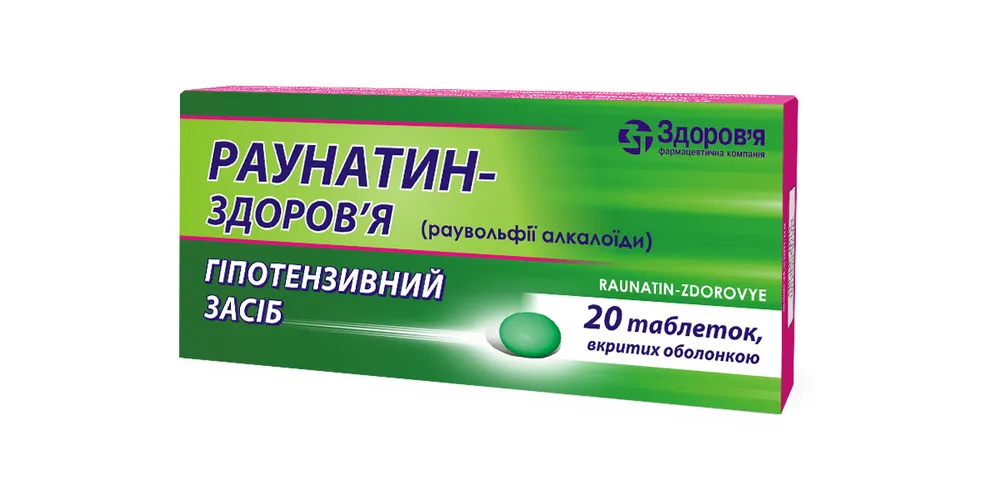
Table of Contents
INSTRUCTIONS FOR MEDICAL USE OF THE MEDICINAL PRODUCT RAUNATIN-ZDOROVYE (RAUNATIN-ZDOROVYE)
Composition:
Active substance: 1 tablet contains Rauwolfia extract (total alkaloids of Rauwolfia) (dry extract of Rauwolfia vomitoria root (31–33:1) (extraction solvent: methanol)) 2 mg;
Excipients: sucrose; corn starch; glucose monohydrate; calcium stearate; stearic acid; mineral oil; light magnesium carbonate; titanium dioxide (E 171); povidone; talc; colloidal anhydrous silicon dioxide; yellow wax; colorant Sikovit Green Z2755 containing quinoline yellow (E 104) and patent blue V (E 131).
Pharmaceutical form. Coated tablets.
Main physicochemical properties: coated tablets, light green in color, with a biconvex surface. Speckles on the tablet surface are permissible. Three layers are visible in cross-section.
Pharmacotherapeutic group. Antihypertensive agents. Antiadrenergic agents with central mechanism of action. Rauwolfia alkaloids. ATC code C02AA04.
Pharmacological properties.
Pharmacodynamics.
The medicinal product contains a mixture of alkaloids derived from the roots of Rauwolfia serpentina or the root bark of Rauwolfia vomitoria of the Apocynaceae family. The alkaloids include reserpine, serpentines, and ajmaline. The total alkaloid content is not less than 90%.
Raunatin has a hypotensive effect due to reduction in the levels of biogenic monoamines (noradrenaline, dopamine, serotonin) in the central nervous system (CNS), particularly in cortico-hypothalamic structures, especially the posterior hypothalamus. By interfering with the storage processes of neurotransmitters in vesicles of the presynaptic membrane of peripheral adrenergic nerve endings, vascular walls, and the adrenal medulla, the drug blocks adrenergic transmission, resulting in a gradual decrease in arterial blood pressure. The hypotensive effect of Raunatin develops more gradually compared to reserpine, but in terms of intensity, it does not significantly differ from reserpine. A distinctive feature of the drug is the enhancement of glomerular filtration in the kidneys, leading to increased renal blood flow.
The drug also exhibits antiarrhythmic activity and a calming effect on the CNS. The sedative effect of Raunatin is less pronounced compared to reserpine.
The therapeutic effect of the drug develops gradually, reaching its peak by the 10th to 14th day after initiation of treatment, and persists for 2–3 months.
In some cases, Raunatin is better tolerated than reserpine.
Pharmacokinetics.
The alkaloids of the drug are well absorbed from the gastrointestinal tract; Cmax in blood is reached within 1–3 hours after administration. Plasma protein binding is 40–50%. The half-life (T½) ranges from 50 to 170 hours. The drug is metabolized in the intestine and liver and is primarily excreted in feces, as well as in urine.
Clinical characteristics.
Indications.
Mild to moderate arterial hypertension.
Contraindications.
Hypersensitivity to Rauwolfia alkaloids; arterial hypotension, cardiac insufficiency, organic heart disease, bradycardia, aortic valvular disorders, severe cerebral atherosclerosis, depression, epilepsy, parkinsonism, peptic ulcer of the stomach and duodenum in the stage of exacerbation, ulcerative colitis, nephrosclerosis, bronchial asthma, pheochromocytoma, electroconvulsive therapy (the drug should be discontinued at least 7 days before electroconvulsive therapy).
Interaction with other medicinal products and other forms of interactions.
Concomitant use with monoamine oxidase inhibitors (MAO inhibitors) may lead to excitation and arterial hypertension. The antihypertensive effect of raunatine is enhanced when used with other antihypertensive agents (thiazide diuretics, β-adrenoblockers, angiotensin-converting enzyme (ACE) inhibitors, calcium ion antagonists). Enhances the central nervous system depressant effects of alcohol, barbiturates, and antidepressants. Digitalis preparations or quinidine used concomitantly with raunatine may cause arrhythmia. Reduces the efficacy of antiparkinsonian agents and sympathomimetics.
Special precautions for use.
Treatment with the drug should be carried out under medical supervision. In patients with angina pectoris, chest pain may be intensified.
The drug should be discontinued several days prior to planned surgical procedures. In case of emergency surgery under general anesthesia in patients taking raunatine, premedication with atropine is required.
The drug should not be used prior to electroconvulsive therapy sessions.
Since rauwolfia alkaloids enhance gastrointestinal motility and secretion, caution should be exercised when administering the drug to patients with a history of peptic ulcer disease.
Caution is also advised when using the drug in debilitated patients and elderly patients; in patients with renal impairment, cholelithiasis, arrhythmia, or those who have recently suffered myocardial infarction.
If a patient has known intolerance to certain sugars, medical advice should be sought before taking this drug.
Use during pregnancy or breastfeeding.
The use of the drug during pregnancy or breastfeeding is contraindicated because the alkaloid reserpine crosses the placenta and is excreted in breast milk. If treatment with the drug is necessary, breastfeeding should be discontinued for the duration of therapy.
Ability to affect reaction rate when driving or operating machinery.
The medicinal product may reduce reaction speed, especially at the beginning of treatment. Therefore, during treatment, patients should avoid potentially hazardous activities requiring high attention and rapid psychomotor reactions.
Method of Administration and Dosage
The medicinal product should be administered orally to adults after meals.
On day 1, the initial dose is usually 1 tablet at night; on day 2, 1 tablet twice daily; on day 3, 1 tablet three times daily. Then, gradually increase the total daily dose to 4–6 tablets. After achieving a stable therapeutic effect (usually within 10–14 days), the dose should be gradually reduced to 1–2 tablets per day. The treatment course lasts 3–4 weeks, but in some cases, the drug should be used long-term at a maintenance dose (1 tablet per day) as indicated.
Children. Data on the use of the drug in children are lacking.
Overdose
Symptoms: sweating, general weakness, and pronounced arterial hypotension. In severe cases, after a brief period of euphoria, somnolence, hypodynamia, severe depression (which may lead to suicide), pronounced parkinsonism, loss of consciousness, coma, seizures, respiratory depression, and hypothermia may develop.
Treatment: gastric lavage and administration of activated charcoal. Forced diuresis is indicated. In cases of pronounced reduction in arterial pressure or collapse, lay the patient down and elevate their legs. If necessary, intravenous administration of reopolyglucin or mesaton with angiotensinamide or a 2% solution of norepinephrine bitartrate is indicated. Adrenergic agents should be used with great caution due to the risk of pulmonary edema. Subcutaneously administer 10% solution of sodium caffeine benzoate. In cases of severe respiratory depression or respiratory arrest, suctioning of mucus from the airways, intubation, artificial ventilation of the lungs, and oxygen therapy are required.
There are no specific antidotes for poisoning with raunatin and other Rauvolfia preparations.
Adverse Reactions
The drug is usually well tolerated. Occasionally possible:
Cardiovascular system: edema, flushing, bradycardia; in patients with angina pectoris, possible exacerbation of chest pain; with prolonged use, increased frequency of angina attacks.
Nervous system: headache, drowsiness, sweating, depression, general weakness; with prolonged use – occurrence of nightmares, development of parkinsonism symptoms.
Eye disorders: miosis.
Gastrointestinal system: nausea, vomiting, diarrhea, abdominal pain, increased or decreased appetite, hypersalivation, dry mouth, increased gastric juice secretion.
Hepatobiliary system: with prolonged use in high doses, possible liver function impairment.
Urinary and reproductive system: dysuria, impotence.
Endocrine system and metabolism: decreased libido, sodium retention, increased prolactin secretion, galactorrhea, gynecomastia, breast engorgement, weight gain.
Allergic reactions: skin rashes, itching, dryness of mucous membranes, nasal mucosa edema.
Blood and lymphatic system disorders: thrombocytopenic purpura.
Adverse effects resolve upon dose reduction or after a short break (1–3 days) in drug administration.
Shelf life. 3 years.
Storage conditions. Store in original packaging at a temperature not exceeding 25 °C.
Keep out of reach of children.
Packaging. Tablets, pack size: № 10, № 20, № 10×5, № 10×10 in blisters in a box; № 10 in blisters.
Prescription status. Prescription only.
Manufacturer. LIMITED LIABILITY COMPANY "CORPORATION "ZDOROVIYA".
Manufacturer's address and place of business.
22, Shevchenka Street, Kharkiv, Kharkiv region, 61013, Ukraine.