Progestogel
Ukraine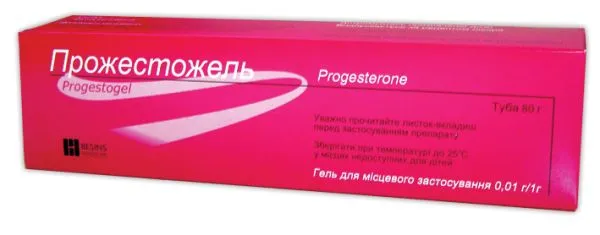
Table of Contents
INSTRUCTIONS FOR MEDICAL USE OF THE MEDICINAL PRODUCT PROGESTOGEL® (PROGESTOGEL®)
Composition:
active substance: progesterone;
1 g of gel contains 10 mg of progesterone;
excipients: octyldodecanol; carbomer 980; polyethoxylated hydrogenated castor oil; triethanolamine; ethanol 96%; purified water.
Pharmaceutical form. Gel.
Basic physical and chemical properties: colorless, slightly opalescent, semi-transparent gel with an alcoholic odor.
Pharmacotherapeutic group. Sex hormones and agents used in pathologies of the reproductive system. Progestogens. Derivatives of pregnane.
ATC code G03DA04.
Pharmacological Properties
Pharmacodynamics
The pharmacological properties are determined by the presence of progesterone, one of the natural hormones in the human body. In breast tissue, progesterone reduces capillary permeability, which is increased under the influence of estrogens. Progesterone participates in the regulation of growth and differentiation of mammary ducts and lobules, and blocks the estrogen-induced cycle of rapid mitosis of epithelial cells. Progesteron® is used for the treatment of benign breast diseases developing due to absolute or relative local progesterone deficiency.
Topical application of progesterone significantly increases the activity of 17β-hydroxysteroid dehydrogenase in the breast tissue; this enzyme stimulates the local conversion of estradiol to estrone and contributes to a reduction in estrogen activity in target tissues.
As a result of estrogen receptor blockade, fluid absorption from tissues improves, and compression of mammary ducts decreases.
Thermogenic effect is almost absent due to a different metabolic pathway of progesterone: when applied transdermally, progesterone is converted into alpha-reduced derivatives, unlike orally administered progesterone, which is metabolized into thermogenic beta-reduced derivatives.
Due to inhibition of tubular sodium ion reabsorption and increased cellular filtration, progesterone prevents fluid retention during secretory transformations of the glandular component of mammary glands, thereby preventing the development of pain syndrome (mastalgia or mastodynia).
In addition, the action of progesterone is associated with blockade of prolactin receptors in breast tissue, leading to a reduction in lactopoeisis.
Transdermal delivery of progesterone also affects the glandular epithelium and vascular network, resulting in reduced capillary permeability and, consequently, decreased breast tissue edema and associated mastalgia symptoms.
Pharmacokinetics
Absorption of progesterone through the skin is approximately 10% of the applied dose, resulting in high concentrations of the drug (10 times higher than systemic blood concentrations) in breast tissue, without significant entry into the systemic circulation in amounts capable of producing systemic effects, particularly on the uterus.
Serum concentration studies of prolactin, estradiol, and progesterone during treatment with Progesteron® showed that one hour after application—when maximum absorption into tissues occurs—hormone levels remain practically unchanged.
With transdermal administration, progesterone reaches breast tissue without being destroyed in the liver and without exerting adverse systemic effects on the body.
Secondary metabolism of the drug occurs in the liver, forming conjugates with glucuronic and sulfuric acids. The isoenzyme CYP2C19 is also involved in the metabolism. The drug is excreted via the kidneys (50–60%) and via bile (more than 10%). The amount of metabolites excreted by the kidneys varies depending on the luteal phase.
Clinical characteristics.
Indications.
Benign breast diseases:
- Essential mastodynia;
- Mastodynia associated with benign breast disease (complex treatment of benign mastopathy against the background of progesterone deficiency).
Prozhestozhel® is not indicated for use in men.
Contraindications.
Hypersensitivity to any component of the medicinal product.
Breast cancer.
Nodular forms of fibrocystic mastopathy.
Breast tumors (tumor-like formations) of unclear etiology.
Genital organ cancers (as monotherapy).
Interaction with other medicinal products and other types of interactions.
The effect of the drug may be enhanced when used concomitantly with combined hormonal contraceptives.
Interaction studies have not been conducted.
According to currently available information, no interactions with other medicinal products have been observed.
Special precautions.
Do not exceed the recommended dose.
The breasts and hands must be completely clean during application. In cases of menstrual cycle disorders, concomitant use with oral progesterone or progestin may be recommended.
This medicinal product is intended for topical use only — it should not be swallowed.
This medicinal product IS NOT A CONTRACEPTIVE.
Although not specifically studied or reported, there remains a potential risk of adverse reactions in other individuals through skin contact with the patient who has applied the medicinal product.
When the skin's barrier function is impaired, there is a risk of progesterone entering the systemic circulation. Therefore, the use of the medicinal product Progesterone® in such cases is not recommended.
The medicinal product contains ricinus oil, which may cause skin reactions.
Use with caution in the following conditions: hepatic insufficiency, renal insufficiency, bronchial asthma, epilepsy, migraine, depression, hyperlipoproteinemia, ectopic pregnancy, abortion, tendency to thrombosis, acute forms of phlebitis or thromboembolic disorders, vaginal bleeding of unknown etiology, porphyria, arterial hypertension, diabetes mellitus.
Avoid exposure to direct sunlight after applying the gel.
Use during pregnancy or breastfeeding.
Progesterone® is not indicated for use during pregnancy. There is insufficient experience with the use of Progesterone® during pregnancy. However, no negative effects of progesterone on the fetus have been reported.
Progesterone® is not indicated for use during breastfeeding. Progesterone may be partially excreted in breast milk. However, no adverse effects on the infant have been reported.
Ability to influence reaction speed when driving or operating machinery.
No data available.
Method of Administration and Dosage
For transdermal use.
Treatment should be continuous throughout the month, including during menstruation, with daily application of the medicinal product.
The treatment course is determined by a physician; usually, the average duration of treatment is from 3 to 6 months.
The maximum daily dose is 5 g.
Method of Administration
Press on the lower part of the tube and place the dose of the medicinal product into the groove of the dosing spatula.
Apply one or two doses (2.5 g each) of the gel onto clean and dry skin of each breast using the dosing spatula. Gently rub in until the medicinal product is completely absorbed into the skin.
Children.
The drug is not used in pediatric practice.
Overdose.
There have been no reports of overdose.
Due to the method of administration, overdose is unlikely.
Menstruation may start one to two days earlier; in such a case, the drug may be used from day 10 to day 25 of the cycle. Normal cycle duration will be restored immediately after discontinuation of treatment.
Adverse reactions.
Isolated cases of hypersensitivity or non-specific skin irritation have been reported.
In some cases, menstruation may start one to two days earlier without any changes in the usual monthly volume of discharge. Weak secretory LH-mimetic activity has been observed, which does not share characteristics with the effects of systemic administration of an equivalent dose of progesterone.
When the recommended method of application is followed, systemic absorption of progesterone is unlikely. However, if the skin barrier function is impaired, there is a risk of developing systemic adverse reactions, including menstrual cycle disturbances, amenorrhea, breakthrough bleeding, and headache.
Very rare: breast tenderness, hot flushes, metrorrhagia, decreased libido, hypersensitivity reactions including erythema at the site of gel application, swelling of the lips and neck, fever, headache, nausea.
Reporting of suspected adverse reactions
After authorization of the medicinal product, it is important to collect reports of suspected adverse reactions. This enables ongoing monitoring of the benefit-risk balance of the medicinal product. Healthcare professionals should report any suspected adverse reactions through the national pharmacovigilance system.
Shelf life: 3 years.
Storage conditions:
Store at temperatures not exceeding 25 °C. Keep out of reach of children.
Packaging:
80 g in a tube, 1 tube with a spatula-doser in a cardboard box.
Prescription status: Prescription only.
Manufacturer:
Besins Manufacturing Belgium.
Manufacturer's address and location of operations:
Groot-Bijgaardenstraat 128, 1620 Drogenbos, Belgium.
Marketing Authorization Holder:
Besins Healthcare SA.
Address of the Marketing Authorization Holder:
Rue Washington 80, 1050 Ixelles, Belgium.