Proteflazid
Ukraine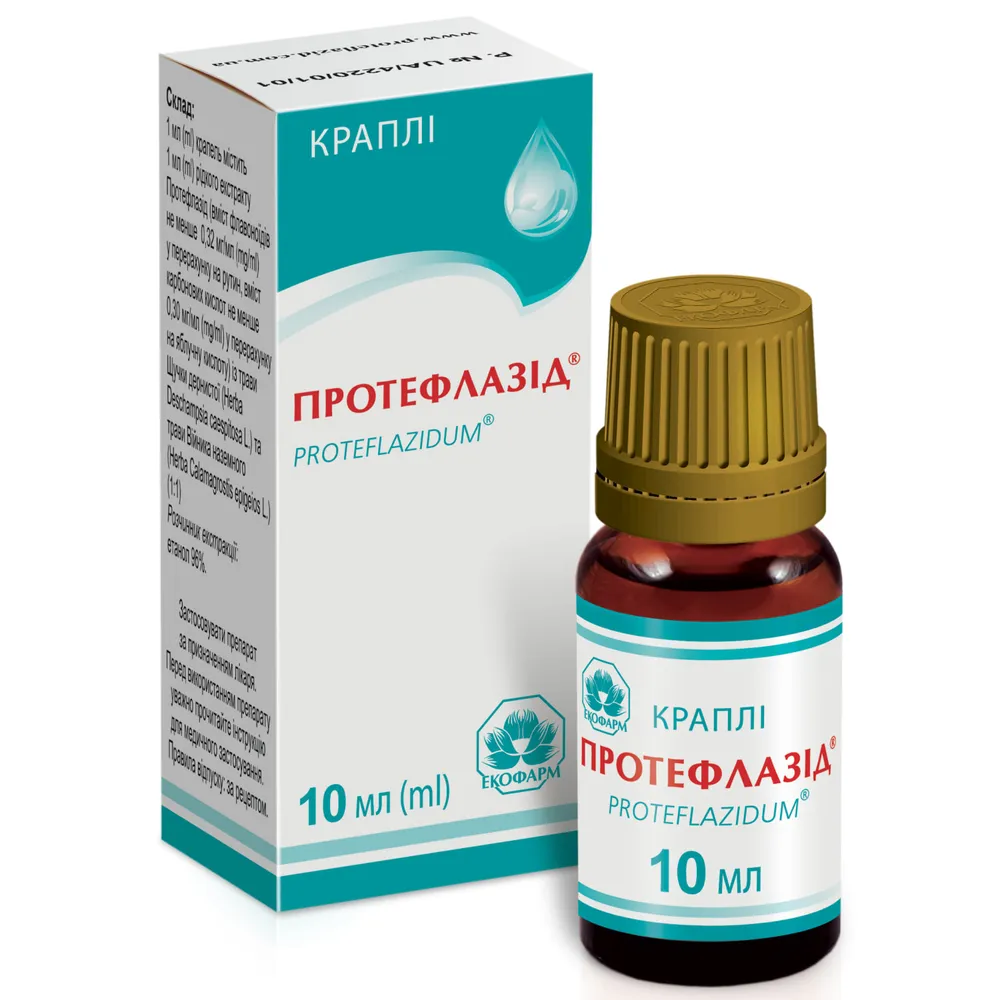
Table of Contents
INSTRUCTION FOR MEDICAL USE OF THE MEDICINAL PRODUCT PROTEFLAZID® (PROTEFLAZIDUM®)
Composition:
1 ml of drops contains 1 ml of liquid extract Proteflazid (flavonoid content 0.85 mg/ml expressed as rutin, content of carboxylic acids not less than 0.30 mg/ml expressed as malic acid) from the herb of Deschampsia caespitosa L. and the herb of Calamagrostis epigeios L. (1:1). Extraction solvent: 96% ethanol.
Medicinal form: Drops.
Main physicochemical properties: dark green liquid with a specific odor.
Pharmacotherapeutic group: Direct-acting antiviral agents. ATC code J05AX.
Pharmacological Properties
Pharmacodynamics
The flavonoids contained in the drug inhibit DNA and RNA virus replication both in vitro and in vivo. Antiviral activity of the drug against herpes viruses, hepatitis viruses, papillomaviruses, HIV infection, influenza, and acute respiratory infections has been demonstrated and confirmed in preclinical and clinical studies.
The mechanism of direct antiviral action has been proven to involve inhibition of virus-specific enzymes—DNA- and RNA-polymerases, thymidine kinase, reverse transcriptase, 3CL protease, and neuraminidase.
Proteflazid inhibits the activity of SARS-CoV-2 coronavirus 3CL protease, as confirmed by molecular docking methods and using an assay kit containing MBP-tagged (maltose-binding protein) SARS-CoV-2 coronavirus 3CL protease.
Using a dual-luciferase reporter gene assay (Renilla luciferase, modeling replication of the seasonal coronavirus CoV-229E), it was shown that the drug blocks viral replication.
Preclinical in vitro studies on monkey (Vero E6) and human (A549/ACE2) cell cultures demonstrated antiviral activity of the drug against the pandemic human coronavirus SARS-CoV-2, with significant inhibition of viral replication.
The drug possesses immunotropic properties. It protects mucous membranes by normalizing local immune parameters (lactoferrin, secretory immunoglobulin A, lysozyme, and complement component C3).
It has been established that the drug acts as an inducer of endogenous α- and γ-interferon synthesis up to physiologically active levels, thereby enhancing the body's nonspecific resistance to viral and bacterial infections.
Clinical studies have shown that, when taken daily according to age-related dosing and administration regimens, the drug does not exert immunotoxic effects and does not cause refractoriness (hyporeactivity) of the immune system: no suppression of alpha- and gamma-interferon synthesis is observed, allowing prolonged use of the drug when necessary.
The drug exhibits antioxidant activity, inhibits free radical processes, thereby preventing the accumulation of lipid peroxidation products, enhancing the cellular antioxidant status, reducing intoxication, promoting recovery after infections, and supporting adaptation to adverse environmental conditions.
The drug acts as a modulator of apoptosis, enhances the action of apoptosis-inducing agents, and activates caspase-9, thus promoting elimination of virus-infected cells and primary prevention of chronic diseases associated with latent viral infections.
The drug helps prevent disease recurrences and prolongs remission periods.
Pharmacokinetics
The active ingredients of the drug are rapidly absorbed from the gastrointestinal tract into the bloodstream, reaching maximum concentrations within 20 minutes after administration (in vivo studies). According to available kinetic data, the plasma half-life is approximately 2.3 hours. Oral bioavailability is 80%. Elimination from the body is slow. The level of active substance accumulation in blood cells is significantly higher compared to plasma. Sustained active substance concentrations in the blood ensure prolonged drug action in the body and accumulation in organs and tissues due to gradual release from blood cells. This pharmacokinetic profile of accumulation and release of active substances by blood cells necessitates twice-daily dosing to maintain effective concentrations.
Clinical characteristics.
Indications.
Treatment and prevention of recurrences caused by:
- Herpes simplex viruses type 1 and type 2;
- Varicella zoster virus and varicella (Herpes Zoster, type 3);
- Herpes virus type 4 (Epstein-Barr virus), acute and chronic active forms;
- Herpes virus type 5 (cytomegalovirus).
Treatment and prevention of influenza and other acute respiratory viral infections (including pandemic influenza strains).
As part of complex therapy for:
- Hepatitis B and C;
- Viral, bacterial, fungal infections, and their associations (chlamydia, mycoplasma, ureaplasma, etc.);
- HIV infection and AIDS.
Etiotropic therapy of mild and moderate forms of cervical dysplasia (CIN1 and CIN2) caused by papillomavirus infection, including oncogenic strains.
As part of combination therapy for other diseases caused by papillomavirus infection, including oncogenic strains.
Contraindications.
Hypersensitivity to the components of the drug. Gastric or duodenal ulcer.
Interaction with other medicinal products and other types of interactions.
During clinical use, combination of Proteflazid® with antibiotics and antifungal agents has been found possible and appropriate for treatment of viral-bacterial and viral-fungal diseases. No negative effects due to interaction with other medicinal products have been observed.
Special precautions for use.
When treating viral hepatitis, in 10–15% of patients with pronounced cytolytic syndrome, 2–4 weeks after the start of treatment, an increase in aminotransferase activity may occur, and less frequently, an increase in bilirubin levels. This condition persists for 2–4 weeks and does not require discontinuation of the drug.
For patients with gastrointestinal disorders and chronic gastroduodenitis, in case of gastroduodenitis exacerbation or development of gastroesophageal reflux, the drug should be taken 1.5–2 hours after eating.
Transient increase in body temperature up to 38 °C does not require discontinuation of the drug. If body temperature rises, it is necessary to consult a physician to rule out other possible causes of fever.
When the drug is applied locally, if a sensation of burning, itching, or dryness occurs, the concentration of the drug in the solution for applications should be reduced.
To prevent urogenital reinfection, simultaneous treatment of the sexual partner is recommended.
Use during pregnancy or breastfeeding.
Preclinical studies have not revealed embryotoxic, teratogenic, fetotoxic, mutagenic, or carcinogenic effects. Specific studies on the effects of the drug on the human fetus have not been conducted; however, clinical experience with the use of the drug during the I–III trimesters of pregnancy and during breastfeeding has not revealed any negative effects. The decision on the appropriateness of using the drug during pregnancy or breastfeeding should be made by a physician.
Ability to affect reaction speed when driving vehicles or operating machinery.
When used at recommended doses, no negative impact on the ability to perform tasks requiring special attention and rapid reaction has been observed.
Method of Administration and Dosage
Before use, the vial should be shaken.
The medication is dosed using a dropper. The required amount of the medication should be administered into water (volume - 1-2 tablespoons) and taken 10-15 minutes before meals.
Dosage regimen for the medication Proteflazid®, drops, according to age
| Age (years) |
Dose (drops) and frequency per day |
| from birth to 1 year |
1 drop per day |
| 1 - 2 years |
1 drop 2 times per day |
| 2 - 4 years |
2 drops 2 times per day |
| 4 - 6 years |
4 drops 2 times per day |
| 6 - 9 years |
9 drops 2 times per day |
| 9 - 12 years |
10 drops 2 times per day |
| Children from 12 years and adults |
12-15 drops 2 times per day |
The duration of use of the drug Proteflazid® depends on the indications and the course of the disease.
For the treatment and prevention of recurrences of herpetic gingivostomatitis, pharyngotonsillitis, chickenpox; for complex treatment of viral, bacterial, fungal infections and their associations; for prevention of viral and bacterial infections occurring in patients with impaired immune system function it is recommended to take the drug for 1 month.
For the treatment of eczema herpeticum and herpetic vesicular dermatitis (in combination with local application of the solution); herpetic meningitis and encephalitis; herpetic eye lesions; genital herpes; for the treatment of herpes zoster (Herpes zoster); acute and chronic active forms of Epstein-Barr virus infection; cytomegalovirus disease; papillomavirus infection (in combination with local application of the solution) it is recommended to take the drug continuously for 3 months.
In recurrent forms of infections, treatment courses with the drug are carried out 1–2 times per year as recommended by a physician.
The duration of treatment in pediatric practice is similar to that in adults. Doses are prescribed according to the patient's age and depending on the course of the disease. Treatment must be conducted under medical supervision.
In complex treatment of viral hepatitis B and C, HIV infection and AIDS it is recommended to take the drug continuously for 6–12 months.
Treatment of hepatitis in HIV-infected patients and patients with AIDS is carried out either before or after antiretroviral therapy.
For the treatment of influenza and other acute respiratory viral infections (ARVI) the drug is used for 5 to 14 days depending on the course of the disease. For prophylactic purposes, the drug is taken for 2–4 weeks at a dose equal to half the therapeutic dose. During an epidemic, the duration of drug intake may be extended up to 6 weeks.
Local use in combination with oral administration of the drug:
For the treatment of cutaneous and mucosal herpes simplex infections, acute forms of herpes zoster, and skin papillomatosis applications with the drug solution should be applied to the affected area up to 3–5 times daily. The exposure time of applications is 10–15 minutes. To prepare the solution, dilute 1.5 mL (36–38 drops) in 10 mL of sodium chloride physiological solution.
Local application should be continued until the signs of skin or mucosal lesions disappear, but for no less than 10 days.
For primary and recurrent genital herpes, papillomavirus, and virus-bacterial infections of female genital organs vaginal tampons soaked with the drug solution are used. To prepare the solution, dilute 3.0 mL (72–75 drops) of the drug in 20 mL of sodium chloride physiological solution. The exposure time of vaginal tampons is 30–40 minutes; procedures should be performed twice daily.
The duration of local application with vaginal tampons is 10 days for genital herpes and 14 days for papillomavirus and virus-bacterial infections of female genital organs.
Children.
The drug Proteflazid® can be used in children from birth.
Overdose.
Cases of overdose are unknown, but adverse effects, particularly from the gastrointestinal tract, may occur. Treatment is symptomatic.
In case of overdose of Proteflazid®, immediate medical attention should be sought.
Adverse reactions.
Allergic reactions: in individuals with increased sensitivity, hypersensitivity reactions may occur. Allergic reactions, including erythematous rashes and itching, may rarely develop.
Gastrointestinal system disorders: isolated cases of gastrointestinal disturbances have been observed—epigastric pain, nausea, vomiting, diarrhea. In patients with chronic gastroduodenitis, exacerbation of gastroduodenitis and development of gastroesophageal reflux (reflux esophagitis) are possible.
General disorders: in isolated cases, headache, general weakness, and transient increase in body temperature up to 38 °C during days 3–10 of treatment may occur.
Laboratory findings: during treatment of viral hepatitis, increased aminotransferase activity (less frequently, bilirubin levels) has been observed in 10–15% of patients with pronounced cytolytic syndrome.
Local reactions: with topical application, burning sensation, itching, and dryness may occur.
If any adverse reactions occur, medical advice should be sought immediately.
Shelf life. 3 years.
Do not use after the expiry date stated on the package.
Storage conditions.
Store in the original packaging at a temperature not exceeding 25 °C. Do not freeze! Formation of a gel-like structure, which breaks down upon shaking, is acceptable. Keep out of reach of children.
Packaging.
Glass bottles of 10 ml, 30 ml, 50 ml, closed with caps for bottles fitted with horizontal dropper plugs with first-opening control or caps for bottles fitted with horizontal dropper plugs with first-opening control and child-resistant protection; one bottle per cardboard box labeled in Ukrainian.
Classification.
Prescription only.
Manufacturer.
LLC "NVC "Ekofarm".
Manufacturer's name and address of business location.
116, Shevchenka St., Ulashanivka village, Shepetivka district, Khmelnytskyi region, Ukraine, 30070.
Marketing Authorization Holder.
LLC "NVC "Ekofarm".
Address of the Marketing Authorization Holder.
136-B, Naberezhno-Korchuvatska St., Kyiv, Ukraine, 03045.