Protamine sulfate
Ukraine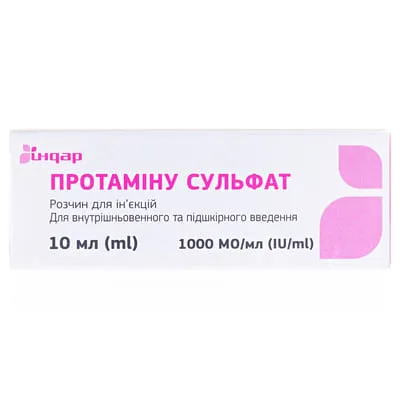
Table of Contents
INSTRUCTIONS FOR MEDICAL USE OF THE MEDICINAL PRODUCT PROTAMINE SULPHATE (PROTAMINE SULPHATE)
Composition:
Active substance: protamine sulphate;
1 ml of injection solution contains 10 mg (1000 IU) of protamine sulphate;
Excipients: sodium chloride, hydrochloric acid (concentrated), water for injections.
Pharmaceutical form. Solution for injection.
Main physico-chemical properties: clear, colorless liquid.
Pharmacotherapeutic group.
Antidotes. Protamine. ATC code V03AB14.
Pharmacological properties.
Pharmacodynamics.
The active ingredient of the medicinal product, protamine sulfate, has hemostatic effects. It neutralizes the action of heparin, reducing its anticoagulant properties. It forms stable complexes with heparin, thereby causing heparin to lose its ability to inhibit blood coagulation. Complex formation is due to a large number of cationic groups (from arginine), which bind to the anionic sites of heparin. Protamine sulfate is effective in certain types of hemorrhage associated with heparin-like disturbances of blood coagulation.
Pharmacokinetics.
After intravenous administration, the effect occurs immediately ("on the needle") and lasts approximately 2 hours. Protamine sulfate is excreted from the body mainly by the kidneys and to a lesser extent via the liver with bile. Together with heparin, it forms an inactive complex, the half-life of which is 24 minutes. Protamine sulfate is inactivated in blood plasma by enzymes, whereas the protamine-heparin complex is likely to dissociate into its components, releasing heparin.
Clinical characteristics.
Indications.
To neutralize excessive unwanted anticoagulant effect of heparin: in cases of overdose, before and after surgery during heparin therapy, after cardiac and vascular surgery involving extracorporeal circulation, during hemodialysis using heparin.
Contraindications.
Hypersensitivity to components of the drug. Idiopathic and congenital hyperheparinemia (in such cases protamine sulfate is ineffective and may even increase bleeding); severe arterial hypotension, thrombocytopenia, adrenal cortex insufficiency, hypovolemia.
Interaction with other medicinal products and other types of interactions.
PROTAMINE SULFATE is incompatible with cephalosporin and penicillin antibiotics, as well as with radiopaque substances, since precipitation reaction may develop.
Special precautions for use
During therapy, monitoring of blood coagulation parameters is required. Prior to administration, ensure adequate blood volume of the patient (hypovolemia increases the risk of collapse). Too rapid administration of the drug may cause sensation of warmth, skin hyperemia, decreased arterial pressure, bradycardia, shortness of breath, and allergic reactions.
The use of protamine is associated with the risk of anaphylactic reactions, which may lead to bronchospasm, collapse, and cardiac arrest. Therefore, all necessary precautionary measures should be taken.
PROTAMINE SULFATE does not neutralize the effect of indirect anticoagulants of the coumarin type.
When protamine sulfate is used, unlike other protamine salts, the phenomenon of "heparin rebound" does not occur (a decrease in heparin activity prior to the elimination of the heparin-protamine complex after extracorporeal circulation).
Cross-sensitivity may occur in patients with diabetes mellitus who are receiving protamine-zinc-insulin. In such patients, anaphylactic reactions to protamine sulfate are possible.
Due to the increased risk of hypersensitivity reactions, protamine should be used with caution in patients who have undergone coronary angioplasty or cardiopulmonary bypass, and in infertile men. Because of the risk of anaphylactoid reactions, resuscitation equipment must be available.
Use during pregnancy or breastfeeding
Controlled studies on the effects of the drug in pregnant women have not been conducted to date. Therefore, the drug should be administered to pregnant women only when the expected benefit to the mother outweighs the potential risk to the fetus.
It is not known whether protamine is excreted in human milk. Breastfeeding should be discontinued during administration of the drug.
Ability to influence reaction rate while driving or operating machinery
Unknown.
Administration and Dosage
PROTAMINE SULFATE should be administered as very slow intravenous or subcutaneous injections.
The required amount of PROTAMINE SULFATE depends on the level of circulating heparin in the blood; due to the short half-life of heparin, the dose of protamine needed to neutralize heparin decreases progressively with the time elapsed since heparin administration. Following bolus injections of heparin, the dose of protamine sulfate depends on the time elapsed since heparin injection.
Table 1.
Doses of protamine sulfate administered according to the time elapsed since heparin injection
| Time elapsed since heparin injection |
Protamine sulfate doses calculated per 100 IU (1 mg) of heparin |
| 15–30 minutes |
100–150 IU (1–1.5 mg) |
| 30–60 minutes |
50–75 IU (0.5–0.75 mg) |
| More than 2 hours |
25–37.5 IU (0.25–0.375 mg) |
In individual cases where treatment of heparin-induced bleeding is required, the dose of PROTAMINE SULFATE solution should be 50% of the last administered dose of heparin (in IU). If heparin has been administered by continuous intravenous infusion, the infusion must be stopped and 2500–3000 IU (25–30 mg) of protamine sulfate should be administered by slow intravenous injection. For subcutaneous heparin injections, the dose is 100–150 IU (1–1.5 mg) of protamine sulfate per 100 IU (1 mg) of heparin. The first 2500–5000 IU (25–50 mg) of protamine sulfate should be administered by slow intravenous bolus, and the remaining dose should be given by intravenous infusion over 8–16 hours.
PROTAMINE SULFATE can be used to inactivate heparin after extracorporeal dialysis, depending on the required dose. In the case of extracorporeal circulation during surgical procedures, the dose is 150 IU (1.5 mg) per 100 IU (1 mg) of heparin.
If the heparin level is unknown, administration of PROTAMINE SULFATE should begin with a dose of no more than 1 mL (1000 IU; 10 mg/mL) given by slow intravenous injection.
To prevent protamine overdose, administration of the drug should continue until normalization of thrombin time.
The dose of PROTAMINE SULFATE solution should be determined based on the results of periodic coagulation tests (thrombin time, activated partial thromboplastin time).
Patients who have previously received protamine treatment or protamine-containing insulin, or patients with fish allergy or a history of vasectomy, are at increased risk of developing anaphylactic reactions. To prevent such reactions, PROTAMINE SULFATE should be administered slowly, preferably by infusion, after dilution in 100–200 mL of 0.9% sodium chloride solution.
After opening the vial, any unused portion should be discarded according to current regulations.
Children.
The safety and efficacy of PROTAMINE SULFATE in children have not been established; therefore, the drug should not be used in pediatric patients.
Overdose.
To prevent protamine overdose, coagulation parameters (activated partial thromboplastin time) should be monitored.
Overdose of PROTAMINE SULFATE solution may be associated with bleeding, as protamine sulfate itself exhibits anticoagulant activity. Such bleeding can be managed by administering heparin until thrombin time returns to normal range.
Adverse reactions.
Immune system side effects: allergic reactions, including anaphylactic and anaphylactoid reactions, urticaria, angioneurotic edema, anaphylactic shock. In isolated cases, allergic reactions including shock states may occur. Risk factors for such reactions include: fish allergy, vasectomy, treatment with protamine-zinc-insulin, or protamine for heparin inactivation.
Cardiac side effects: vasodilation, left ventricular heart failure or general heart failure with pulmonary hypertension.
Respiratory system side effects: pulmonary edema; bronchospasm, non-cardiogenic pulmonary edema.
Blood and lymphatic system side effects: thrombocytopenia, leukopenia.
When protamine is administered intravenously too rapidly, nausea, vomiting, flushing, bradycardia, dyspnea, severe arterial hypotension, or arterial hypertension may occur.
Shelf life.
3 years.
Storage conditions.
Store at a temperature not exceeding 30 °C. Do not freeze!
The medicinal product must not be used after the expiry date stated on the packaging.
Keep out of reach of children.
Incompatibility.
PROTAMINE SULFATE must not be mixed with other medicinal products.
Packaging.
Injection solution (1000 IU/mL), 5 mL in vials № 5, 10 mL in vials № 1.
Prescription status.
Prescription only.
Manufacturer.
JSC "Insulin Production Enterprise "INDAR".
Manufacturer's address and location of business activity.
5 Zroshuvana Street, Kyiv, 02099, Ukraine.