Propolis tincture
Ukraine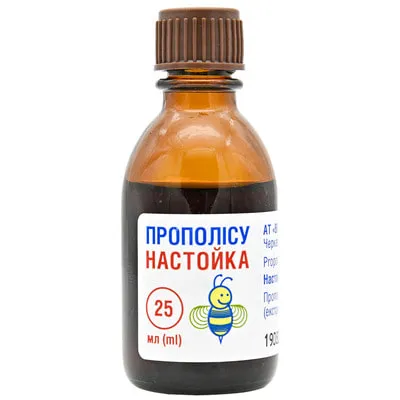
Table of Contents
INSTRUCTIONS FOR MEDICAL USE OF THE MEDICINAL PRODUCT PINE BUDS TINCTURE (PROPOLIS TINCTURE)
Composition:
Active substance:
1 vial contains propolis tincture (propolisi tinctura) (1:10) (extractant – ethanol 80%) – 25 ml;
Excipients: none.
Pharmaceutical form. Tincture.
Main physicochemical properties: clear liquid ranging from yellowish-brown to reddish-brown in color, with a specific odor; presence of sediment is permissible.
Pharmacotherapeutic group. Agents for the treatment of wounds and ulcerative lesions. Preparations promoting wound healing.
ATC Code D03A X.
Pharmacological properties.
Pharmacodynamics.
Propolis (bee glue) is a product of bee vital activity containing several biogenic substances: essential oils, a mixture of resins, wax, flavonoids, flavones, and derivatives of cinnamic acid.
Pharmacokinetics.
Exhibits antimicrobial and anti-inflammatory activity, and accelerates regeneration processes (recovery of affected tissues).
Clinical characteristics.
Indications.
Minor injuries and superficial skin or mucous membrane damage, otitis, pharyngitis, tonsillitis, sinusitis, periodontitis.
Contraindications.
Hypersensitivity to propolis or individual intolerance, especially in patients with liver or kidney disorders, eczema, allergic reactions (particularly to bee products), bleeding from affected areas of skin or mucous membranes.
Interaction with other medicinal products and other forms of interaction.
It is not recommended to mix with other antiseptics or bee products.
Special precautions.
Complications may occur during the use of the drug; therefore, patients should be informed about the possibility of their occurrence. Symptoms of propolis intolerance may appear immediately after its application or several hours, and even days later. In some patients, they may occur only during repeated courses of treatment.
Before the first application of the drug, a tolerance test must be performed: apply the drug with a cotton swab to the skin of the forearm or to the skin of the palate and observe for 30 minutes. If pronounced hyperemia, severe burning, or blistering occurs, the drug is contraindicated. If the tolerance test is positive or intolerance manifests during drug use, administration must be discontinued and antihistamines prescribed.
Use during pregnancy or breastfeeding.
The drug is not recommended during pregnancy or breastfeeding.
Ability to affect reaction rate when driving or operating machinery.
Does not affect.
Method of Administration and Dosage
Apply propolis tincture topically to adults and children aged 3 years and older as compresses, rinses, irrigations, or administer as inhalations. In case of minor skin injuries and purulent skin diseases, apply the propolis tincture with a swab to the affected area 1–3 times daily. In treating external suppurative otitis, after cleaning the ear canal, insert a tampon moistened with propolis tincture into the ear for 1–2 minutes, 2–3 times daily, or instill 1–2 drops of propolis tincture 3–4 times daily. In chronic tonsillitis and pharyngitis, lubricate the mucous membrane 1–2 times daily for 8–15 days. Additionally, in tonsillitis, use propolis tincture to prepare an inhalation alcoholic-aqueous solution in a 1:20 ratio.
Perform 1–2 inhalations daily; treatment course lasts 7–10 days. In chronic sinusitis, irrigate the maxillary sinuses twice daily for 2 weeks with a solution prepared from propolis tincture and 0.9% sodium chloride solution (in a 1:10 ratio). In periodontosis, insert propolis tincture on a pledget into periodontal pockets for 5 minutes. In superficial erosions and lesions of the oral mucosa, use a rinse prepared from 15 mL of propolis tincture in ½ cup of warm water, 4–5 times daily for 3–4 days.
Children
Administer to children aged 3 years and older.
Overdose
Symptoms: loss of appetite, decreased general body tone, lethargy, appearance of skin rashes.
Treatment: administer antihistamine drugs.
Adverse reactions.
The medicinal product is non-toxic and well tolerated at usual therapeutic doses. Adverse reactions are rare, and their outcome is favorable.
Possible adverse reactions:
- Skin and subcutaneous tissue disorders: urticaria, localized skin itching, local swelling, skin redness, blisters, vesicular eruptions, dryness and skin fissures, especially on the hands and other body parts in contact with the product;
- Nervous system disorders: dizziness;
- Immune system disorders: allergic reactions, including allergic dermatitis, hyperemia, skin itching, rash, laryngospasm, dyspnea, angioedema (Quincke's edema), increased body temperature;
- Gastrointestinal disorders: nausea;
- Respiratory system disorders: dyspnea.
Local reactions may occur, including a sensation of tongue burning, dry mouth.
Reporting of adverse reactions following medicinal product registration is highly important. It enables continuous monitoring of the benefit-risk balance of the medicinal product. Healthcare and pharmaceutical professionals, as well as patients or their legal representatives, are encouraged to report all suspected adverse reactions and lack of efficacy via the Automated Pharmacovigilance Information System at the following link: https://aisf.dec.gov.ua.
Shelf life.
3 years.
Storage conditions.
In the original packaging at a temperature not exceeding 25 °C, in a place inaccessible to children.
Packaging.
25 ml in a bottle.
25 ml in a bottle, 1 bottle per carton.
Availability.
Over-the-counter (without prescription).
Manufacturer.
JSC "VITAMINS".
Manufacturer's name and address of place of business.
31 Uspenska Street, Uman, Cherkasy region, 20300, Ukraine.
Marketing Authorization Holder.
JSC "VITAMINS".
Address of the Marketing Authorization Holder and/or its representative.
31 Uspenska Street, Uman, Cherkasy region, 20300, Ukraine.