Proalor
Ukraine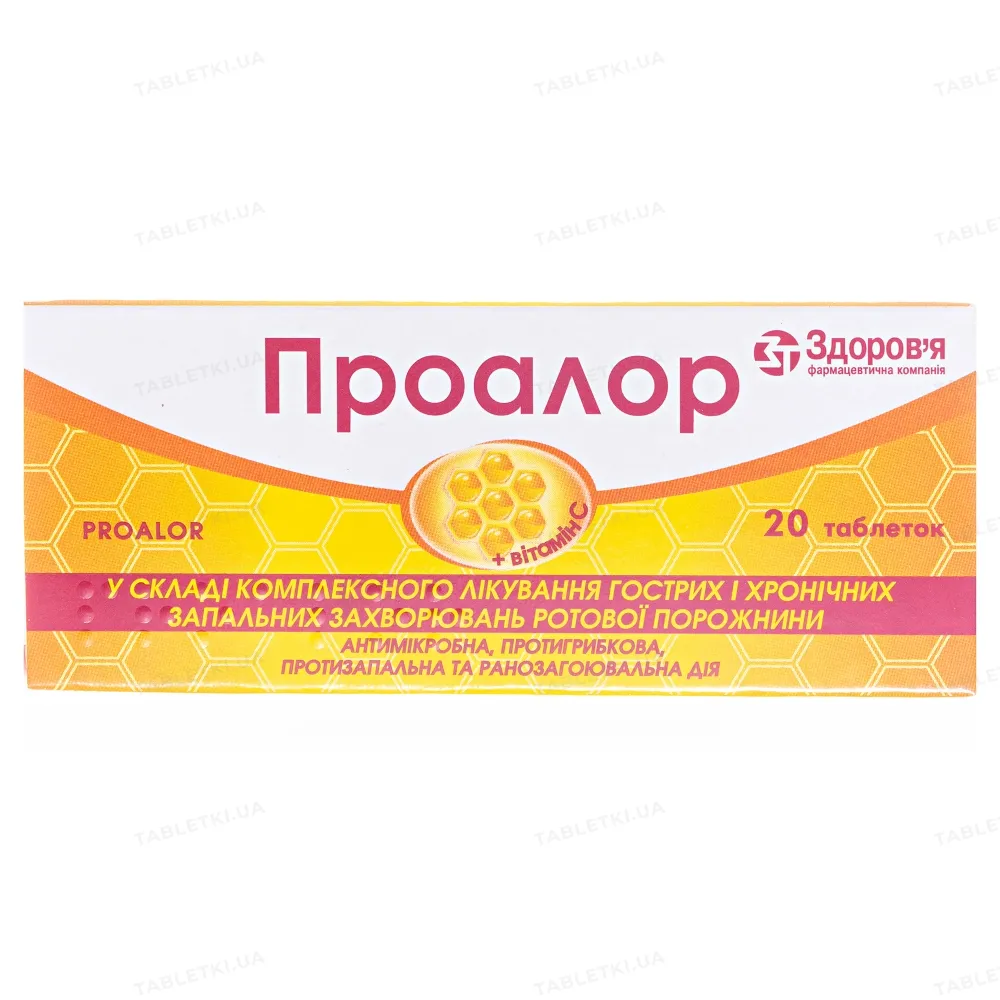
Table of Contents
INSTRUCTIONS FOR MEDICAL USE | consumption | of the medicinal product PROALOR (PROALOR)
Composition:
Active substances: 1 tablet | tablet | contains | contains | phenolic hydrophobic propolis preparation calculated as 100% content of total phenolic compounds 17.5 mg, ascorbic acid 31.5 mg;
Excipients: refined sugar, povidone, potato starch, magnesium stearate.
Pharmaceutical form. Tablets | tablets |.
Main physicochemical properties: tablets | tablets | from light brown to light brown with greenish or grayish tinge, with specks and specific odor, with a score line and bevel.
Pharmacotherapeutic group. Preparations used in throat diseases. Antiseptics. ATC code R02A A20.
Pharmacological properties.
Pharmacodynamics. A combination drug whose effects are determined by the components contained in its composition.
The phenolic hydrophobic propolis preparation (a product of bee vital activity) exerts antimicrobial (against staphylococci, enterobacteria, Pseudomonas aeruginosa), antifungal (against fungi of the genus Candida), anti-inflammatory, wound-healing, and deodorizing effects.
Ascorbic acid participates in the regulation of redox processes, carbohydrate metabolism, blood coagulation, and tissue regeneration. It exerts a general stimulatory effect, increases the body's resistance to infections, and normalizes capillary permeability.
Clinical characteristics.
Indications. As part of complex treatment of acute and chronic inflammatory diseases of the oral cavity, pharynx and larynx (stomatitis, pharyngitis, nasopharyngitis, laryngitis, laryngotracheitis), inflammatory processes after tonsillectomy and other surgical interventions on ENT organs, radiation epithelitis.
Contraindications. Hypersensitivity to the components of the drug/beekeeping products, acute eczema, thrombosis/thrombophilia, thrombophlebitis, diabetes mellitus, severe kidney diseases.
The drug should be used only after cessation of bleeding from affected areas of the oral mucosa.
Interaction with other medicinal products and other types of interactions. The drug is not recommended to be used simultaneously with other antiseptics or beekeeping products, multivitamin preparations, hormonal contraceptives, alkaline drinks.
Ascorbic acid enhances the absorption of benzylpenicillin, penicillin, tetracycline, iron, and ethyl alcohol clearance; reduces the effect of heparin and indirect anticoagulants; increases the risk of crystalluria during treatment with salicylates and short-acting sulfonamides; increases tissue toxicity of iron (especially in cardiac muscle) when used concomitantly with deferoxamine, which may lead to circulatory decompensation; therefore, the drug may be taken only 2 hours after deferoxamine injection.
Special precautions for use.
Ascorbic acid, as a reducing agent, may affect the results of laboratory tests for blood glucose, bilirubin, transaminase activity, lactate dehydrogenase, etc. Ascorbic acid has a mild stimulating effect, which may affect the process of falling asleep. The drug should be used only under medical supervision in patients with hemochromatosis, sideroblastic anemia, thalassemia, hyperoxaluria, oxalosis, urolithiasis, and in patients with glucose-6-phosphate dehydrogenase deficiency.
The drug contains refined sugar; therefore, if a patient has a known intolerance to certain sugars, medical advice should be sought before taking this medicinal product.
Use during pregnancy or breastfeeding. During pregnancy, the drug should be used under medical supervision, taking into account the benefit–risk ratio. If use is necessary, breastfeeding should be discontinued.
Ability to affect reaction speed when driving or operating machinery. No effect.
Method of administration and dosage. For oral use in adults and children aged 15 years and older. Tablets should be dissolved in the oral cavity.
Acute and chronic diseases of the oral cavity and pharynx (stomatitis, pharyngitis, nasopharyngitis): 1–2 tablets three times daily.
Laryngitis, laryngotracheitis: On the first day, take 2 tablets every 2 hours (8–10 tablets per day). Then, 1–2 tablets three times daily.
Radiation epithelitis: For treatment of radiation epithelitis of grade I and II, take 1 tablet 3–4 times daily; for grade III, take 1 tablet 4–6 times daily.
Duration of treatment: 5–10 days, depending on the therapeutic effect, drug tolerance, and nature of concomitant therapy.
Children: The drug is indicated for children aged 15 years and older.
Overdose. Acute overdose may lead to an intensification of adverse reactions, including nausea, vomiting, abdominal distension and pain, and increased excitability.
Treatment: Discontinue the drug; administer antihistamines as needed.
Adverse reactions.
Hypersensitivity reactions are possible, including itching, skin hyperemia, rash.
To date, no other adverse reactions have been reported. However, the following reactions associated with hypersensitivity to the active substances of the drug are theoretically possible: urticaria, eczema, dyspnea, Quincke's edema, anaphylactic shock, nausea, sensation of mild burning/dryness in the mouth.
Shelf life. 2 years.
Storage conditions. Store in the original packaging at a temperature not exceeding 25 °C. Keep out of reach of children.
Packaging. Tablets № 10×2, № 24 in blister packs in a box; № 10 in a blister pack.
Dispensing category. Over-the-counter.
Manufacturer. LIMITED LIABILITY COMPANY "CORPORATION "ZDOROVYA".
Manufacturer's address and place of business. Ukraine, 61013, Kharkiv region, city of Kharkiv, Shevchenko Street, building 22.