Prepidil
Ukraine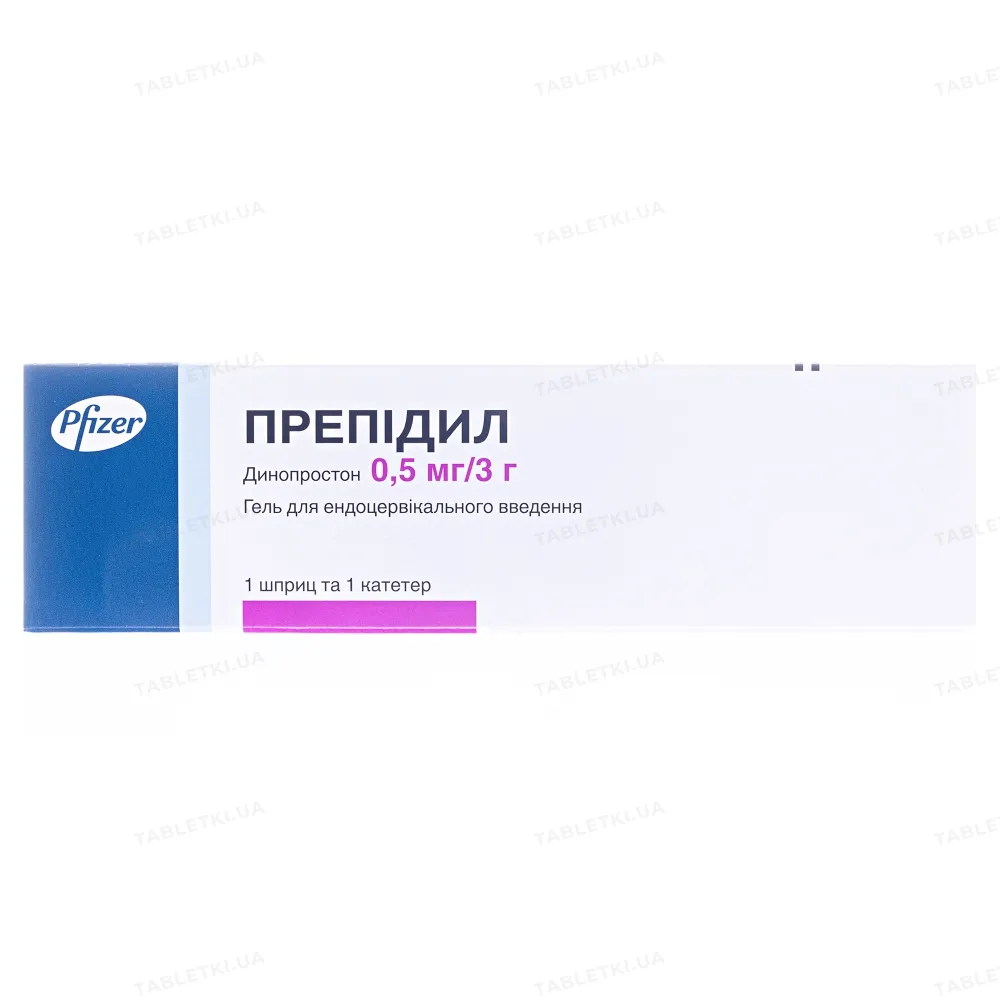
Table of Contents
INSTRUCTIONS FOR MEDICAL USE OF THE MEDICINAL PRODUCT PREPIDIL (PREPIDIL®)
Composition:
Active substance: dinoprostone;
1 syringe (3 g) contains 0.5 mg of dinoprostone;
Excipients: colloidal silicon dioxide anhydrous, glycerol triacetate.
Pharmaceutical form.
Endocervical gel.
Main physicochemical characteristics: semitransparent viscous gel.
Pharmacotherapeutic group.
Agents acting on the genitourinary system and sex hormones. Other gynecological agents. Uterotonic agents. Prostaglandins. Dinoprostone. ATC code G02AD02.
Pharmacological properties.
Pharmacodynamics.
Dinoprost, or prostaglandin E2 (PGE2), belongs to natural unsaturated fatty acids.
Prostaglandins have very diverse pharmacological properties, including the ability to stimulate organs containing smooth muscle and to modulate organ responses to other hormonal stimuli.
When administered endocervically, dinoprost promotes cervical ripening in patients with unfavorable induction parameters. The mechanism of action of the drug has not yet been fully elucidated. However, experimental studies in humans have demonstrated that the drug increases blood circulation volume in cervical tissues, similar to what occurs in the early stages of spontaneous labor. These data clearly indicate that endocervical administration of dinoprost stimulates cervical hemodynamics, thereby promoting cervical ripening.
Pharmacokinetics.
Prostaglandins are rapidly formed in the body from corresponding free polyunsaturated fatty acids. These compounds exert pronounced effects even in minimal amounts and are then rapidly converted into inactive metabolites.
After endocervical administration of a 0.5 mg dose (gel), plasma concentration of dinoprost (in the peripheral circulation) reaches its maximum within 30–40 minutes, then rapidly declines to baseline levels, regardless of the level of uterine contractile activity. The elimination half-life of dinoprost after intravenous injection is less than one minute, whereas each of the main metabolites has a half-life of approximately eight minutes.
Clinical characteristics.
Indications.
The medicinal product is indicated for cervical ripening in pregnant women with full-term or near-term pregnancy, when induction of labor is required for therapeutic or obstetrical reasons.
Contraindications.
Use of Prepidil is contraindicated in:
patients with hypersensitivity to dinoprostone or any of the excipients listed in the section "Composition";
patients in whom uterotonic agents are generally contraindicated:
- women who have had six or more full-term pregnancies;
- if the fetal head is not engaged in the pelvis;
- in the presence of uterine scars (following cesarean section, hysterotomy, etc.);
- in case of cephalopelvic disproportion;
- in the presence of changes in fetal heart rate indicating onset of fetal distress;
- when obstetrical conditions exist for which the risk/benefit ratio favors surgical intervention;
- in the presence of pathological uterine bleeding or vaginal discharge of unknown etiology during pregnancy;
- in case of non-cephalic fetal presentation;
- in case of infectious diseases of the lower genital tract;
- severe and/or traumatic deliveries in medical history;
- in case of fetal presentation above the plane of the pelvic inlet;
- in case of active-phase heart, lung, kidney, or liver disease;
Interaction with other medicinal products and other forms of interaction.
The response to oxytocin may be enhanced in the presence of exogenous prostaglandin therapy. Concomitant use with other agents stimulating labor is not recommended. If administration of oxytocin is considered necessary after dinoprostone administration, a recommended interval of at least 6 hours between dosing is advised.
Therefore, careful monitoring of the patient is recommended when these agents are used concomitantly.
Special precautions for use.
This medicinal product is used exclusively under hospital conditions and under the supervision of healthcare professionals.
As with any agents stimulating uterine activity, the risk of uterine rupture should be considered. Concomitant therapy, maternal and fetal status must be taken into account to minimize the risk of uterine hyperstimulation, uterine rupture, uterine hemorrhage, fetal and neonatal death.
During administration of dinoprostone, continuous electronic monitoring of uterine contraction activity and fetal heart rate is required. In patients with uterine hypertonus or increased contractile activity, or in those with unusual changes in fetal heart rate, labor should be managed in such a way as to ensure overall safety of the fetus and mother.
Dinoprostone should be administered with caution in patients with a history of cardiovascular, hepatic, or renal disorders, as well as in those with asthma (or history of asthma), glaucoma (or elevated intraocular pressure), or rupture of chorioamniotic membranes, including in the past. Dinoprostone should be used with caution in patients with multiple gestation.
Women aged 35 years or older, those who experienced complications during pregnancy, and women with a gestational age exceeding 40 weeks have an increased risk of developing disseminated intravascular coagulation (DIC) in the postpartum period.
Furthermore, these factors may contribute to an increased risk associated with labor induction (see section "Adverse Reactions"). Therefore, dinoprostone should be used with caution in such women.
In the early postpartum period, appropriate measures should be taken as soon as possible to detect the possible onset of fibrinolysis.
Before administration of the Prepidil preparation, a careful assessment of the proportionate relationship between fetal size and maternal pelvis should be performed.
Animal studies using high doses over several weeks have shown that prostaglandins of the E and F groups may cause proliferation of bone tissue. A similar effect has been observed in newborns receiving prolonged therapy with prostaglandin E1. However, such effects on bone tissue have not been observed with short-term therapy using Prepidil.
Administration of Prepidil gel above the level of the internal os of the cervix should be avoided, as uterine hyperstimulation has been observed with extra-amniotic administration of the drug.
In general, labor induction is associated with the risk of amniotic fluid embolism (anaphylactoid syndrome of pregnancy). Cases of amniotic fluid embolism have been reported after administration of various dosage forms of dinoprostone used for cervical ripening (see section "Adverse Reactions"). This condition often occurs suddenly during labor, cesarean section, or within 48 hours after delivery.
The clinician should be aware that intracervical administration of dinoprostone may lead to unpredictable ruptures followed by embolization with antigenic tissue and, in isolated cases, development of anaphylactoid syndrome of pregnancy (amniotic fluid embolism).
As with all intrauterine administrations, the risk of developing local infections with extra-amniotic use should be considered. In such cases, infections should be treated.
After administration of prostaglandins and prostaglandin analogs by injection, cases of severe cardiovascular complications, which may be fatal (myocardial infarction and/or ventricular fibrillation), have been reported. To date, there have been no reports of such complications following vaginal administration of prostaglandin E2. The risk of these complications increases with age and with chronic or recent smoking. For safety reasons, patients should refrain from smoking for several days prior to administration of dinoprostone.
Use during pregnancy or breastfeeding.
There are no clinical data on the effect of dinoprostone on fertility.
Pregnancy. Prepidil is indicated for use in women with term or near-term pregnancy or during labor. Any dose of the drug causing prolonged increase in uterine tone may pose a risk to the embryo or fetus (see sections "Special Precautions for Use" and "Adverse Reactions").
Animal studies have shown reproductive toxicity.
Breastfeeding. Prostaglandins are excreted in breast milk in very low concentrations. No differences in drug concentration in breast milk have been observed between women who delivered preterm and those who delivered at term.
Ability to affect reaction speed when driving or operating machinery. The medicinal product is administered only under hospital conditions.
Method of Administration and Dosage
The drug may be administered only by qualified healthcare professionals in hospitals and clinics with specialized obstetric units equipped with facilities for continuous monitoring.
The recommended dose should not be exceeded, and the dosing interval must not be shortened, as this increases the risk of uterine hyperstimulation, uterine rupture, uterine hemorrhage, fetal death, and neonatal death.
For proper administration, the patient must be in a supine position, and the cervix must be visualized using a speculum.
The syringe is carefully inserted into the cervical canal (directly beneath the internal os of the cervix). Using the provided catheter, the entire contents of the syringe (0.5 mg dinoprostone = 3 g of Prepidil gel) are gently administered, after which the catheter is removed. Prepidil should not be administered above the level of the internal os of the cervix. After gel administration, the patient should remain lying on her back for at least 15 minutes to minimize gel leakage.
The contents of the syringe are intended for use in a single patient only. Do not attempt to administer the small amount of gel remaining in the catheter. The syringe, catheter, and other components of the drug packaging must be disposed of after use.
INSTRUCTIONS FOR SYRINGE USE
Remove the sterile syringe and sterile catheter from the packaging.
- Remove the protective cap (to use it as a piston extender).
- Insert the protective cap into the syringe.
- Firmly attach the catheter to the syringe (a click should be heard), then administer the syringe contents to the patient.
Children
The safety and efficacy of Prepidil in children have not been established. Currently, there is no appropriate use of Prepidil in children, except in adolescents.
Overdose
Since Prepidil is intended for administration in single doses only, symptoms of overdose may occur only in individual patients with increased sensitivity to the drug. As clinical studies of prostaglandin antagonists have not yet yielded sufficient data to provide recommendations, treatment of overdose is currently symptomatic.
Overdose of the drug may manifest as uterine hypertonus or pathologically increased intensity or frequency of uterine contractions, which may lead to fetal distress. Due to the transient nature of PGE2-induced myometrial hyperstimulation, conservative management has proven effective in the majority of overdose cases; that is, repositioning the patient and administering oxygen to the pregnant woman are indicated.
If excessive uterine stimulation (and/or fetal distress) does not resolve after discontinuation of treatment, intravenous administration of β2-adrenergic agents may be appropriate. If tocolytic agents are ineffective, immediate delivery is recommended.
Side effects
Safety profile
The adverse reactions most commonly reported during clinical trials of topical dinoprostone formulations (occurring in > 10% of patients) were: maternal vomiting and fetal heart rate abnormalities.
Other adverse reactions reported in up to 10% of patients included: nausea, back pain, pyrexia, uterine hypertonus, uterine spasm, pathological uterine contractions, fetal distress syndrome, and burning sensation in the vagina and/or vulva.
The data on the adverse reactions listed below and their frequencies were obtained from clinical trials. Within each section, reactions are presented in order of decreasing severity according to frequency.
The frequency and severity of adverse effects caused by dinoprostone are dose-dependent and somewhat influenced by the route of administration. The undesirable effects observed during the use of Prepidil are listed below and classified into categories according to their frequency of occurrence: very common (≥ 1/10), common (≥ 1/100, < 1/10), uncommon (≥ 1/1000, < 1/100), rare (≥ 1/10000, < 1/1000), very rare (< 1/10000), frequency not known (cannot be estimated from available data).
Blood and lymphatic system disorders. Rare: disseminated intravascular coagulation*; frequency not known: leukocytosis.
Immune system disorders. Frequency not known: anaphylactic shock, anaphylactic reactions, anaphylactoid reactions, hypersensitivity reactions.
Respiratory, thoracic and mediastinal disorders. Frequency not known: wheezing, dyspnea, chest discomfort, cough.
Gastrointestinal disorders. Very common: vomiting; common: nausea; frequency not known: diarrhea.
Musculoskeletal and connective tissue disorders. Common: back pain.
Pregnancy, puerperium and perinatal conditions. Common: uterine contractility disorders, uterine hypertonus, increased uterine contractile activity, fetal distress syndrome*; frequency not known: anaphylactoid syndrome of pregnancy*, uterine rupture, fetal death§, stillbirth§, neonatal death§, preterm infant, fetal acidosis.
Reproductive system and breast disorders. Common: burning sensation in the vagina and/or vulva.
General disorders and administration site conditions. Common: fever*; frequency not known: pain.
Investigations. Very common: changes in fetal heart rate*; frequency not known: low Apgar score.
* See section "Special precautions".
§ Fetal death, stillbirth and neonatal death have been reported following dinoprostone administration, particularly after serious events such as uterine rupture (see sections "Dosage and administration", "Contraindications" and "Special precautions").
Reporting of suspected adverse reactions
Reporting suspected adverse reactions after medicine authorization is important. It allows continued monitoring of the benefit-risk balance of the medicine. Healthcare professionals are encouraged to report any suspected adverse reactions in accordance with the local reporting system.
Shelf life.
2 years.
Storage conditions.
Store in a refrigerator at 2–8 °C.
Keep out of the reach of children.
Packaging.
3 g of gel in a single-dose syringe. 1 syringe (in a blister pack) and 1 sterile catheter (in a blister pack) in a cardboard box.
Prescription status.
Prescription only.
Manufacturer.
Pfizer Manufacturing Belgium NV.
Manufacturer's address and place of business.
Reyksweg 12, Puurs-Sint-Amands, 2870, Belgium.