Pramistar
Ukraine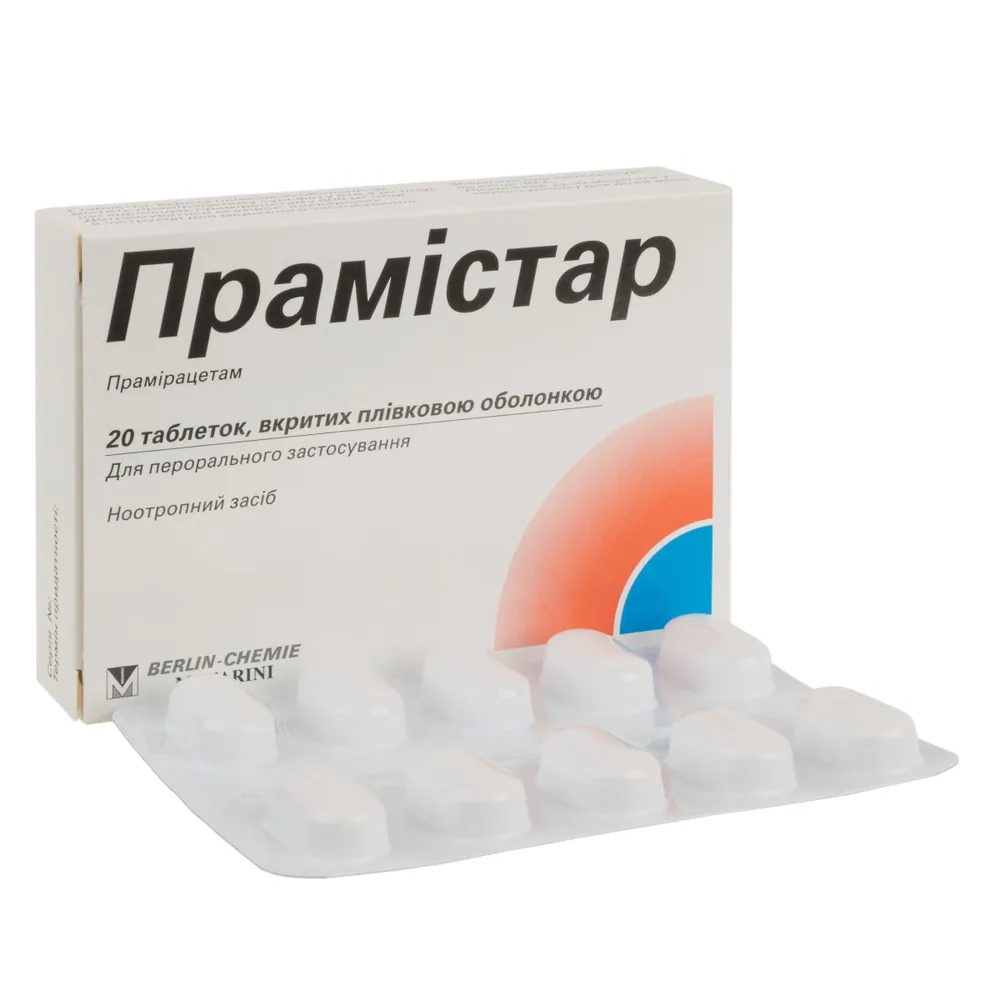
Table of Contents
INSTRUCTIONS FOR MEDICAL USE OF THE MEDICINAL PRODUCT PRASTAR
Composition:
Active substance: pramiracetam;
One film-coated tablet contains pramiracetam sulfate 818.4 mg, corresponding to pramiracetam 600 mg;
Excipients: microcrystalline cellulose, colloidal anhydrous silicon dioxide, crospovidone, calcium stearate, hydroxypropylcellulose, titanium dioxide (E 171), hypromellose, polyethylene glycol 3350, polyethylene glycol 400.
Pharmaceutical form. Film-coated tablets.
Main physico-chemical properties: white, elliptical, biconvex tablets, film-coated, with a score line on both sides for division.
Pharmacotherapeutic group.
Psychostimulants and nootropic agents. ATC code N06B X16.
Pharmacological properties.
Pharmacodynamics.
Pramiracetam is a nootropic agent that improves memory and learning ability. Its mechanism of action has not been fully elucidated. By acting on cholinergic receptors and choline metabolism, pramiracetam stimulates neuronal activity. The drug does not have a depressant effect on the central nervous system and has no influence on the autonomic nervous system. Pramiracetam also exerts an antidepressant effect. In clinical trials, in patients with mild to moderate senile dementia, pramiracetam increased attention span, improved learning ability, memory, orientation, and other cognitive functions.
Pharmacokinetics.
Pharmacokinetic studies in humans have shown that the drug is rapidly and almost completely absorbed in the gastrointestinal tract. Peak plasma concentration is reached within 2–3 hours. The elimination half-life of the drug is 4–6 hours. Pharmacokinetic parameters of the drug in young and elderly patients are similar. However, as creatinine clearance decreases, pramiracetam clearance also decreases. The drug does not bind to plasma proteins. The drug is almost completely excreted unchanged in the urine.
Clinical characteristics.
Indications.
Reduced ability to concentrate and memory disorders of degenerative or vascular origin, especially in elderly individuals.
Contraindications.
Hypersensitivity to the active substance or to any of the excipients listed in the section "Composition". Cerebral hemorrhage. Severe renal impairment. Hepatic impairment.
Interaction with other medicinal products and other forms of interaction.
No interactions with cardiac glycosides, xanthines, anticoagulants, or ACE inhibitors have been observed in patients receiving 600 mg of pramiracetam every 12 hours. No other significant interactions have been reported.
Concomitant use of another active substance from the same pharmacological group (e.g. piracetam) with thyroid extract (T3+T4) has caused confusion, irritability, and sleep disturbances. According to data from a published single-blind study in patients with severe recurrent venous thrombosis, administration of 9.6 g of piracetam per day did not alter the required dose of acenocoumarol to achieve an INR (International Normalized Ratio) of 2.5–3.5. However, compared to acenocoumarol alone, adding 9.6 g of piracetam per day significantly reduced platelet aggregation, β-thromboglobulin release, fibrinogen levels, von Willebrand factors (VIII:C; VIII:vW:Ag; VIII:vW:RCo), and blood and plasma viscosity.
Special precautions for use.
In patients with mild to moderate renal impairment, the elimination of pramiracetam is slower. Therefore, caution should be exercised when administering the drug to such patients. If any adverse reactions occur, the drug should be discontinued, as these reactions may be signs of accumulation of the active substance in the body (see section "Dosage and administration").
Piracetam, a drug of the same pharmacological class, has been shown to affect platelet aggregation and function, as well as other hemostasis parameters. Therefore, caution is necessary when used concomitantly with anticoagulants or platelet aggregation inhibitors (see section "Interaction with other medicinal products and other forms of interaction"), as well as in treating patients with coagulation disorders (see section "Interaction with other medicinal products and other forms of interaction").
Use during pregnancy or breastfeeding.
Pramiracetam is contraindicated during pregnancy and breastfeeding; there are insufficient data on its use during pregnancy or lactation.
Ability to influence reaction rate when driving or operating machinery.
The effect on the ability to drive or operate machinery has not been studied. However, in patients who have taken Pramistar, adverse reactions such as dizziness, excitement, tremor, and confusion have been reported (see section "Adverse reactions"). Therefore, patients should be warned about the possible effect on their ability to drive or operate machinery.
Method of Administration and Dosage
The recommended dose is 600 mg every 12 hours.
The total daily dose should not exceed 1200 mg per day.
A clinically significant effect is achieved within 4–8 weeks of treatment. In case of long-term treatment in elderly patients, serum creatinine levels should be monitored regularly.
Patients with renal impairment.
Piracetam excretion is delayed in patients with renal impairment. The clinical significance of slowed piracetam excretion in mild to moderate renal impairment has not been established. Therefore, caution should be exercised when treating patients with mild to moderate renal impairment, and Pramistar should be discontinued if adverse effects occur, as this may indicate accumulation of the active substance in the body. Pramistar is contraindicated in patients with severe renal impairment (see section "Contraindications").
Children.
Studies in children have not been conducted; therefore, the drug is not recommended for use in pediatric patients.
Overdose.
There have been no reports of overdose.
Adverse reactions.
In clinical studies involving 1110 individuals, the following adverse reactions have been reported. They are classified by organ systems and frequency of occurrence. Frequency is defined as follows: very common (> 1/10), common (from > 1/100 to < 1/10), uncommon (from > 1/1000 to < 1/100), rare (from > 1/10000 to < 1/1000), very rare (< 1/10000), and not known (cannot be estimated from the available data).
| System organ class |
Frequency |
Adverse reactions |
| Metabolism and nutrition disorders |
Uncommon |
Decreased appetite |
| Psychiatric disorders |
Common Uncommon Rare |
Excitation, insomnia Confusion Dysphoria |
| Nervous system disorders |
Common Uncommon |
Dizziness Tremor |
| Gastrointestinal disorders |
Common Uncommon Rare |
Nausea, upper abdominal pain Dry mouth, dyspepsia Fecal incontinence |
| Musculoskeletal and connective tissue disorders |
Rare |
Muscle spasms |
| Renal and urinary disorders |
Rare |
Urinary incontinence |
Reporting of suspected adverse reactions.
Reporting of suspected adverse reactions after authorization of the medicinal product is of great importance. It allows continued monitoring of the benefit-risk balance of the medicinal product. Healthcare professionals should report any suspected adverse reactions.
Shelf life. 3 years.
Do not use the medicinal product after the expiry date stated on the packaging.
Storage conditions.
Store at a temperature not exceeding 30 °C. Keep the medicinal product out of the reach of children.
Packaging.
10 tablets in a blister; 2 blisters in a cardboard box.
Prescription status.
Prescription only.
Manufacturer.
COSMO S.P.A.
Manufacturer's address and location of its operations.
Via C. Colombo, 1, Lainate (MI), 20045, Italy.
Marketing Authorization Holder.
F.I.R.M.A. S.p.A.
Address of the Marketing Authorization Holder.
Via di Scandicci 37, 50143 Florence, Italy.