Piracetam-darnitsa
Ukraine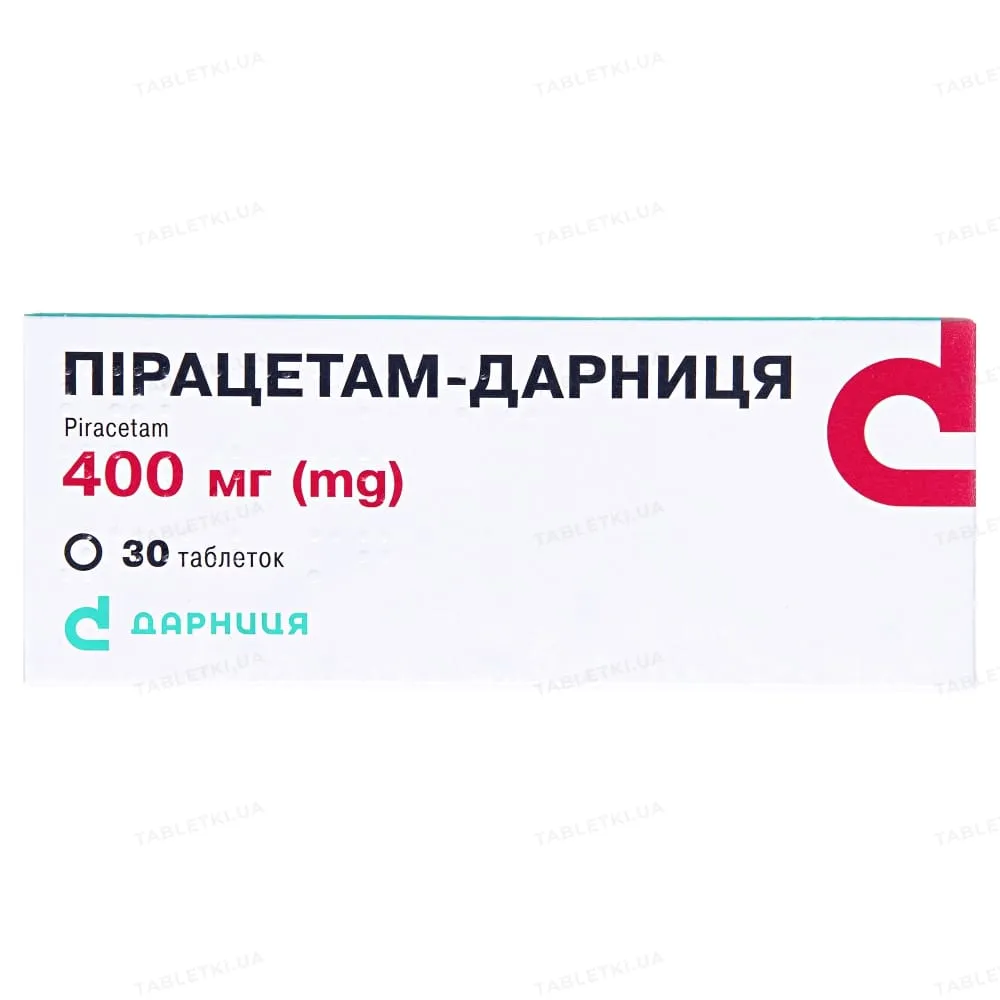
Table of Contents
INSTRUCTIONS FOR MEDICAL USE OF THE MEDICINAL PRODUCT PIRACETAM-DARNITSA (PIraCetam-Darnitsa)
Composition:
Active substance: piracetam;
1 tablet contains 400 mg of piracetam;
Excipients: sucrose, microcrystalline cellulose, potato starch, talc, colloidal anhydrous silicon dioxide, magnesium stearate.
Pharmaceutical form. Tablets.
Main physico-chemical properties: tablets of white or white with creamy shade, marbling is allowed, with flat surface, beveled edge and score line.
Pharmacotherapeutic group. Psychostimulants and nootropics.
ATC code N06B X03.
Pharmacological properties.
Pharmacodynamics.
Piracetam is a nootropic agent that acts on the brain, improving cognitive processes such as learning ability, memory, attention, and mental performance. Piracetam affects the central nervous system through various mechanisms: altering the rate of excitation propagation in the brain, improving metabolic processes in nerve cells, enhancing microcirculation, and exerting a positive influence on blood rheological properties. At the same time, it does not produce vasodilatory effects.
Piracetam improves interhemispheric connections and synaptic conduction in non-cortical structures. It inhibits platelet aggregation and restores erythrocyte membrane elasticity, reducing erythrocyte adhesion. At a dose of 9.6 g, it reduces fibrinogen and von Willebrand factor levels by 30–40% and prolongs bleeding time. Piracetam exerts protective and restorative effects in cases of impaired brain function due to hypoxia and intoxication. Piracetam reduces the intensity and duration of vestibular nystagmus.
Pharmacokinetics.
After oral administration, piracetam is rapidly and almost completely absorbed, with peak plasma concentrations reached within 1 hour. The bioavailability of the drug is approximately 100% after a single 2 g dose. The volume of distribution of piracetam is approximately 0.6 L/kg. The elimination half-life of the drug from blood plasma is 4–5 hours and 8.5 hours from cerebrospinal fluid, with prolongation in renal impairment. Piracetam does not bind to plasma proteins and is not metabolized in the body. 80–100% of piracetam is excreted unchanged by the kidneys via glomerular filtration. Renal clearance of piracetam in healthy volunteers is 86 mL/min. The pharmacokinetics of piracetam are not altered in patients with hepatic insufficiency. Piracetam crosses the blood-brain barrier, placental barrier, and membranes used during hemodialysis.
Clinical characteristics.
Indications.
Adults:
- symptomatic treatment of pathological conditions associated with impaired memory and cognitive disorders, excluding diagnosed dementia;
- treatment of cortical myoclonia, either as monotherapy or as part of combination therapy.
Contraindications.
Hypersensitivity to piracetam or pyrrolidone derivatives, as well as to other components of the medicinal product.
Acute cerebral circulation disorders (hemorrhagic stroke).
Terminal stage of renal failure.
Huntington’s chorea.
Interaction with other medicinal products and other types of interactions.
Thyroid hormones.
When used concomitantly with thyroid hormones, increased irritability, disorientation, and sleep disturbances may occur.
Acenocoumarol.
Clinical studies have shown that in patients with severe recurrent thrombosis, administration of high-dose piracetam (9.6 g/day) did not affect the dosing of acenocoumarol required to achieve a prothrombin time ratio (INR) of 2.5–3.5. However, when used concomitantly, a significant reduction in platelet aggregation, fibrinogen levels, von Willebrand factor levels (coagulation activity (VIII:C); ristocetin cofactor (VIII:vW:Rco); and plasma protein (VIII:vW:Ag)), blood and plasma viscosity was observed.
Pharmacokinetic interactions.
The likelihood of changes in the pharmacodynamics of piracetam due to other medicinal products is low, as 90% of the drug is excreted unchanged in urine.
In vitro, piracetam does not inhibit cytochrome P450 isoenzymes CYP1A2, 2B6, 2C8, 2C9, 2C19, 2D6, 2E1, and 4A9/11 at concentrations of 142, 426, and 1422 µg/mL.
At a concentration of 1422 µg/mL, slight inhibition of CYP2A6 (21%) and 3A4/5 (11%) was observed. However, the Ki values for these two CYP isoenzymes are sufficiently high when exceeding 1422 µg/mL. Therefore, metabolic interactions with drugs metabolized by these enzymes are unlikely.
Antiepileptic medicinal products.
Administration of piracetam at a dose of 20 g daily for 4 weeks or longer did not alter the serum concentration-time curves or maximum concentrations (Cmax) of antiepileptic drugs (carbamazepine, phenytoin, phenobarbital, sodium valproate) in patients with epilepsy.
Alcohol.
Concomitant intake with alcohol did not affect the serum concentration of piracetam, and the serum alcohol concentration was not altered following a single 1.6 g dose of piracetam.
In elderly individuals, piracetam enhances the effects of antianginal agents and increases the efficacy of antidepressants.
Special precautions for use.
Effect on platelet aggregation.
Since piracetam reduces platelet aggregation (see section "Pharmacological properties"), it should be prescribed with caution to patients with impaired hemostasis, conditions that may be associated with bleeding (e.g., peptic ulcer of the gastrointestinal tract), during major surgical procedures (including dental interventions), patients with symptoms of severe hemorrhage or patients with a history of hemorrhagic stroke; and to patients receiving anticoagulants, platelet antiaggregants, including low-dose acetylsalicylic acid. The drug is excreted by the kidneys; therefore, special attention should be paid to patients with renal impairment.
Elderly patients.
During long-term therapy in elderly patients, regular monitoring of renal function parameters is recommended. If necessary, the dose should be adjusted according to creatinine clearance test results (see section "Dosage and administration"). The drug passes through the filtering membranes of hemodialysis equipment.
When treating patients with cortical myoclonus, abrupt discontinuation of therapy should be avoided due to the risk of generalized myoclonus or seizure occurrence.
The medicinal product contains crystalline sugar as an excipient, which should be taken into account in patients with diabetes mellitus.
Use during pregnancy or breastfeeding.
Pregnancy. There are no data on the use of piracetam in pregnant women. Preclinical studies do not indicate a direct or indirect harmful effect on pregnancy, embryonal or fetal development, or postnatal development of the child.
Piracetam crosses the placental barrier. The concentration of the drug in newborns ranges from 70% to 90% of the concentration in the mother. Piracetam should not be used during pregnancy unless clearly necessary, except in cases where the clinical condition of the pregnant woman requires treatment with piracetam and the expected benefit to the mother outweighs the potential risk to the fetus.
Breastfeeding. Piracetam is excreted in breast milk. It should not be used during breastfeeding. If treatment with the drug is necessary, breastfeeding should be discontinued. A decision to discontinue breastfeeding or to discontinue therapy with piracetam should be made, taking into account the benefits of breastfeeding for the child and the benefit of therapy for the woman.
Fertility. There are no clinical data on the effect of piracetam on fertility. Preclinical studies show that piracetam does not affect fertility in male and female rats.
Ability to influence reaction rate when driving or operating machinery.
Caution should be exercised when driving or operating machinery due to the potential for adverse reactions affecting the central nervous system.
Method of Administration and Dosage.
Administer the medicinal product orally, swallowing it with a small amount of water.
The medicinal product is intended for use in adults.
Treatment of conditions associated with impaired memory and cognitive disorders.
The initial daily dose is 4.8 g during the first week of treatment. The dose is usually divided into 2–3 administrations per day. The maintenance dose is 2.4 g per day. Subsequently, gradual reduction of the dose by 1.2 g per day may be possible.
Treatment of cortical myoclonus.
The initial daily dose is 24 g for the first 3 days. If the desired therapeutic effect has not been achieved within this time, continue administration of the medicinal product at the same dosage (24 g per day) for up to 7 days. If the desired therapeutic effect has not been achieved by day 7 of treatment, therapy should be discontinued. If a therapeutic effect has been achieved, starting from the day when stable improvement is observed, begin reducing the dose of the medicinal product by 1.2 g of piracetam every 2 days until symptoms of cortical myoclonus reappear. This will allow determination of the average effective dose. The daily dose should be divided into 2–3 administrations.
Concomitant treatment with other antimyoclonic agents should be maintained at previously prescribed doses. Treatment should continue until symptoms of the disease have disappeared. To prevent worsening of the patient's condition, abrupt discontinuation of the medicinal product must be avoided. The dose should be gradually reduced by 1.2 g of piracetam every 2–3 days. Every 6 months, repeat courses of treatment with the medicinal product should be prescribed, adjusting the dose according to the patient's condition, until symptoms of the disease disappear or decrease.
Elderly patients.
Dose adjustment is recommended for elderly patients with diagnosed or suspected renal function disorders (see section "Patients with Renal Impairment"). During treatment, creatinine clearance should be monitored to ensure appropriate dose adjustment in these patients, if necessary.
Patients with renal impairment.
Since the medicinal product is eliminated via the kidneys, caution should be exercised when treating patients with renal insufficiency.
Prolongation of the elimination half-life is directly related to impaired renal function and reduced creatinine clearance. This also applies to elderly patients, in whom creatinine clearance is age-dependent. The dosing interval should be adjusted based on the degree of renal function impairment.
Dose calculation should be based on assessment of the patient's creatinine clearance. Calculate using the following formula:
| Creatinine clearance = |
. [140 - age (in years)] × body weight (kg) . |
(× 0.85 for women) |
| 72 × plasma creatinine concentration (mg/dL) |
Treatment for such patients should be prescribed according to the severity of renal impairment, following these recommendations:
| Renal impairment degree |
Creatinine clearance (mL/min) |
Dosing |
| No renal impairment |
> 80 |
Usual dose divided into 2 or 4 administrations |
| Mild |
50–79 |
2/3 of usual dose in 2–3 administrations |
| Moderate |
30–49 |
1/3 of usual dose in 2 administrations |
| Severe |
< 30 |
1/6 of usual dose as a single administration |
| End-stage |
− |
Contraindicated |
Patients with hepatic impairment.
Dose adjustment is not required for patients with hepatic impairment alone. In cases of diagnosed or suspected hepatic and renal impairment, dose adjustment should be performed as specified in the section «Patients with renal impairment».
Children.
Not to be used.
Overdose.
Symptoms: intensification of adverse drug reactions. Symptoms of overdose were observed following oral administration of the drug at a dose of 75 g.
Treatment: symptomatic. There is no specific antidote; hemodialysis can be used (elimination of 50–60% of piracetam).
Side effects.
Frequency is defined as follows: very common (≥ 1/10), common (≥ 1/100 to <1/10), uncommon (≥ 1/1000 to <1/100), rare (≥ 1/10000 to <1/1000), very rare (<1/10000), not known (cannot be estimated from the available data).
| System organ class of the WHO classification system |
Common (≥1/100 to <1/10) |
Uncommon (≥1/1000 to <1/100) |
| Nervous system disorders |
Hyperkinesia |
|
| Metabolism and nutrition disorders |
Weight increased |
|
| Psychiatric disorders |
Nervousness |
Depression |
| General disorders |
Asthenia |
Adverse reactions reported during post-marketing surveillance are listed below by system organ class.
Ear and labyrinth disorders.
Single cases: dizziness.
Gastrointestinal disorders.
Single cases: abdominal pain, upper abdominal pain, diarrhea, nausea, vomiting.
Nervous system disorders.
Frequent: hyperkinesia.
Uncommon: somnolence.
Single cases: ataxia, loss of balance, increased frequency of epileptic seizures, headache, insomnia, tremor.
Psychiatric disorders.
Frequent: irritability.
Uncommon: depression.
Single cases: increased excitability, anxiety, confusion, hallucinations.
Blood and lymphatic system disorders.
Single cases: hemorrhagic disorders.
Immune system disorders.
Single cases: hypersensitivity reactions, anaphylactoid reactions.
Skin and subcutaneous tissue disorders.
Single cases: angioneurotic edema, dermatitis, rash, urticaria, pruritus.
Reproductive system and breast disorders.
Single cases: increased libido.
Investigations.
Frequent: weight gain.
Shelf life. 3 years.
Storage conditions.
Store in the original packaging, out of reach of children, at a temperature not exceeding 25 °C.
Packaging.
10 tablets in a blister pack; 3 blisters per carton.
Prescription status. Prescription only.
Manufacturer. JSC "Pharmaceutical company "Darnytsia".
Manufacturer's name and address of the place of business.
13, Boryspilska Street, Kyiv, 02093, Ukraine.