Pyrantel
Ukraine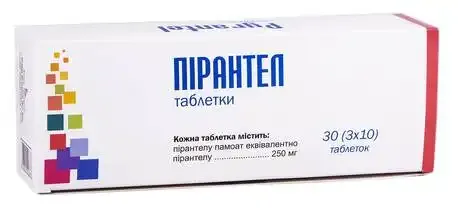
Table of Contents
- INSTRUCTION FOR MEDICAL USE OF THE MEDICINAL PRODUCT PIRANTEL (Pyrantel)
- Composition:
- Pharmacological properties.
- Clinical characteristics.
- Special precautions for use.
- Method of Administration and Dosage
- Adverse reactions.
- Composition:
- Pharmacological properties.
- Clinical characteristics.
- Special precautions for use
- Method of Administration and Dosage
- Side effects.
INSTRUCTION FOR MEDICAL USE OF THE MEDICINAL PRODUCT PIRANTEL (Pyrantel)
Composition:
Active substance: pyrantel pamoate;
1 tablet contains pyrantel pamoate equivalent to pyrantel 250 mg;
Excipients: povidone, maize starch, sodium croscarmellose, microcrystalline cellulose, magnesium stearate, colloidal anhydrous silicon dioxide.
Pharmaceutical form. Tablets.
Main physicochemical properties: capsule-shaped yellow tablets with a dividing line on one side.
Pharmacotherapeutic group. Antiparasitic agents, insecticides and repellents. Anthelmintics. ATC code P02CC01.
Pharmacological properties.
Pharmacodynamics.
Pyrantel is an anthelmintic agent. It is active against Enterobius vermicularis, Ascaris lumbricoides, Ancylostoma duodenale, and Necator americanus. Pyrantel causes neuromuscular blockade, paralyzing helminths, resulting in their elimination via intestinal peristalsis along with fecal masses. Pyrantel is effective against both mature and immature susceptible forms of helminths. It has no effect on migrating tissue larvae.
Pharmacokinetics.
Gastrointestinal absorption of pyrantel is very low. After administration, plasma concentrations are very low (0.05–0.13 mcg/mL) and reach maximum levels within 1–3 hours. Up to 93% of the administered dose is excreted unchanged in feces. Less than 7% is recovered in urine as unchanged drug and metabolites.
Clinical characteristics.
Indications.
Enterobiasis, ascariasis, ancylostomiasis.
Contraindications.
Hypersensitivity to any component of the drug.
Interaction with other medicinal products and other forms of interaction.
Do not use concomitantly with piperazine, which is an antagonist of the anthelmintic effect of pyrantel.
Special precautions for use.
In case of hepatic insufficiency, dose reduction is recommended.
Enterobiasis: to prevent reinfection, strict hygiene measures should be observed: daily perianal hygiene, cleaning under the nails several times a day. Children's nails should be kept short. Underwear and pajamas should be changed regularly. Scratching should be avoided. Simultaneous treatment of all family members is recommended, as infection often occurs without symptoms.
Use during pregnancy or breastfeeding.
Due to the absence of teratogenic effects of pyrantel in animals, congenital malformations in humans are not expected. Currently, congenital malformations or fetotoxic effects of pyrantel have not been clinically confirmed. However, monitoring of pyrantel use during pregnancy is insufficient to exclude all possible risks. Therefore, this medication may be used during pregnancy only if absolutely necessary, after careful assessment of the benefit-to-risk ratio for the mother and fetus, as determined by a physician.
Due to the lack of published studies on the adverse effects of pyrantel in breastfed infants, and considering the very low absorption of pyrantel, the use of the drug may be possible, if necessary, after consultation with a physician.
Ability to affect reaction speed when driving vehicles or operating machinery.
Adverse reactions from the nervous system, which may occasionally occur during treatment with pyrantel, may affect reaction speed when driving vehicles or operating machinery.
Method of Administration and Dosage
The medication can be taken at any time; there is no need to take the drug on an empty stomach or to use laxatives beforehand.
Enterobiasis and Ascariasis.
For the treatment of enterobiasis and ascariasis, the usual dose is a single dose of 10 mg/kg to 12 mg/kg.
Children aged 6 years and older: 1 tablet per 20 kg body weight as a single dose.
Adults with body weight less than 75 kg: 3 tablets as a single dose.
Adults with body weight over 75 kg: 4 tablets as a single dose.
In cases of enterobiasis, to completely eliminate parasites, strict hygiene measures must be followed, and all family members should be treated simultaneously. To prevent reinfection, a repeat dose is recommended 3 weeks after the initial dose.
Hookworm infection (Ankylostomiasis).
In endemic areas, for infection with Necator americanus or heavy infestation with Ancylostoma duodenale, the dosage is 20 mg/kg daily (in 1 or 2 divided doses) for 2–3 days.
Children aged 6 years and older: 1 tablet per 10 kg body weight daily.
Adults with body weight less than 75 kg: 6 tablets daily.
Adults with body weight over 75 kg: 8 tablets daily.
In cases of mild infection with Ancylostoma duodenale (which typically occurs in non-endemic areas), a single dose of 10 mg/kg may be sufficient.
Children.
The drug should be administered to children aged 6 years and older. For children under 6 years of age, it is recommended to use the suspension formulation.
Overdose.
Due to the low absorption coefficient, plasma concentrations of the drug are low. Overdose may cause gastrointestinal disturbances (e.g., nausea, vomiting, diarrhea) and mild, transient central nervous system effects (e.g., asthenia, dizziness, headache). Occasionally, elevated levels of liver transaminases (AcAT) may occur. Specific antidotes are not known. Recommended measures include immediate gastric lavage and monitoring of respiratory and cardiovascular functions. Treatment is symptomatic.
Adverse reactions.
Gastrointestinal tract: epigastric pain, abdominal pain, nausea, vomiting, diarrhea, anorexia; abdominal cramps, tenesmus.
Hepatobiliary system: decreased or temporary increase in liver transaminase levels.
Nervous system: headache, dizziness, drowsiness, increased fatigue, insomnia, asthenia.
Skin and subcutaneous tissue: skin rashes, pruritus, urticaria.
Immune system: hypersensitivity reactions.
Shelf life. 3 years.
Storage conditions.
Store at a temperature not exceeding 25 °C in the original packaging.
Keep out of reach of children.
Packaging.
3 tablets in a blister, 1 blister in a cardboard package.
3 tablets in a blister, 1 blister in a cardboard package, 10 cardboard packages in a cardboard box.
Availability category.
Over-the-counter.
Manufacturer.
Kusum Healthcare Pvt Ltd.
Manufacturer's location and address of its business site.
SP-289 (A), RIICO Industrial area, Chopanki, Bhiwadi, Dist. Alwar (Rajasthan), India.
INSTRUCTIONS
for medical use of medicinal product
Pyrantel
(Pyrantel)
Composition:
Active substance: pyrantel pamoate;
One tablet contains pyrantel pamoate equivalent to 250 mg of pyrantel;
Excipients: povidone, maize starch, sodium croscarmellose, microcrystalline cellulose, magnesium stearate, colloidal anhydrous silicon dioxide.
Pharmaceutical form. Tablets.
Main physicochemical properties: yellow, capsule-shaped tablets with a score line on one side.
Pharmacotherapeutic group. Antiparasitic agents, insecticides and repellents. Anthelmintics. ATC code P02CC01.
Pharmacological properties.
Pharmacodynamics.
Pyrantel is an anthelmintic agent. It is active against Enterobius vermicularis, Ascaris lumbricoides, Ancylostoma duodenale, and Necator americanus. Pyrantel causes neuromuscular blockade, paralyzing helminths, resulting in their elimination via intestinal peristalsis along with fecal matter. Pyrantel is effective against both mature and immature susceptible forms of helminths. It has no effect on migrating tissue larvae.
Pharmacokinetics.
Intestinal absorption of pyrantel is very low. After administration, plasma concentration is very low (0.05–0.13 mcg/mL) and reaches maximum levels within 1–3 hours. Up to 93% of the drug is excreted unchanged in feces. Less than 7% is found in urine, either unchanged or as metabolites.
Clinical characteristics.
Indications.
Enterobiasis, ascariasis, ancylostomiasis.
Contraindications.
Hypersensitivity to any component of the drug.
Interaction with other medicinal products and other forms of interactions.
Do not use with piperazine, which is an antagonist of pyrantel's anthelmintic effect.
Special precautions for use
In case of liver insufficiency, dose reduction is recommended.
Enterobiasis: to prevent reinfection, strict hygiene measures should be observed: daily perianal area hygiene, cleaning of nails several times a day. Children should have their nails cut short. Underwear and pajamas should be changed regularly. Scratching should be avoided. Simultaneous treatment of all family members is recommended, since infection often occurs asymptomatically.
Use during pregnancy or breastfeeding.
Due to the absence of teratogenic effects of pyrantel in animals, congenital malformations in humans are not expected. Currently, congenital malformations or fetal toxicity of pyrantel have not been clinically confirmed. However, monitoring of pyrantel use during pregnancy is insufficient to exclude all possible risks. Therefore, this medication may be used during pregnancy only if absolutely necessary, after careful assessment of the benefit to the woman versus the risk to the fetus, as determined by a physician.
Due to the lack of published studies on adverse effects of pyrantel in nursing infants, and considering the very low absorption of pyrantel, use of the drug may be possible, if necessary, after consultation with a physician.
Ability to affect reaction speed when driving vehicles or operating machinery.
Adverse reactions affecting the nervous system, which may occasionally occur during treatment with pyrantel, could influence reaction speed when driving vehicles or operating machinery.
Method of Administration and Dosage
The drug can be taken at any time; there is no need to take the medication on an empty stomach or use laxatives beforehand.
Enterobiasis and Ascariasis.
For the treatment of enterobiasis and ascariasis, the usual dosage is a single dose of 10 mg/kg to 12 mg/kg.
Children aged 6 years and older: 1 tablet per 20 kg of body weight as a single dose.
Adults with body weight less than 75 kg: 3 tablets as a single dose.
Adults with body weight over 75 kg: 4 tablets as a single dose.
In cases of enterobiasis, to completely eliminate parasites, strict hygienic measures must be observed and all family members should be treated simultaneously. To prevent reinfection, a repeat dose is recommended 3 weeks after the initial dose.
Ancylostomiasis.
In endemic areas, for infection with Necator americanus or heavy infestation with Ancylostoma duodenale, the dosage is 20 mg/kg daily (in 1 or 2 divided doses) for 2–3 days.
Children aged 6 years and older: 1 tablet per 10 kg of body weight daily.
Adults with body weight less than 75 kg: 6 tablets daily.
Adults with body weight over 75 kg: 8 tablets daily.
In cases of mild infection with Ancylostoma duodenale (which usually occurs in non-endemic areas), a single dose of 10 mg/kg may be sufficient.
Children.
The drug is indicated for children aged 6 years and older. For children under 6 years of age, it is recommended to use the suspension formulation.
Overdose.
Due to the low absorption coefficient, plasma concentrations of the drug are low. Overdose may cause gastrointestinal disturbances (e.g., nausea, vomiting, diarrhea) and mild transient central nervous system effects (e.g., asthenia, dizziness, headache). Occasionally, increased levels of liver transaminases (AST) may occur. Specific antidotes are not known. Immediate gastric lavage is recommended, along with monitoring of respiratory and cardiovascular functions. Treatment is symptomatic.
Side effects.
Gastrointestinal disorders: epigastric pain, abdominal pain, nausea, vomiting, diarrhea, anorexia; abdominal cramps, tenesmus.
Hepatobiliary disorders: decreased or transient increase in hepatic transaminase levels.
Nervous system disorders: headache, dizziness, somnolence, increased fatigue, insomnia, asthenia.
Skin and subcutaneous tissue disorders: skin rashes, pruritus, urticaria.
Immune system disorders: hypersensitivity reactions.
Shelf life. 3 years.
Storage conditions.
Store at a temperature not exceeding 25 °C in the original packaging.
Keep out of reach of children.
Packaging.
3 tablets in a blister, 1 blister in a cardboard pack.
3 tablets in a blister, 1 blister in a cardboard pack, 10 packs in a cardboard box.
Supply category.
Over-the-counter.
Manufacturer.
LLC "GLEDPHARM LTD".
Manufacturer's address and place of business.
54 Davydovskoho Hryhoriia Street, Sumy, Sumy region, 40020, Ukraine.