Picosen® mikra
Ukraine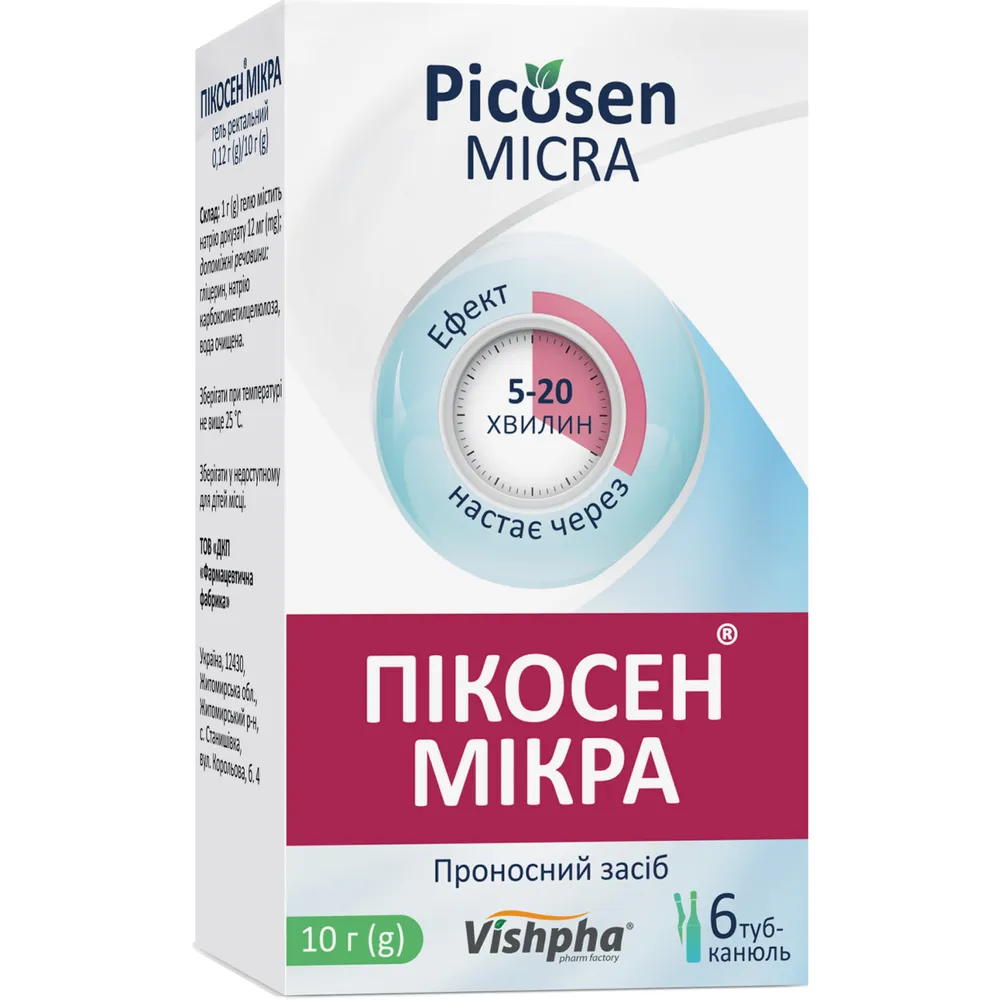
Table of Contents
INSTRUCTIONS FOR MEDICAL USE OF THE MEDICINAL PRODUCT PICOSEN® MICRA (PICOSEN MICRA)
Composition:
Active substance: 1 g of gel contains 12 mg of sodium docusate;
Excipients: glycerin, sodium carboxymethylcellulose, purified water.
Pharmaceutical form. Rectal gel.
Main physicochemical properties: colorless opalescent liquid with the consistency of a liquid gel.
Pharmacotherapeutic group. Laxatives. Enemas.
ATC code A06AG10.
Pharmacological Properties.
Pharmacodynamics.
The product facilitates softening and easier passage of fecal masses and stimulates the defecation reflex.
Sodium docusate promotes water retention in the fecal matter, thereby increasing its volume. The onset of effect occurs within 5–20 minutes after administration.
PICOSEN® MICRO acts locally in the rectum.
Pharmacokinetics.
Minimal absorption cannot be ruled out even with rectal administration.
Clinical characteristics.
Indications.
Symptomatic treatment of occasional constipation, when enema application is required. Preparation for endoscopic examination of the rectum.
Contraindications
Hypersensitivity to any component of the medicinal product.
Intestinal obstruction, haemorrhoids, anal fissures, anal bleeding, inflammatory bowel diseases, abdominal pain, nausea, vomiting, ulcerative colitis.
Special precautions.
Like other laxatives, PICOSEN® MICRA should not be used continuously. Prolonged use may cause intestinal atony and hypokalaemia. With long-term use, there is a risk of developing dependence, requiring regular use of a laxative and increasing its dose. If treatment is discontinued, constipation may occur. Pharmacological treatment of constipation should only supplement hygienic and dietary measures:
- enrichment of the diet with dietary fibre and fluids;
- physical activity and development of defecation habits.
Interaction with other medicinal products and other forms of interaction.
Use with caution in combination with medicinal products that cause hypokalaemia, which may promote cardiac arrhythmias (particularly torsades de pointes) and increase the toxicity of certain drugs, e.g. digoxin. Medicinal products causing hypokalaemia include: hypokalaemic diuretics, either alone or in combination, stimulant laxatives, glucocorticoids, tetracosactide, and amphotericin B (intravenous).
PICOSEN® MICRA may enhance the absorption of other medicinal products. Sodium docosate may increase the hepatotoxicity of other drugs.
Special precautions for use.
Prolonged use is not recommended (if single or double application proves ineffective, the treatment strategy should be reconsidered).
The use of this medicinal product is contraindicated in ulcerative colitis.
The medicinal product contains glycerol, which may exert a mild laxative effect.
Use during pregnancy or breastfeeding.
Pregnancy.
There are no adequate data on the use of docusate enemas or oral docusate in pregnant women. Animal studies on oral administration of docusate are insufficient to assess its effects on pregnancy and embryofetal development.
The potential risk to humans is unknown. Since minimal systemic absorption cannot be excluded following rectal administration, PICOSEN® MICRO may be used during pregnancy only if the benefit outweighs the risks.
Breastfeeding.
It is unknown whether docusate is excreted in human breast milk. Animal studies have demonstrated excretion of docusate and its metabolites into breast milk following systemic administration. A decision on continuing/discontinuing breastfeeding or continuing/discontinuing treatment with PICOSEN® MICRO should be made taking into account the benefit of breastfeeding for the child and the benefit of treatment with PICOSEN® MICRO for the woman.
Ability to affect reaction rate when driving or operating machinery. Unknown.
Method of Administration and Dosage.
Administer rectally.
Insert the gel into the rectum using the tube-cannula (microenema). Remove the protective cap. Insert the tapered end of the tube-cannula into the rectum and squeeze out the entire contents of the tube. Remove the tube-cannula without releasing pressure.
If necessary, a drop of the gel can be used to lubricate the cannula.
Symptomatic treatment of constipation: 1 tube-cannula per day.
Preparation for endoscopic examination of the rectum: 1 tube-cannula 5–20 minutes before the planned defecation time.
Children. Do not use the medicinal product in children (under 18 years of age).
Overdose. May lead to an intensification of adverse effects.
Side effects
The frequency of adverse reactions is defined according to the following classification: very common (≥ 1/10), common (≥ 1/100 to < 1/10), uncommon (≥ 1/1000 to < 1/100), rare (≥ 1/10000 to < 1/1000), very rare (˂ 1/10000), frequency not known (cannot be estimated based on available data).
Gastrointestinal disorders: very rare — proctitis; frequency not known — with prolonged use: burning sensation around the anus, rectal pain, rectal bleeding.
The presence of glycerol may lead to digestive disturbances and diarrhea.
Hepatobiliary disorders: cases of hepatotoxicity have been reported with oral administration of sodium docussate, particularly in patients who were concurrently using other laxatives.
Skin and subcutaneous tissue disorders: frequency not known — urticaria.
Reporting of suspected adverse reactions after drug registration is important. It allows ongoing monitoring of the benefit-risk balance of the medicinal product. Healthcare and pharmaceutical professionals, as well as patients or their legal representatives, are encouraged to report all suspected adverse reactions and lack of efficacy via the Automated Pharmacovigilance Information System at the following link: https://aisf.dec.gov.ua.
Shelf life. 3 years.
Storage conditions.
Store at a temperature not exceeding 25 °C. Keep out of reach and sight of children.
Packaging. 10 g in a cannula tube; 6 cannula tubes in a carton.
Classification. Over-the-counter (without prescription).
Manufacturer. LLC "DKP "Pharmaceutical Factory".
Manufacturer's address and place of business. 4 Korolova St., Stanyshivka, Zhytomyr District, Zhytomyr Oblast, 12430, Ukraine