Piconorm
Ukraine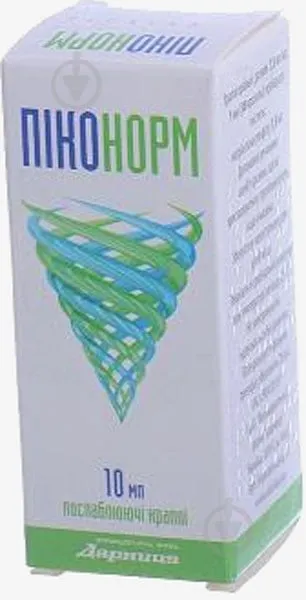
Table of Contents
INSTRUCTIONS FOR MEDICAL USE OF THE MEDICINAL PRODUCT PICONORM® (PIСONORM)
Composition:
Active substance: sodium picosulfate;
1 ml of solution contains sodium picosulfate 7.5 mg;
Excipients: sorbitol solution (non-crystallizing), propylene glycol, purified water.
Pharmaceutical form. Oral drops, solution.
Main physicochemical properties: clear, colorless liquid.
Pharmacotherapeutic group. Contact laxatives. ATC code A06A B08.
Pharmacological properties.
Pharmacodynamics.
Sodium picosulfate is a stimulant laxative of the triarylmethane group which, after metabolism in the large intestine, inhibits water absorption and thus increases the excretion of water and electrolytes. This leads to softening of stool consistency and rapid bowel evacuation, increasing stool volume, as well as stimulating peristalsis.
Pharmacokinetics.
Sodium picosulfate is absorbed from the small intestine only to a negligible extent. After cleavage of the sulfate esters by bacteria in the large intestine, the active diphenoxy derivative (diphenol laxative) is formed, which is partially absorbed and, after conjugation, excreted in bile.
A minor portion is excreted in urine as glucuronides; the majority is excreted in feces, both as free diphenols and as unchanged picosulfate. Information regarding plasma levels and protein binding is not available.
Clinical characteristics.
Indications.
For short-term use in constipation or conditions requiring facilitation of defecation.
Like other laxatives, PICORORM® should not be taken daily or for prolonged periods without determining the cause of constipation.
Contraindications.
- Hypersensitivity to the active substance, other triarylmethanes, or to any of the excipients.
- Intestinal obstruction or acute abdominal disorders, such as appendicitis.
- Acute inflammatory bowel diseases.
- Acute abdominal pain accompanied by nausea and vomiting, which may indicate the aforementioned acute conditions.
- Severe dehydration.
PICORORM® should be administered under medical supervision in conditions associated with disturbances in fluid and electrolyte balance (e.g., severe renal impairment).
Interaction with other medicinal products and other forms of interaction.
With prolonged use or use of high doses, hypokalemia may enhance the effect of cardiac glycosides. Potassium loss may be intensified when used concomitantly with diuretics and corticosteroids.
Since sodium picosulfate is metabolized into its active form by colonic bacteria, concomitant use with antibiotics may result in reduced or absent laxative effect of the medicinal product.
Special precautions for use.
PICONORM®, drops, are intended for short-term use only.
Patients suffering from chronic constipation should undergo a full diagnostic evaluation to determine the underlying cause of constipation.
The medicinal product should not be taken daily or for prolonged periods without identifying the cause of constipation. Prolonged or excessive use of the medicinal product may lead to disturbances in water and electrolyte balance and to hypokalemia.
Pharmacological treatment is indicated only when long-term dietary modifications (a diet rich in fiber and bulk-forming substances, as well as adequate fluid intake) and lifestyle changes (e.g., maintaining an active physical regimen) have proven insufficiently effective.
PICONORM®, drops, should be administered to children aged 4 years and older only under medical supervision.
PICONORM®, drops, may be used in patients with conditions associated with disturbances in water-electrolyte balance only under medical supervision.
After discontinuation of the medicinal product, symptoms may recur. Recurrence of symptoms following prolonged use in chronic constipation may be associated with the presence of severe constipation.
The medicinal product contains sorbitol; therefore, PICONORM®, drops, should not be administered to patients with hereditary fructose intolerance.
The medicinal product can be used by patients with diabetes mellitus, as it contains the sugar substitute sorbitol (1 ml of drops corresponds to 0.03 bread units).
Use during pregnancy or breastfeeding.
PICONORM®, drops, should not be used during pregnancy.
Clinical data indicate that neither the active metabolite bis-(p-hydroxyphenyl)-pyridyl-2-methane nor its glucuronides pass into breast milk. Therefore, PICONORM® may be used during breastfeeding.
Studies evaluating effects on fertility have not been conducted.
Ability to affect reaction speed when driving or operating machinery.
Has no influence on the ability to drive or operate machinery.
However, patients should be warned about possible vasovagal reactions (e.g., abdominal cramps) and/or adverse reactions such as dizziness and/or fainting.
If abdominal cramps occur, patients should avoid potentially hazardous activities such as driving or operating machinery.
Dosage and Administration.
PICONORM®, drops, should be taken orally as a single dose, preferably in the evening.
The drops may be taken undiluted or mixed with liquid.
The effect usually occurs within 10–12 hours.
The recommended dose for adults is 20–40 drops (corresponding to 5–10 mg of sodium picosulfate monohydrate). For children aged 4 years and older (only upon physician's recommendation), the dose is 10–20 drops (corresponding to 2.5–5 mg of sodium picosulfate monohydrate).
The duration of treatment with this medicinal product should be short-term.
1 ml of the medicinal product contains 30 drops.
Children.
PICONORM®, drops, is contraindicated in children under 4 years of age.
In children aged 4 years and older, the medicinal product should be used only upon physician's recommendation.
Overdose.
Symptoms. When large doses are taken, diarrhea and intestinal spasms may occur, along with clinically significant losses of potassium and other electrolytes.
Ischemia of the mucosa of the large intestine may occur following intake of sodium picosulfate in doses substantially higher than those recommended for the treatment of constipation.
Prolonged overdose may lead to chronic diarrhea, abdominal pain, hypokalemia, secondary hyperaldosteronism, and kidney stones. With chronic abuse, renal tubular damage, metabolic alkalosis, and muscle weakness due to hypokalemia may also occur.
Treatment. If the medicinal product has been recently ingested, absorption may be reduced or prevented by inducing emesis or gastric lavage.
Rehydration therapy (replacement of fluid and electrolyte losses) should be administered. This is particularly important in children and elderly patients.
The use of spasmolytic agents may be beneficial.
Adverse reactions.
The frequency of occurrence of the adverse reactions listed below is assessed as follows: very common (≥ 1/10); common (≥ 1/100, < 1/10); uncommon (≥ 1/1000, < 1/100); rare (≥ 1/10,000, < 1/1000); very rare (< 1/10,000); unknown (cannot be determined from available data).
Adverse reactions during short-term use are as follows.
Gastrointestinal disorders: very common – diarrhoea; common – flatulence, abdominal pain, discomfort or colic; uncommon – nausea and vomiting.
Immune system disorders: unknown – allergic reactions, including Quincke's oedema and skin reactions.
Nervous system disorders: uncommon – dizziness; unknown – syncope. Dizziness and/or syncope may occur during defecation (Valsalva manoeuvre) or due to a parasympathetic response to abdominal pain.
Prolonged use is often associated with increased excretion of water, potassium and other salts from the body. This, in turn, may exacerbate intestinal atony and lead to cardiac disturbances and muscle weakness, particularly when used concomitantly with diuretics and corticosteroids.
Shelf life.
2 years. Shelf life after opening the bottle – 28 days.
Storage conditions.
Keep out of reach of children in the original packaging at a temperature not exceeding 25 °C. Do not freeze.
Packaging.
10 ml, 15 ml or 30 ml in a bottle with dropper; 1 bottle with dropper per carton.
Classification.
Over-the-counter (without prescription).
Manufacturer.
JSC "Pharmaceutical Company "Darnytsia".
Manufacturer's address and place of business.
13, Boryspilska Street, Kyiv, 02093, Ukraine.