Panthenol
Ukraine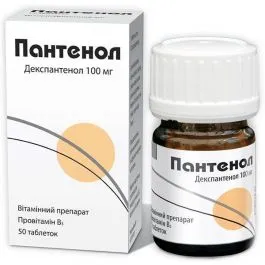
Table of Contents
INSTRUCTION FOR MEDICAL USE OF THE MEDICINAL PRODUCT PANTENOL
Composition:
Active substance: dexpanthenol;
1 tablet contains 100 mg of dexpanthenol;
Excipients: silicon dioxide, sucrose, sodium saccharin, gelatin, potato starch, glycerol 85%, talc, magnesium stearate, lemon flavoring.
Pharmaceutical form. Tablets.
Main physicochemical properties: white, round, flat on both sides tablets without imprint, with beveled edges and a score line, with a slight lemon aroma.
Pharmacotherapeutic group. Simple vitamin preparations. Dexpanthenol.
ATC code A11H A30.
Pharmacological properties.
Pharmacodynamics.
Dexpanthenol is an analogue of pantothenic acid, which, during metabolism in the body, provides the same biological effects. Pantothenic acid and its salts are vitamins that play an important role in acetylation and oxidation processes, and participate in carbohydrate, lipid, and energy metabolism as coenzyme A. They act as synergists of other B-group vitamins. Dexpanthenol participates in the formation and functioning of epithelial tissue and in the synthesis of protein—collagen, thus positively influencing the structure of the skin and its appendages (hair, nails). As a result, the number of mitoses increases in skin defects, and the capacity of epidermal cells for division is enhanced, producing a strong reparative effect. It exerts a mild anti-inflammatory action and reduces itching.
According to safety guidelines, the German Nutrition Society recommends a daily intake of 5 mg of pantothenic acid for healthy adults. This recommendation is based on the amount of pantothenic acid that, when consumed daily with food, generally prevents deficiency symptoms.
During pregnancy, the recommended daily dose of pantothenic acid is 5 mg. Breastfeeding mothers are advised to increase their intake to 7 mg/day.
Pharmacokinetics.
The bioavailability of pantothenic acid taken with food is over 50%. Transport in the body occurs via binding to plasma proteins. Approximately 70% is excreted unchanged in the urine, the remainder in feces.
Clinical characteristics.
Indications.
To be used in complex therapy as a reparative agent in inflammatory diseases of the oral cavity and throat (stomatitis, erosions, aphthae, post-tonsillectomy state, traumatic injuries).
For the treatment of conditions associated with pantothenic acid deficiency that cannot be corrected by diet (e.g., replacement therapy in patients undergoing chronic dialysis), and for paresthesia and pain in toes and feet (burning feet syndrome).
Contraindications.
Hypersensitivity to the active substance or to any of the excipients of the medicinal product.
Hemophilia, intestinal obstruction, childhood age. Rare hereditary fructose intolerance, glucose-galactose malabsorption, or sucrase-isomaltase deficiency.
Interaction with other medicinal products and other forms of interaction.
Data are available on the prolonged effect of succinylcholine.
Special precautions for use
Patients with diabetes should be aware that 1 tablet contains less than 0.03 bread units (BU).
Use with caution in patients with chronic hepatic insufficiency and also in patients with chronic renal insufficiency, as the main route of elimination of the drug from the human body is via the kidneys.
Pantanol contains sucrose. If you have been diagnosed with carbohydrate intolerance, consult your doctor before taking this medicinal product. Patients with hereditary fructose intolerance, glucose-galactose malabsorption syndrome, or sucrase-isomaltase deficiency should not take Pantanol.
This medicinal product contains glycerol and may cause headache, gastrointestinal irritation, and diarrhea.
Use during pregnancy or breastfeeding.
Available data from a limited number of pregnant women do not indicate any adverse effects of dexpanthenol on pregnancy or on the health of the fetus/newborn following oral administration. At present, there are no other substantial epidemiological data available. Dexpanthenol crosses the placenta and is excreted into breast milk in proportion to the administered dose.
Animal studies have not shown any teratogenic or fetotoxic effects after oral administration.
The potential risk in humans is not sufficiently known. Pantanol should be used during pregnancy or breastfeeding only after careful assessment of benefit versus risk and only if clearly necessary.
Ability to affect reaction speed while driving or operating machinery.
Pantanol has no effect or has a negligible effect on the ability to drive or operate machinery.
Dosage and Administration.
In complex therapy for inflammatory diseases of the oral and pharyngeal mucosa: 1 tablet 3 times daily (corresponding to 300 mg of dexpanthenol); the tablet should be slowly dissolved in the mouth.
For correction of pantothenic acid deficiency: adults – 1 tablet daily (corresponding to 100 mg of dexpanthenol), taken orally with liquid, regardless of food intake. The duration of treatment depends on the course of the disease.
Children.
There is no available data on the use of this medicinal product in children.
Overdose.
No toxic effects have been observed to date following oral administration of high doses of pantothenic acid and its derivatives.
No specific measures are required in case of ingestion of more tablets than prescribed.
Side effects.
Allergic reactions (skin rash, redness, itching) are possible; gastrointestinal disturbances may also occur.
Reporting of suspected side effects
Reporting of suspected side effects is very important. Healthcare professionals and patients should report any suspected side effects through the national reporting system.
Shelf life. 2 years.
After opening the bottle: 6 months.
Storage conditions. Keep out of reach of children and store at a temperature not exceeding 25 °C.
Packaging. 20, 50, or 100 tablets in a glass bottle; 1 bottle in a cardboard box.
Availability. Over-the-counter (without prescription).
Manufacturer. mibe GmbH Arzneimittel.
Manufacturer's address.
Muenchener Strasse 15, Breuna, Saxony-Anhalt, 06796, Germany.