Osteogenon
Ukraine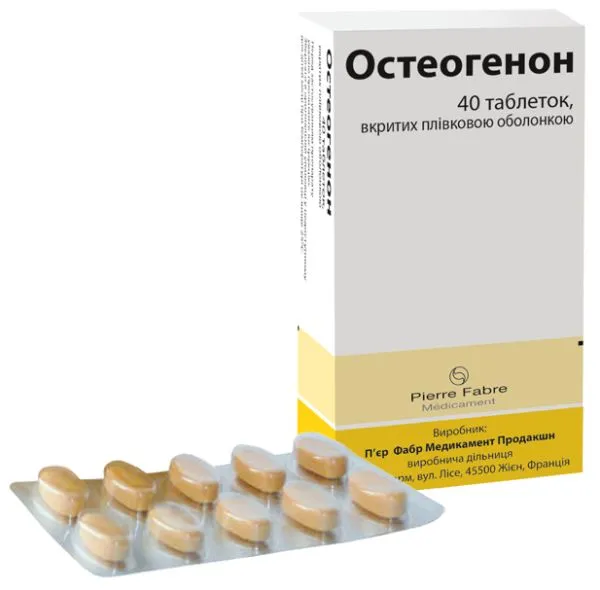
Table of Contents
INSTRUCTIONS FOR MEDICAL USE OF THE MEDICINAL PRODUCT OSTEOGONON (OSTEOGENON)
Composition:
Active ingredient: ostein-hydroxyapatite compound;
One tablet contains 830 mg of ostein-hydroxyapatite compound, comprising: 291 mg of ostein, including non-collagenous peptides and proteins (75 mg) and collagen (216 mg);
444 mg of hydroxyapatite, containing calcium (178 mg) and phosphorus (82 mg);
Excipients: microcrystalline cellulose, colloidal anhydrous silicon dioxide, magnesium stearate, potato starch, hypromellose, titanium dioxide (E 171), polyethylene glycol, talc, yellow iron oxide (E 172).
Pharmaceutical form. Film-coated tablets.
Main physicochemical properties: elongated biconvex film-coated tablets, uniformly light yellow in color.
Pharmacotherapeutic group. Agents affecting bone structure and mineralization. Other agents affecting bone structure and mineralization.
ATC code: M05BX.
Pharmacological properties.
Pharmacodynamics.
A regulator of calcium-phosphorus metabolism used in systemic osteoporosis. The drug exerts a dual effect on bone tissue metabolism: stimulating on osteoblasts and inhibitory on osteoclasts. These different actions physiologically complement each other and regulate the balance between bone resorption and bone tissue restoration. Calcium is present in the drug as a component of hydroxyapatite, which promotes more complete absorption of calcium from the gastrointestinal tract. Phosphorus, which participates in hydroxyapatite crystallization, promotes calcium fixation in bones and inhibits its renal excretion.
Studies in animals have demonstrated that upon oral administration, the organic component of the drug (ossein, containing type I collagen, osteocalcin, growth factors, and other proteins) provides a more pronounced osteogenic effect than the mineral component alone (hydroxyapatite).
Clinical studies have confirmed that the ossein-hydroxyapatite compound produces an anabolic effect on bone metabolism greater than that observed with calcium alone.
Pharmacokinetics.
Studies using radiolabeled isotope (47Ca) of the drug have demonstrated that absorption occurs in the intestinal tract.
The slow release of calcium from the ossein-hydroxyapatite compound ensures prolonged absorption in the gastrointestinal tract and prevents peaks of hypercalcemia (in contrast to drugs containing only calcium salts).
Clinical characteristics.
Indications.
- Prevention of osteoporosis.
- Treatment of osteoporosis.
- Prevention or treatment of calcium deficiency in the body.
- Adjunctive therapy to improve bone healing in fractures.
Contraindications.
- Hypersensitivity to the active substance or to any of the excipients.
- Severe renal function impairment; requirement for hemodialysis.
- Hypercalcemia, hypercalciuria, acute calcium nephrolithiasis, tissue calcinosis.
- Prolonged immobilization associated with hypercalcemia and/or hypercalciuria (calcium treatment should be initiated after restoration of mobility).
- Children under 6 years of age (due to the pharmaceutical form).
Interaction with other medicinal products and other forms of interaction.
Undesirable combinations
Thiazide diuretics: may reduce urinary calcium excretion and cause hypercalcemia.
Combinations requiring special precautions
Vitamin D: caution is required when combining Osteogenon with vitamin D, as vitamin D increases calcium absorption and may cause hypercalcemia.
Cardiac glycosides: risk of developing arrhythmias. Patients should be under close monitoring, and regular ECG and serum calcium level checks are recommended.
Tetracyclines: risk of reduced intestinal absorption of tetracyclines due to formation of insoluble chelates when co-administered with calcium-containing products; therefore, Osteogenon and tetracyclines should be taken at least 2 hours apart.
Medicinal products containing iron or zinc salts: risk of reduced intestinal absorption of iron and zinc due to formation of insoluble chelates when co-administered with calcium-containing products; therefore, Osteogenon and these products should be taken at least 2 hours apart.
Bisphosphonates: risk of reduced intestinal absorption of bisphosphonates due to formation of insoluble chelates when co-administered with calcium-containing products; therefore, Osteogenon and bisphosphonates should be taken at least 2 hours apart.
Quinolones: risk of reduced intestinal absorption of quinolones due to formation of insoluble chelates when co-administered with calcium-containing products; therefore, Osteogenon and quinolones should be taken at least 2 hours apart.
Glucocorticoids: when co-administered, glucocorticoids may reduce intestinal calcium absorption; therefore, Osteogenon and glucocorticoids should be taken at least 2 hours apart.
Strontium-containing products: risk of reduced intestinal absorption of strontium when co-administered with calcium-containing products; therefore, Osteogenon and strontium-containing products should be taken at least 2 hours apart.
Thyroid hormones: risk of reduced intestinal absorption of levothyroxine; therefore, Osteogenon and thyroid hormones should be taken at least 2 hours apart.
Estramustine: risk of reduced estramustine absorption when co-administered with calcium-containing products; therefore, Osteogenon and estramustine should be taken at least 2 hours apart.
Special precautions for use.
Calcium
When calcium and vitamin D are used concomitantly, serum and urinary calcium levels should be monitored regularly, and doses should be adjusted accordingly if elevations occur.
In patients with renal insufficiency, regular monitoring of serum and urinary calcium levels is recommended, and high doses and/or prolonged administration should be avoided.
During long-term treatment and/or in the presence of impaired renal function, urinary calcium levels should be monitored regularly. Doses should be reduced or treatment temporarily discontinued if levels exceed 7.5 mmol/24 hours (300 mg/24 hours) in adults and 0.12–0.15 mmol/kg body weight/24 hours (5–6 mg/kg body weight/24 hours) in children.
For patients with a history of calcium nephrolithiasis, it is recommended to:
- adhere to standard dietary recommendations regarding fluid, salt, and protein intake;
- limit calcium intake from Osteogenon to 500 mg per day;
- adjust dietary calcium intake to ensure total daily calcium intake does not exceed 1.5 g, and avoid additional vitamin D supplementation.
Phosphorus
In patients with moderate renal impairment, periodic monitoring of serum phosphorus levels is recommended.
Use during pregnancy or breastfeeding.
Available data on the use of Osteogenon in pregnant women (from 300 to 1000 patients) indicate no occurrence of malformations and no toxic effects on the fetus or newborn.
Studies in a large number of pregnant women who received calcium salts show no adverse effects on pregnancy or on fetal or neonatal health.
Animal studies have not revealed reproductive toxicity of the drug (preclinical data from repeated toxicity, genotoxicity, and reproductive toxicity studies have not shown potential risk to human health).
Osteogenon may be used during pregnancy if clinically needed.
Excretion of ossein-hydroxyapatite complex into animal milk has not been studied.
Studies on dietary supplements have shown that calcium excretion into human breast milk does not increase with higher calcium intake during lactation, even in women who previously had low calcium intake.
The ossein-hydroxyapatite complex, including calcium, may be excreted into human breast milk in small amounts, but therapeutic doses of the drug are not expected to cause adverse effects in neonates/infants.
Osteogenon may be used during breastfeeding.
Fertility. Animal studies indicate no direct or indirect adverse effects on fertility in males or females.
Ability to influence reaction speed when driving or operating machinery.
No effect.
Dosage and Administration
Take tablets orally, swallowing with a small amount of water. It is recommended to take the tablets during meals.
Adults:
- For osteoporosis: 2 to 4 tablets daily (divided into 2 doses); in severe osteoporosis, the dose may be increased at the physician's discretion;
- In other cases: 1–2 tablets daily.
The duration of treatment is determined individually by the physician, depending on the nature and course of the disease.
Children:
Osteogenon may be prescribed for children aged 6 years and older. Depending on the patient's age and calcium requirements, the physician prescribes a daily dose of 1–2 tablets.
Overdose
Osteogenon overdose is unlikely.
The data provided below refer to overdose of calcium salts (more than 2000 mg of calcium per day).
Symptoms of overdose: Clinical symptoms are mainly related to hypercalcemia and are nonspecific, including thirst, polyuria, polydipsia, nausea, vomiting, dehydration, increased arterial blood pressure, vasomotor disturbances, constipation, loss of appetite, arrhythmias, weakness, nephrocalcinosis, nephrolithiasis, bone pain, and mental changes.
In children, failure to gain weight or delayed physical development may precede the above-mentioned symptoms.
Treatment in case of overdose: Discontinue the drug and restore fluid and electrolyte balance. Depending on the severity of hypercalcemia, diuretics and/or corticosteroids, bisphosphonates, or calcitonin should be administered. Some patients may require peritoneal dialysis or hemodialysis.
Side effects
Side effects are categorized according to their frequency as follows: very common (≥ 1/10), common (≥ 1/100, < 1/10), uncommon (≥ 1/1000, < 1/100), rare (≥ 1/10000, < 1/1000), very rare (< 1/10000), and not known (available data do not allow estimation of the frequency).
Metabolism and nutrition disorders
Not known frequency: hypercalciuria, hypercalcemia (with prolonged use at high doses).
Gastrointestinal disorders
Not known frequency: gastrointestinal disturbances, including nausea, abdominal pain, constipation.
Skin and subcutaneous tissue disorders
Not known frequency: hypersensitivity reactions, including pruritus and rash.
Shelf life
4 years.
Storage conditions
Store in the original packaging, out of reach of children, at a temperature not exceeding 25 °C.
Packaging
10 tablets per blister, 4 blisters per cardboard pack.
Prescription category
Prescription only.
Manufacturer
Pierre Fabre Médicament Production.
Pierre Fabre Medicament Production.
Manufacturer's address and location of manufacturing site
Production site Progipharm, Rue du Lycée, 45500 Gien, France /
site Progipharm, Rue du Lycee, 45500 Gien, France.