Orgametrel®
Ukraine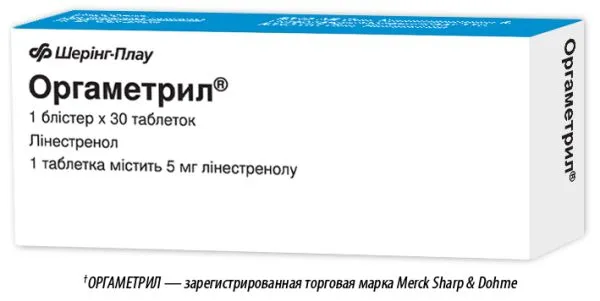
Table of Contents
INSTRUCTIONS for medical use of the medicinal product ORGAMETRIL® (ORGAMETRIL®)
Composition:
Active substance: lynestrenol (lynestrenol);
1 tablet contains 5 mg of lynestrenol;
Excipients: potato starch; alpha-tocopherol; glycerol; magnesium stearate; talc; lactose monohydrate.
Pharmaceutical form. Tablets.
Main physicochemical characteristics: white, round, flat tablets with bevelled edges; on one side of the tablet the inscription "ORGANON*" is printed, on the other side the inscription "TT" above the line and "4" below the line.
Pharmacotherapeutic group. Sex hormones and modulators of the sex organs, progestogens. Estrane derivatives. ATC code G03DC03.
Pharmacological properties.
Pharmacodynamics
Mechanism of action
Orgametrel® is an oral medicinal product. The active ingredient, lynestrenol (a synthetic progestogen), has pharmacological characteristics similar to those of the natural hormone progesterone.
Orgametrel® exerts a pronounced progestogenic effect on the endometrium. With continuous use, both ovulation and menstruation are suppressed. Orgametrel® can be used in conditions requiring treatment with agents having a pronounced progestogenic effect.
Pharmacokinetics
After oral administration, lynestrenol is rapidly absorbed and subsequently metabolized in the liver into the pharmacologically active compound norethisterone. Maximum plasma concentrations of norethisterone are reached within 2–4 hours after oral administration of lynestrenol. Lynestrenol and its metabolites are primarily excreted via the urine, and to a lesser extent, via the feces.
Clinical characteristics.
Indications.
- Polymenorrhea.
- Menorrhagia and metrorrhagia.
- Selected cases of primary or secondary amenorrhea and oligomenorrhea with insufficient levels of endogenous estrogens.
- Endometriosis.
- Benign tumors of the mammary glands.
- Selected cases of endometrial carcinoma.
- Inhibition of ovulation, pain associated with ovulation and menstruation.
- For postponement of normal menstruation.
- As an adjunct to estrogen therapy during perimenopausal and postmenopausal periods – for prevention of endometrial hyperplasia.
Contraindications.
- Hypersensitivity to the active substance or to any of the excipients contained in Orgametril®.
- Pregnancy or suspected pregnancy.
- Severe liver disease, e.g., cholestatic jaundice or hepatitis (or severe liver disease in medical history without normalization of pathologically altered liver function tests), hepatocellular tumors, Rotor syndrome, and Dubin–Johnson syndrome.
- Vaginal bleeding of unknown etiology.
- Conditions influenced by sex steroid hormones that first appeared or worsened during pregnancy or during treatment with sex steroid hormones, such as severe pruritus, cholestatic jaundice, herpes gestationis, porphyria, and otosclerosis.
- Active-phase venous thromboembolic disorders.
Interaction with other medicinal products and other forms of interaction.
Although data are limited, there is a possibility of interaction between Orgametril® and other medicinal products. The interactions listed below have been observed with synthetic progestogens or combined oral contraceptives and therefore may also occur during the use of Orgametril®.
Activated charcoal, barbiturates (including primidone), hydantoins, rifampicin, carbamazepine, and aminoglutethimide may reduce the efficacy of Orgametril®. Orgametril® may enhance the effect, pharmacological or toxic effects of cyclosporine, theophylline, troleandomycin, and certain beta-adrenoreceptor blockers. Orgametril® may reduce the efficacy of insulin.
Special precautions for use.
The medicinal product Orgametrel® contains lactose. For this reason, the medicinal product should not be used in patients with such rare hereditary conditions as galactose intolerance, Lapp lactase deficiency, or glucose-galactose malabsorption.
Treatment should be discontinued if pathological changes in liver function tests occur.
During treatment with estrogenic and/or progestogenic agents, chloasma may occasionally occur, particularly in women with a history of chloasma of pregnancy. Women predisposed to chloasma development should avoid exposure to natural or artificial sunlight.
The use of steroids may affect the results of specific laboratory tests. During treatment with Orgametrel®, an increase in low-density lipoprotein cholesterol and a decrease in high-density lipoprotein cholesterol levels have been observed in many patients. Changes in liver function parameters, carbohydrate metabolism, and hemostasis may also occur occasionally.
Periodic medical examinations are recommended during prolonged treatment with progestogens.
Orgametrel® exerts a weak androgenic effect, as demonstrated by its influence on sex hormone-binding globulin (SHBG). This is supported by the occurrence of mild signs of virilization (mainly acne and seborrhea) observed in some patients.
Epidemiological studies have shown that the use of progesterone in combination with estrogenic agents is associated with an increased risk of venous thromboembolism (venous thromboembolism, deep vein thrombosis, and pulmonary embolism). Although the clinical significance of these data is unknown in situations where linestrenol must be used without an estrogenic agent, Orgametrel® should be discontinued in case of active venous thromboembolic disorder. The possibility of discontinuing Orgametrel® should also be considered in cases of prolonged immobilization following surgery or due to illness. Women with a history of thromboembolic disorders should be informed about the possibility of recurrence.
Patients with the following conditions should be monitored regularly:
- Circulatory disorders (or such conditions in medical history), since a slightly increased risk of specific cardiovascular or cerebrovascular disorders has been reported during the use of oral contraceptives containing estrogen/progestogen;
- Severe forms of depression, since the condition may worsen during treatment with sex steroid hormones.
Use during pregnancy or breastfeeding
Pregnancy. Orgametrel® is contraindicated during pregnancy.
Breastfeeding. There are insufficient data on the use of this medicinal product during breastfeeding to assess the potential risk to the infant.
Ability to affect reaction speed when driving or operating machinery
Caution is recommended when driving or operating machinery, as dizziness has been reported in some patients.
Dosage and Administration.
Orgametryl® tablets should be taken orally and preferably swallowed with water or another liquid.
A missed dose should be taken as soon as possible, except when more than 24 hours have passed since the missed dose.
| Indications |
Dosage* |
| Polymenorrhea |
1 tablet daily from day 14 to day 25 of the cycle. |
| Menorrhagia and metrorrhagia |
2 tablets daily for 10 days. In most cases, bleeding stops within a few days after starting treatment. Repeat treatment for 3 menstrual cycles, taking 1 tablet daily from day 14 to day 25 of each cycle. If symptoms persist during or after treatment, further patient evaluation is required. |
| Selected cases of primary or secondary amenorrhea and oligomenorrhea with insufficient endogenous estrogen levels. |
Treatment should begin with administration of estrogen, e.g., 0.02–0.05 mg ethinylestradiol daily for 25 days. Concurrently, 1 tablet of Orgametril® should be taken daily from day 14 to day 25 of the cycle. In most cases, withdrawal bleeding begins within 3 days after stopping treatment. On the 5th day of withdrawal bleeding, resume estrogen therapy and continue until day 25 of the cycle. Then again, from day 14 to day 25 of the cycle, administer 1 tablet of Orgametril®. This treatment should be repeated for at least one additional cycle. |
| Endometriosis |
1–2 tablets daily for at least 6 months. |
| Benign breast tumors |
1 tablet daily from day 14 to day 25 of the cycle for at least 3–4 months. |
| Selected cases of endometrial carcinoma |
6–10 tablets daily over a prolonged period. |
| Inhibition of ovulation, ovulatory and menstrual pain |
Treatment with 1 tablet daily should ideally begin on day 1 of the cycle, but no later than day 5. Treatment should be continued for many months (taking the drug daily without interruption). If breakthrough bleeding occurs despite treatment, the dose should be increased to 2 or 3 tablets daily for 3–5 days. |
| To delay normal menstruation |
Treatment with 1 tablet daily is best started 2 weeks before the expected onset of menstruation. If treatment is started less than 1 week before the expected onset, the dose should be 2–3 tablets daily. In this case, delaying menstruation by more than 1 week is not advisable. If treatment is started later, the risk of breakthrough bleeding increases. Therefore, treatment should not be started later than 3 days before the expected onset of menstruation. |
| As an adjunct to estrogen therapy during perimenopausal and postmenopausal periods – for prevention of endometrial hyperplasia. |
1 tablet daily for 12–15 days per month (e.g., during the first 2 weeks of each calendar month). The estrogen preparation should be taken daily without interruption, at the lowest effective dose. |
*The first day of the cycle is the first day of menstrual bleeding.
Children. The drug is not used in children, as there is no information available for this patient group.
Overdose.
The toxicity of lynestrenol is very low. In case of overdose (e.g., if a child ingests several tablets at once), intoxication is not expected. Symptoms such as nausea and vomiting may occur. Specific treatment is not required. If necessary, symptomatic therapy can be administered.
Adverse reactions
The frequency of adverse reactions is defined as follows: "common" (more than 10%), "uncommon" (1–10%), and "rare" (less than 1%).
Metabolism and nutrition disorders:
Common – weight gain.
Uncommon or rare – fluid retention, increased sweating, decreased glucose tolerance, and changes in lipoprotein profile.
Nervous system disorders:
Uncommon or rare – headache, migraine, dizziness, nervousness, and depressive mood.
Gastrointestinal disorders:
Common – nausea, vomiting, abdominal pain, diarrhea, constipation.
Hepatobiliary disorders:
Uncommon or rare – abnormal liver function tests, jaundice.
Skin and subcutaneous tissue disorders:
Uncommon or rare – chloasma, pruritus, acne and seborrhea, hypersensitivity, rash, urticaria, hirsutism.
Reproductive system and breast disorders:
With continuous use of Orgametrel®, metrorrhagia commonly occurs. With cyclic regimens, metrorrhagia is uncommon. The frequency of breakthrough bleeding is generally higher during the first two months of therapy and gradually decreases thereafter. Most cases of bleeding can be controlled by temporary dose increase. Changes in libido (both increased and decreased) have been frequently reported. Breast tenderness is uncommon. Amenorrhea and changes in vaginal and cervical secretions occur uncommonly or rarely.
Shelf life.
5 years.
Storage conditions.
Store in the original packaging at a temperature not exceeding 30 °C.
Keep out of the reach of children.
Packaging.
30 tablets in a blister pack, 1 blister pack in a cardboard box.
Prescription category.
Prescription only.
Manufacturer.
N.V. Organon.
Manufacturer's address and place of business.
Legal address: Kloosterstraat 6, 5349 AB Oss, The Netherlands
Place of business: Molensestraat 110, 5342 SS Oss, The Netherlands.