Omakor
Ukraine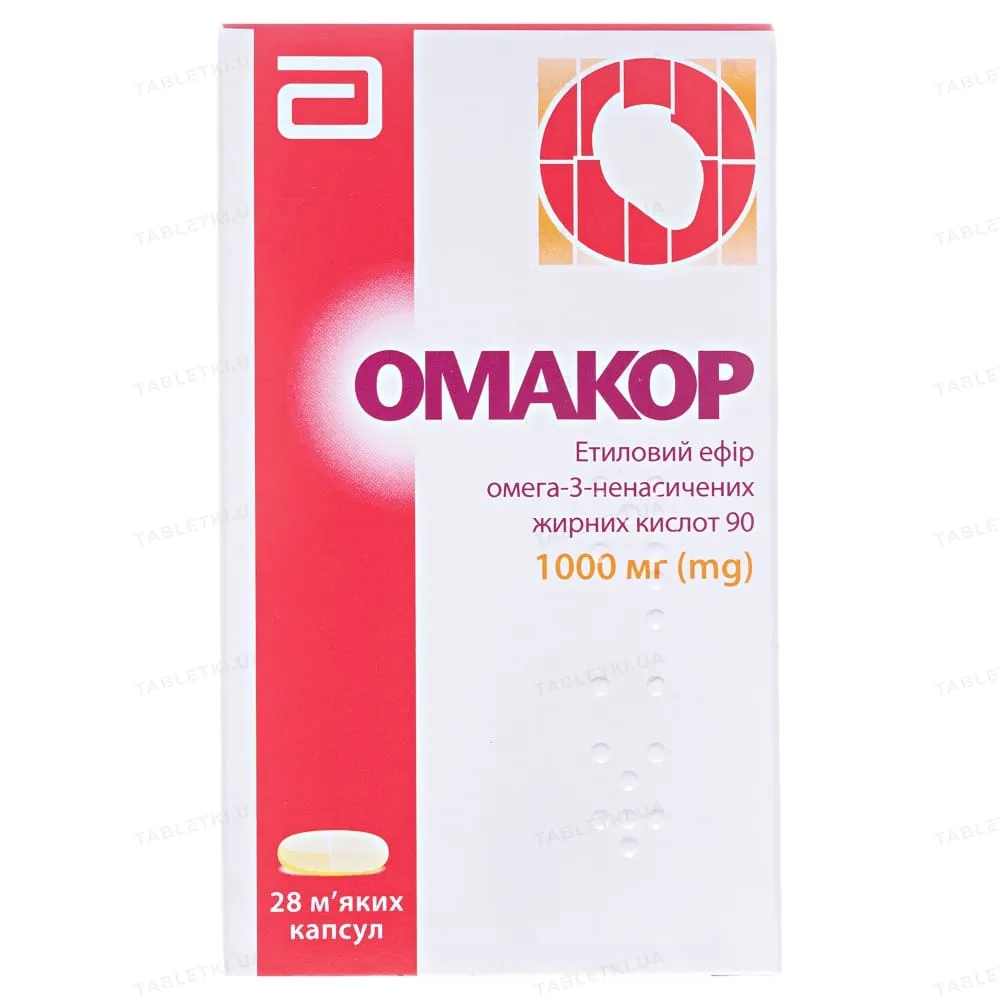
Table of Contents
INSTRUCTIONS FOR MEDICAL USE OF THE MEDICINAL PRODUCT OMAKOR (OMACOR®)
Composition:
Active substance: ethyl ester of omega-3 unsaturated fatty acids 90;
One capsule contains 1000 mg of ethyl ester of omega-3 unsaturated fatty acids 90, which includes 460 mg of ethyl ester of eicosapentaenoic acid (EPA) and 380 mg of ethyl ester of docosahexaenoic acid (DHA); (as an antioxidant, α-tocopherol is used);
Excipients; capsule shell: gelatin, glycerin, medium-chain triglycerides, lecithin, purified water.
Dosage form. Soft capsules.
Main physicochemical properties: elongated transparent soft capsule of size 20, filled with pale yellowish oil.
Pharmacotherapeutic group. Lipid-lowering agents. Omega-3 acid ethyl esters.
ATC code C10AX06.
Pharmacological Properties
Pharmacodynamics
Omega-3 polyunsaturated fatty acids—eicosapentaenoic acid (EPA) and docosahexaenoic acid (DHA)—belong to the group of essential fatty acids.
Omacor affects plasma lipids by reducing triglyceride levels, leading to a decrease in very-low-density lipoprotein (VLDL) levels. In addition, Omacor influences hemostasis and arterial blood pressure.
Omacor reduces hepatic triglyceride synthesis because EPA and DHA are weak substrates for enzymes involved in triglyceride synthesis and inhibit esterification of other fatty acids.
Increased fatty acid β-oxidation in hepatic peroxisomes also contributes to reduced triglyceride levels by decreasing the availability of free fatty acids for triglyceride synthesis. Reduced triglyceride synthesis leads to lower levels of very-low-density lipoproteins (VLDL).
In some patients with hypertriglyceridemia, Omacor increases low-density lipoprotein cholesterol (LDL-C) levels. The increase in high-density lipoprotein cholesterol (HDL-C) during Omacor treatment is small and considerably less than that observed with fibrates, and is inconsistent.
The long-term lipid-lowering effect (beyond 1 year) is unknown. Thus, there is no conclusive evidence that reducing triglyceride levels decreases the risk of ischemic heart disease.
During Omacor treatment, a reduction in thromboxane A2 formation and a slight prolongation of bleeding time are observed. No significant effects on other blood coagulation factors have been reported.
In the multicenter, randomized, open-label clinical trial GISSI-Prevenzione conducted in Italy, 11,324 patients after myocardial infarction (< 3 months), receiving standard preventive therapy and a Mediterranean diet, were randomized into groups: Omacor (n=2,836), vitamin E (n=2,830), Omacor + vitamin E (n=2,830), or no Omacor and no vitamin E (n=2,828).
Results obtained over 3.5 years showed that Omacor administration at a dose of 1 g/day significantly reduced the incidence of the combined primary endpoint, including all-cause mortality, non-fatal myocardial infarction, and non-fatal stroke (relative risk reduction of 15% [2–26], p=0.0226 in patients receiving only Omacor compared to control; and 10% [1–18], p=0.0482 in patients receiving Omacor with or without vitamin E). A reduction in the secondary endpoint, including cardiovascular mortality, non-fatal myocardial infarction, and non-fatal stroke, was also demonstrated (relative risk reduction of 20% [5–32], p=0.0082 in patients receiving only Omacor compared to control; and 11% [1–20], p=0.0526 in patients receiving Omacor with or without vitamin E). A secondary analysis of each component of the primary endpoints revealed a significant reduction in overall mortality and cardiovascular mortality, but no reduction in non-fatal cardiovascular events or in fatal and non-fatal stroke.
Pharmacokinetics
During and after absorption, omega-3 fatty acids undergo three main metabolic pathways:
- Fatty acids are initially transported to the liver, where they are incorporated into various classes of lipoproteins and subsequently distributed to peripheral lipid depots;
- Cell membrane phospholipids are replaced by lipoprotein phospholipids, and fatty acids may then act as precursors for various eicosanoids;
- The majority of fatty acids are oxidized to meet energy requirements.
The concentration of omega-3 fatty acids—EPA and DHA—in plasma phospholipids corresponds to the concentration of EPA and DHA incorporated into cell membranes.
Pharmacokinetic studies in animals have demonstrated complete hydrolysis of ethyl esters, accompanied by adequate absorption and incorporation of EPA and DHA into plasma phospholipids and cholesteryl esters.
Clinical characteristics.
Indications.
Hypertriglyceridemia
For endogenous hypertriglyceridemia, Omakor should be used as an adjunct to diet when dietary measures alone are insufficient to achieve an adequate response:
- type IV – as monotherapy;
- types IIb/III – in combination with statins, when control of blood triglyceride levels is inadequate.
Contraindications.
Hypersensitivity to the active substance, to soy, peanuts, or to any other components of the medicinal product.
Interaction with other medicinal products and other forms of interaction.
Prolonged bleeding time may occur when Omakor is used concomitantly with oral anticoagulants or other medicinal products affecting coagulation (e.g., acetylsalicylic acid or NSAIDs). This may be due to an additive effect, although hemorrhagic complications have not been documented (see section "Special warnings and precautions for use"). Acetylsalicylic acid. Patients should be informed about the potential increase in bleeding time.
Anticoagulants. Administration of Omakor together with warfarin has not led to any hemorrhagic complications. However, when Omakor is used concomitantly with agents affecting prothrombin time/international normalized ratio (PT/INR), or when Omakor treatment is discontinued, monitoring of PT/INR is recommended.
Special precautions for use.
Systematic reviews and meta-analyses of randomized controlled clinical trials have identified a dose-dependent increased risk of developing atrial fibrillation in patients with established cardiovascular diseases or cardiovascular risk factors who were treated with omega-3 acid ethyl esters, compared to those receiving placebo. The observed risk was highest at a dose of 4 g/day (see section "Adverse reactions"). If atrial fibrillation develops, treatment should be discontinued permanently.
Use with caution in patients with known hypersensitivity or allergy to fish.
Due to a moderate increase in bleeding time (when high doses are used, i.e., 4 capsules per day), monitoring is required in patients with coagulation disorders or those receiving anticoagulant therapy or other medicinal products that may affect coagulation (e.g., acetylsalicylic acid or NSAIDs), with appropriate adjustment of anticoagulant dosage as necessary (see section "Interaction with other medicinal products and other forms of interaction"). The use of this medicinal product does not eliminate the need for monitoring typically required for such patients.
Prolonged bleeding time should be considered in patients at high risk of bleeding (e.g., due to severe trauma, surgical intervention, etc.).
During treatment with this medicinal product, thromboxane A2 formation is reduced. No significant effect on other blood coagulation factors has been observed. Clinical studies have not demonstrated an increased frequency of bleeding episodes.
In some patients, minor but statistically significant increases in AST and ALT (within normal limits) have been reported; however, there are no data indicating increased risk in patients with hepatic insufficiency. In patients with any signs of impaired liver function (especially when taking a high dose, i.e., 4 capsules per day), monitoring of ALT and AST levels is required.
Omacer is not indicated for the treatment of exogenous hypertriglyceridemia (type I hyperchylomicronemia). Experience with use in secondary endogenous hypertriglyceridemia (especially in uncontrolled diabetes) is limited. There are no data on the use of the medicinal product in combination with fibrates for the treatment of hypertriglyceridemia.
Use during pregnancy or breastfeeding.
Pregnancy.
There is no experience with the use of Omacer during pregnancy. The potential risk to humans is unknown; therefore, Omacer should not be administered during pregnancy except in cases of extreme necessity.
Animal studies have not shown any toxic effects on the reproductive system.
Breastfeeding.
There are no data on the excretion of Omacer into human breast milk. The medicinal product should not be used during breastfeeding.
Fertility.
There are no reliable data on the effect of Omacer on fertility.
Ability to affect reaction speed when driving vehicles or operating machinery.
The effect of the medicinal product on the ability to drive vehicles or operate machinery has not been studied. However, Omacer is expected to have no effect or a negligible effect on the ability to drive vehicles or operate machinery. Drivers should be aware of the possibility of dizziness occurring.
Dosage and Administration
Hypertriglyceridemia
Initial dose – 2 capsules per day (in 1 or 2 divided doses). If the response is inadequate, the dose may be increased up to 4 capsules per day. The duration of treatment is determined by the physician depending on individual patient characteristics.
Capsules may be taken with food to minimize gastrointestinal disturbances.
There is no information regarding the use of Omacor in children and adolescents, patients aged 70 years and older, and patients with hepatic impairment (see section "Special Warnings and Precautions for Use"), and experience in patients with renal impairment is limited.
Children
Due to lack of data on efficacy and safety of Omacor in children, administration of the drug is not recommended in this patient population.
Overdose
No specific recommendations due to lack of data. Treatment should be symptomatic.
Adverse reactions.
The frequency of adverse reactions based on study data is categorized as follows: very common (≥ 1/10); common (≥ 1/100 to < 1/10); uncommon (≥ 1/1000 to < 1/100); rare (≥ 1/10000 to < 1/1000); very rare (< 1/10000); frequency not known (cannot be estimated from available data).
Immune system
Rare: hypersensitivity.
Metabolism and nutrition disorders
Uncommon: hyperglycaemia, gout.
Nervous system disorders
Uncommon: dizziness, dysgeusia, headache.
Cardiac disorders
Common: atrial fibrillation.
Vascular disorders
Uncommon: arterial hypotension.
Respiratory, thoracic and mediastinal disorders
Uncommon: epistaxis.
Gastrointestinal disorders
Common: gastrointestinal disorders (including abdominal distension, abdominal pain, constipation, diarrhoea, dyspepsia, flatulence, belching, gastroesophageal reflux, nausea or vomiting).
Uncommon: gastrointestinal haemorrhage.
Hepatobiliary disorders
Uncommon: hepatic disorders, including increased levels of transaminases (alanine aminotransferase and aspartate aminotransferase).
Skin and subcutaneous tissue disorders
Uncommon: rash.
Rare: urticaria.
Frequency not known: pruritus.
Description of selected adverse reactions
Atrial fibrillation
Based on data from seven randomized clinical trials, the average incidence of this adverse reaction was 2.8% in placebo groups, compared to 3.4% in groups receiving omega-3 fatty acids.
Reporting of adverse reactions after marketing authorization is important. It allows continuous monitoring of the benefit-risk balance of the medicinal product. Healthcare and pharmacy professionals, as well as patients or their legal representatives, are encouraged to report all suspected adverse reactions and lack of efficacy via the Automated Pharmacovigilance Information System at: https://aisf.dec.gov.ua.
Shelf life.
3 years.
Storage conditions.
Store in the original packaging at a temperature not exceeding 25 °C. Do not freeze. Keep out of reach of children.
Packaging.
20, 28 or 100 soft capsules in a bottle, 1 bottle per carton.
Prescription category.
Prescription only.
Manufacturer.
Abbott Laboratories GmbH.
Manufacturer's address and place of business.
Justus-von-Liebig-Strasse 33, Neustadt, Niedersachsen, 31535, Germany.
If any adverse reactions occur during use of the product or if you have any concerns regarding product quality, please report them to LLC "Abbott Ukraine" at +38 044-498-60-80 or by e-mail: [email protected]